Introduction: The Rise of Automated Trading on Kalshi
Prediction markets have evolved rapidly over the past few years, but in 2026, one platform stands out for a very specific reason—Kalshi operates within a fully regulated framework. This fundamentally changes how traders approach the market. Instead of dealing with fragmented liquidity or blockchain limitations, traders are now interacting with a structured, compliant exchange where pricing tends to be more efficient and competition is significantly higher.
As a result, manual trading is quickly becoming outdated. Opportunities in Kalshi markets often appear and disappear within seconds, especially around major economic releases or breaking news events. Traders who rely solely on human reaction speed are at a clear disadvantage.
This is where automation becomes essential. A well-built Kalshi trading bot allows you to monitor markets continuously, react instantly to new data, and execute trades without hesitation. However, building a bot is only half the equation. Where and how that bot runs plays an equally important role. Because Kalshi’s infrastructure is located in the United States, traders who deploy their systems on a Chicago-based Trading VPS powered by Ryzen 9 9950X CPUs gain a measurable advantage in execution speed and reliability.
This guide is designed to walk you through not just the technical setup, but also the strategic and infrastructural considerations required to build a truly competitive Kalshi trading system.
Understanding Kalshi: A Regulated Approach to Prediction Markets
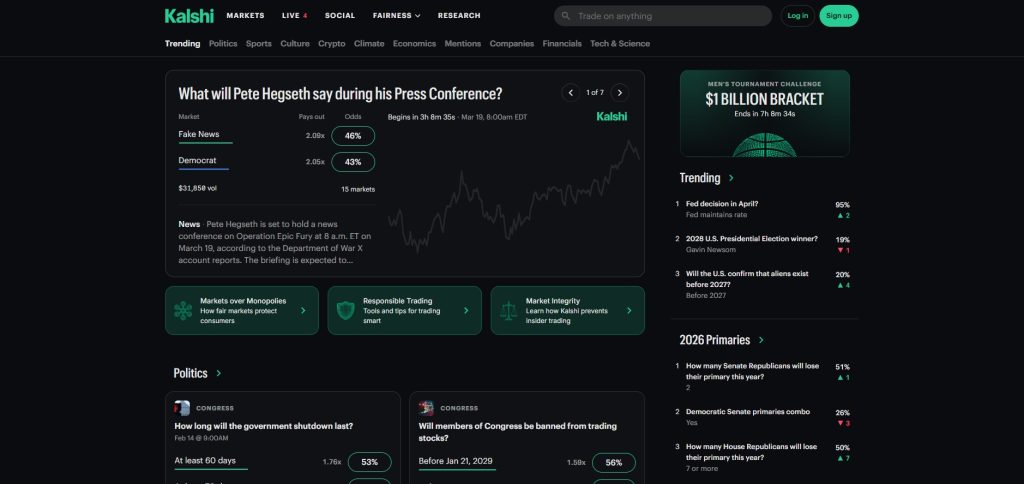
Kalshi is not just another prediction market—it is a regulated exchange that allows users to trade on the outcomes of real-world events. This distinction has a major impact on how the platform operates and how traders interact with it.
Each market on Kalshi is structured as a binary contract, meaning it resolves to either YES or NO. The pricing model is intuitive: contracts trade between $0.01 and $0.99, and this price reflects the market’s implied probability. For example, if a contract is trading at $0.70, the market is effectively assigning a 70% likelihood to that outcome.
What makes Kalshi particularly appealing for algorithmic trading is the clarity of this structure. Bots can easily interpret price as probability and apply statistical models to identify inefficiencies. At the same time, because the platform is regulated, all users must complete identity verification (KYC), and all trades are conducted in U.S. dollars. This removes the complexity of blockchain interactions but introduces a more traditional financial environment.
This combination of simplicity, transparency, and regulation makes Kalshi an ideal platform for systematic trading strategies, especially those driven by automation.
Why Kalshi Trading Bots Are Becoming Essential
As more traders enter the platform, the speed at which markets adjust to new information continues to increase. Prices react almost instantly to data releases, news headlines, and shifts in sentiment. In this environment, relying on manual execution is not just inefficient—it is fundamentally limiting.
A trading bot removes these limitations by operating continuously and executing trades the moment predefined conditions are met. It does not hesitate, second-guess decisions, or miss opportunities due to timing. Instead, it applies logic consistently across all market conditions.
Another important advantage is the ability to monitor multiple markets simultaneously. Kalshi offers a wide range of contracts across different categories, and opportunities are often spread across them. A human trader might be able to focus on one or two markets effectively, but a bot can track dozens at the same time without any loss in performance.
Over time, this combination of speed, consistency, and scalability becomes a significant edge, especially in a competitive and regulated environment like Kalshi.
How a Kalshi Trading Bot Works Behind the Scenes
A trading bot may seem complex at first glance, but its structure can be understood as a system of interconnected components that work together in real time.
At its foundation is the data layer, which continuously collects information from Kalshi’s APIs. This includes price updates, order book data, and recent trades. Because market conditions can change rapidly, this layer must be both efficient and reliable.
Above that sits the strategy layer, which acts as the decision-making engine. This is where your logic lives. The bot analyzes incoming data and determines whether a trading opportunity exists. This could involve identifying mispriced contracts, reacting to external data, or detecting relationships between markets.
Finally, the execution layer handles the actual placement of trades. Even though Kalshi is a centralized exchange, execution speed still matters. A delay of even a few milliseconds can affect the price you receive, especially in fast-moving markets.
These components must work seamlessly together, and their performance is heavily influenced by the environment in which the bot runs.
Setting Up Your Kalshi Account and API Access
Before building a trading bot, it is necessary to understand the setup process required by Kalshi. Unlike decentralized platforms, Kalshi requires all users to complete a full identity verification process. This step is mandatory and ensures compliance with regulatory standards.
Once your account is verified, you can fund it using U.S. dollars. This simplifies the onboarding process, as there is no need to manage cryptocurrency wallets or deal with blockchain confirmations. However, it also means your bot will interact with a traditional account system rather than a decentralized one.
To enable automation, Kalshi provides API access that allows your bot to retrieve market data and place trades programmatically. These API credentials are sensitive and must be stored securely, typically using environment variables. Proper handling of these credentials is critical, as any exposure could compromise your account.
This setup process may seem more involved compared to decentralized platforms, but it ultimately creates a more stable and professional trading environment.
Designing a Strategy That Works in Real Markets
A trading bot is only as good as the strategy it follows. While it is tempting to jump into complex models, the most effective approach is to start with simple, well-understood concepts and refine them over time.
One of the most common strategies in Kalshi involves identifying probability mispricing. Markets are not always perfectly efficient, especially when new information enters the system. A bot can detect when a contract’s price does not accurately reflect real-world probabilities and act before the market corrects itself.
Another approach involves analyzing relationships between contracts. In some cases, multiple markets may be logically connected, and inconsistencies can appear between them. These situations create opportunities for arbitrage or relative value trading.
As you gain experience, you can incorporate external data sources such as economic indicators, news feeds, or statistical models. The key is to build a strategy that is both robust and adaptable, allowing it to perform consistently across different market conditions.
Risk Management: The Foundation of Long-Term Success
While strategy often receives the most attention, risk management is what determines whether a trading system survives over the long term. Without proper controls, even a profitable strategy can lead to significant losses.
A well-designed bot should include strict limits on position size, ensuring that no single trade has an outsized impact on the portfolio. It should also enforce drawdown limits, stopping trading if losses exceed a predefined threshold.
Because trading bots operate continuously, these protections must always be active. This is why infrastructure reliability is so important. If your bot goes offline, your risk management system effectively disappears with it.
In many cases, traders underestimate this aspect and focus too heavily on strategy. In reality, consistent risk control is what separates sustainable systems from short-lived ones.
Why a Chicago VPS Is Critical for Kalshi Trading Performance
Infrastructure plays a far more important role in trading than many beginners realize. Even the best strategy can underperform if it is executed in a slow or unstable environment.
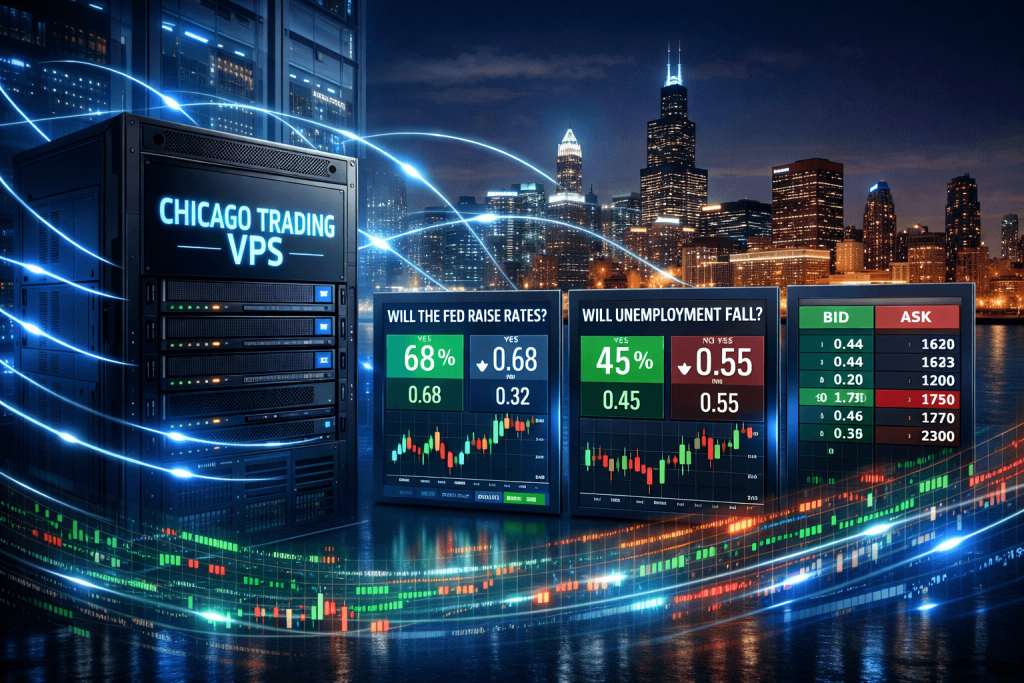
Kalshi’s servers are located in the United States, with infrastructure centered around Chicago. This means that physical proximity to these servers directly impacts latency. The closer your bot is to the exchange, the faster it can receive data and execute trades.
By deploying your bot on a Chicago Trading VPS, you significantly reduce network delays. When combined with high-performance hardware like the Ryzen 9 9950X CPU, this creates an environment where your bot can process data and execute trades with minimal delay.
This advantage becomes especially important in competitive scenarios, where multiple bots are attempting to capture the same opportunity. In such cases, even a small latency difference can determine whether your trade is executed successfully.
Deploying and Running Your Bot in a Professional Environment
Once your bot has been developed and tested locally, the next step is deployment. Moving your system to a VPS environment ensures that it can run continuously without interruption.
This process involves transferring your code, installing dependencies, and configuring the system to run your bot at all times. In a professional setup, the bot should be able to recover automatically from errors and continue operating without manual intervention.
A VPS also allows you to manage your system remotely, giving you full control regardless of your location. This flexibility is essential for monitoring performance and making adjustments as needed.
Over time, as your strategy evolves, this environment provides the stability required to scale your operations effectively.
Real-World Latency Test (Chicago VPS → Kalshi API)
To validate real trading performance, we tested network latency from our Chicago Trading VPS to Kalshi infrastructure.
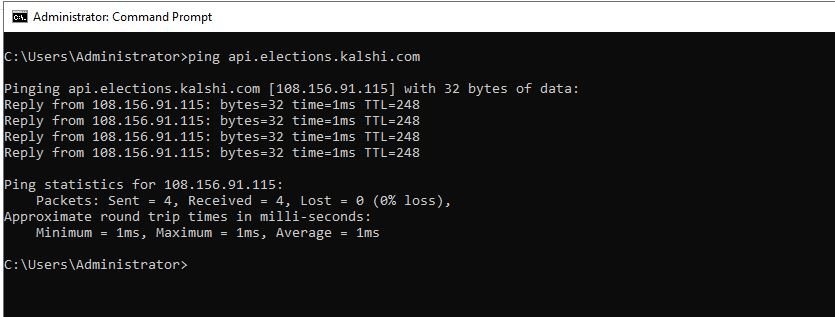
Average ping result: ~0.9–1.5 ms
This ultra-low latency allows trading bots to receive order book updates and execute trades almost instantly. In prediction markets, where arbitrage windows can last only seconds, even small delays can mean missed opportunities or worse fills.
Compared to home internet connections—which often experience fluctuating latency, packet loss, and interruptions—our Chicago Trading VPS provides consistent, stable, and predictable execution performance for Kalshi bots.
Common Mistakes That Can Limit Your Success
Many traders encounter avoidable issues when building their first Kalshi trading bot. One of the most common mistakes is relying on a personal computer for live trading. Local machines are prone to downtime, connectivity issues, and inconsistent performance.
Another frequent issue is underestimating the importance of latency. Even though Kalshi is centralized, execution speed still affects outcomes. Delays can lead to missed opportunities or unfavorable pricing.
Finally, some traders attempt to scale too quickly without sufficient testing. This often leads to unexpected losses and unnecessary risk. A more effective approach is to start small, validate your strategy, and expand gradually.
Conclusion: Building a Competitive Edge in Kalshi Trading
Kalshi represents a new generation of prediction markets—one that combines transparency, regulation, and efficiency. In this environment, automation is no longer optional for traders who want to compete effectively.
A well-designed trading bot allows you to operate with speed, precision, and consistency, but its success depends heavily on the infrastructure supporting it. By deploying your system on a Chicago Trading VPS powered by Ryzen 9 9950X CPUs, you gain the performance and reliability needed to execute your strategy at a professional level.
As competition continues to grow, the combination of strong strategy and high-performance infrastructure will define success. Those who invest in both will be best positioned to capture opportunities in the evolving world of event trading.
FAQs
Yes, Kalshi provides API access that allows traders to build and deploy automated trading systems within its regulated framework.
Yes, identity verification is required before accessing trading features or API functionality.
Because Kalshi’s infrastructure is based in the U.S., hosting your bot in Chicago reduces latency and improves execution speed.
Hardware plays a significant role. High-performance CPUs like the Ryzen 9 9950X allow faster data processing and more efficient execution.