
Introduction: Why VPS Location Can Make or Break Your Polymarket Trading
In fast-moving prediction markets like Polymarket, speed isn’t just an advantage—it’s everything.
Whether you’re running automated trading bots, executing arbitrage strategies, or reacting to breaking news events, milliseconds can determine profit or loss. Many traders focus heavily on strategy, indicators, or market sentiment, but overlook one of the most critical factors behind consistent performance:
👉 Server location and latency
Your physical and network distance from Polymarket’s infrastructure directly affects how quickly your orders reach the exchange and how fast market data reaches your system. This has a direct impact on execution quality, slippage, and overall trading efficiency.
In practice, this means your setup influences:
- How fast your orders are executed
- Whether you get the price you expect
- How quickly your bot reacts to market changes
- Your ability to compete with other traders
This guide explores how Polymarket’s infrastructure works, why latency matters so much, and how choosing the right VPS location can significantly improve your trading performance while staying compliant.
Understanding Polymarket Infrastructure
Where Are Polymarket Servers Located?
Polymarket’s infrastructure is primarily hosted in London (AWS eu-west-2), which serves as the central hub for its trading engine. This is where the core order matching takes place, meaning every trade request ultimately routes through this region.
Because of this, proximity to London becomes a major advantage. The closer your VPS is to this region, the lower your latency will be, and the faster your orders can be executed.
Nearby regions such as Ireland (eu-west-1) and Amsterdam (eu-west-3) benefit from strong network routing and physical proximity, making them highly relevant for traders looking to optimize performance without directly operating inside restricted zones.
How Polymarket’s Trading Engine Works
Polymarket operates using a Central Limit Order Book (CLOB) model, similar to traditional financial exchanges, but with a hybrid architecture designed for both speed and transparency.
Order matching happens off-chain, which allows trades to be processed quickly without the delays typically associated with blockchain transactions. Once matched, trades are then settled on-chain, ensuring security and transparency.
To support this system, Polymarket relies on multiple APIs and real-time data streams. These APIs handle everything from market discovery to order execution, while WebSocket connections provide continuous updates on price movements and orderbook changes. This combination allows traders to build automated systems that react instantly to market conditions—provided their infrastructure is fast enough.
Why VPS Location Matters for Polymarket Trading
What Is Latency in Trading?
Latency refers to the time it takes for a request to travel from your system to the exchange and back again. In everyday internet usage, a delay of a few milliseconds is barely noticeable. In trading, however, it can be the difference between profit and loss.
Lower latency means your orders reach the market faster and are executed closer to your intended price. Higher latency introduces delays that can cause missed opportunities, slippage, or failed trades—especially in fast-moving markets.
Even a relatively small delay of 10 to 50 milliseconds can significantly impact strategies that rely on speed, such as arbitrage or high-frequency trading.
Real-World Latency by Region
Latency varies significantly depending on your VPS location. Traders operating close to London can achieve near-instant execution, while those further away experience increasing delays.
- Dublin: 0.4–0.8ms (optimal balance)
- Amsterdam: 0.6–1ms (low latency with limitations)
- New York: 0.8–1ms (low latency in US but available for only US citizens)
The key takeaway is simple: distance equals delay. Reducing that distance is one of the most effective ways to improve trading performance.
Geo-Restrictions & Compliance Explained
Why Polymarket Restricts Certain Locations
Polymarket operates within a complex regulatory environment, which requires it to restrict access in certain regions. These restrictions are enforced through IP-based geolocation systems that determine whether a user is allowed to trade.
This approach ensures compliance with international regulations, including sanctions and local financial laws, but it also creates challenges for traders who want uninterrupted access to the platform.
What Happens If You’re in a Restricted Region?
When a user attempts to access Polymarket from a restricted location, the platform may block trading functionality entirely. In some cases, users can still view markets but cannot place orders. For traders relying on automation or active strategies, this limitation can effectively prevent participation.
This is where VPS infrastructure becomes essential. By operating from an appropriate location, traders can maintain both access and performance without relying on unstable or high-latency alternatives.
Best VPS Locations for Polymarket Trading
Choosing the right VPS location is one of the most important decisions for any serious Polymarket trader. The goal is to balance three factors: latency, accessibility, and compliance.
Dublin (Ireland – eu-west-1) is widely considered the best overall option. Its proximity to London allows traders to achieve extremely low latency, often in the range of one to five milliseconds, while avoiding many of the geo-restrictions that affect the UK region. This makes Dublin ideal for both manual traders and automated bots, offering a rare combination of speed and unrestricted access. For most users, it represents the optimal setup for consistent and competitive trading.
Amsterdam (EU region) offers another viable option, particularly for traders who rely on API-based execution. While the Polymarket website interface may be blocked in this region, the CLOB API remains fully functional. This means trading bots and automated systems can still place and manage orders without interruption. Latency remains low due to its proximity to London, making it a strong choice for users who operate entirely through APIs rather than manual trading interfaces.
New York (US region) is specifically relevant for traders using Polymarket US. This environment is designed for compliance with U.S. regulations, meaning it is only accessible to users based in the United States. While latency to the main infrastructure is higher compared to European regions, it provides a compliant and stable environment for U.S.-based trading. For non-U.S. users, however, this location is not applicable.
VPS vs Home Internet vs VPN: What’s Best?
Many traders initially attempt to operate from their home internet connection, but this approach quickly reveals its limitations. Home networks are often inconsistent, affected by congestion, routing inefficiencies, and occasional downtime. These factors introduce unpredictable latency, which can negatively impact trading performance.
A VPS, on the other hand, provides a controlled and stable environment. By placing your trading system in a data center close to Polymarket’s servers, you eliminate much of the variability associated with home connections. This results in faster execution, improved reliability, and the ability to run trading systems continuously without interruption.
VPNs are sometimes considered as an alternative, but they are not designed for trading performance. While they can mask your IP address, they often introduce additional latency and instability. For serious trading, a VPS remains the superior solution.
How to Optimize Your Polymarket Trading Setup
Optimizing your trading setup goes beyond simply choosing a VPS location. It requires a combination of infrastructure, monitoring, and strategy alignment.
Selecting a VPS in Dublin is typically the best starting point for most traders, as it provides both speed and accessibility. From there, ensuring that your server is equipped with high-performance hardware—such as fast CPUs(AMD Ryaen 9 9950X) and NVMe storage—helps maintain consistent execution speeds.
Running your trading systems continuously is also critical. Markets operate 24/7, and opportunities can appear at any time. A properly configured VPS ensures that your bots remain active and responsive even when you are offline.
Monitoring latency and system performance should be an ongoing process. By tracking connection speeds and execution times, traders can identify inefficiencies and make adjustments before they impact profitability.
Recommended VPS Setup for Polymarket Traders
A well-optimized VPS setup should be designed with trading performance in mind. At a minimum, traders should look for a system with multiple high-frequency CPU cores, sufficient memory to handle trading applications, and fast NVMe storage to reduce processing delays.
Network quality is equally important. A high-speed connection with optimized routing ensures that your orders reach Polymarket’s servers as quickly as possible. For more advanced users, dedicated servers or upgraded VPS plans can provide additional performance and stability, especially when running multiple bots or complex strategies.
TradingVPS Infrastructure: Built for Ultra-Low Latency Polymarket Trading
When it comes to Polymarket trading, your strategy is only as strong as the infrastructure running behind it. Execution speed, stability, and consistency all depend on the quality of your VPS environment. This is exactly where TradingVPS is designed to give traders a measurable edge.
Our infrastructure is built specifically for performance-critical applications like algorithmic trading and real-time execution. By leveraging AMD Ryzen 9 9950X processors, combined with next-generation DDR5 RAM and ultra-fast NVMe SSD storage, TradingVPS delivers the processing power and responsiveness required for modern trading strategies. This hardware combination ensures that your trading bots can process data instantly, react to market movements without delay, and execute orders with maximum efficiency.
What truly sets TradingVPS apart is not just raw hardware power, but strategic server placement. We offer VPS deployments in both Dublin (eu-west-1) and Amsterdam (eu-west-3)—the two most relevant regions for Polymarket traders.
Our Dublin servers are optimized for full trading access, providing ultra-low latency connections to Polymarket’s London-based infrastructure. This allows traders to achieve near-instant execution speeds, making it ideal for high-frequency strategies, arbitrage, and real-time event trading.
At the same time, our Amsterdam servers provide a powerful alternative for API-driven trading environments. While the Polymarket website interface may be restricted in this region, the CLOB API remains fully functional. This makes Amsterdam an excellent choice for traders running automated bots that rely on direct API execution rather than manual interaction.
To ensure complete transparency and performance validation, we also provide real latency benchmarks from both Dublin and Amsterdam servers. These results, shown below, demonstrate the consistently low response times traders can expect when connecting to Polymarket endpoints.
- Our Amsterdam VPS latency to clob.polymarket.com
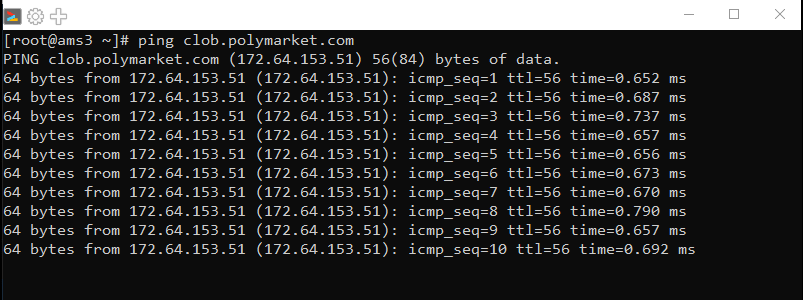
By visualizing these latency differences, traders can clearly understand how infrastructure impacts execution speed.
Beyond performance, TradingVPS is designed for reliability. Our systems are engineered for continuous operation, allowing your trading strategies to run 24/7 without interruption. This ensures you never miss opportunities due to downtime, network instability, or hardware limitations.
In a market where milliseconds define competitiveness, having the right VPS is no longer optional. With TradingVPS, you’re not just renting a server—you’re deploying a high-performance trading environment optimized for speed, stability, and results.
Final Thoughts: Build Your Competitive Edge with the Right VPS
Polymarket trading performance is ultimately shaped by the infrastructure behind your strategy. Server location plays a critical role, directly influencing latency, execution speed, and overall trade quality. Choosing the right VPS environment is not just a technical decision—it’s a strategic one that can significantly impact your results.
Among the available options, Dublin stands out as the most effective choice for most traders, offering the ideal combination of ultra-low latency and full accessibility. Amsterdam provides a reliable alternative for API-driven trading, where the CLOB API enables seamless execution despite limitations on the web interface. Meanwhile, New York remains a specialized solution designed exclusively for U.S.-based users operating on Polymarket US.
In highly competitive markets, the difference between capturing an opportunity and missing it often comes down to milliseconds. A well-optimized VPS setup ensures faster execution, more consistent performance, and uninterrupted operation—allowing your strategies to perform exactly as intended.
By understanding how location, latency, and compliance interact, you can build a trading environment that aligns with your goals and gives you a measurable edge. In Polymarket, where speed defines success, the right infrastructure isn’t optional—it’s your advantage.
FAQs
Dublin is the best overall choice due to its ultra-low latency and unrestricted access for both manual and automated trading.
Yes. While the website interface may be blocked, the CLOB API is fully functional, allowing trading bots and automated systems to operate normally.
No. New York VPS is intended only for U.S. users trading on the Polymarket US platform.