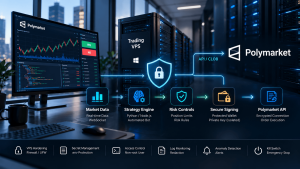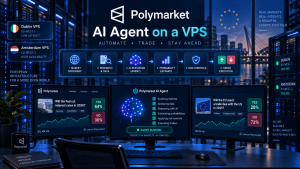
The growth of prediction market trading has transformed platforms like Polymarket from simple betting interfaces into highly competitive trading environments where speed matters. Many traders now use automated bots, arbitrage systems, AI-driven strategies, and real-time market-making algorithms to gain an advantage in fast-moving markets.
As Polymarket adoption continues to increase, infrastructure quality has become one of the biggest factors separating profitable traders from slower competitors. A poorly optimized VPS can introduce latency, delayed order execution, stale market data, and unstable WebSocket connections. Meanwhile, a properly optimized low-latency VPS can significantly improve execution quality and trading efficiency.
This is why serious Polymarket traders are now paying close attention to TTFB, routing quality, VPS location, and network optimization instead of focusing only on CPU cores or RAM.
In this guide, we will explain how TTFB affects Polymarket trading, what makes a good VPS provider, and how major VPS providers compare for Polymarket trading workloads.
Understanding TTFB in Polymarket Trading
TTFB, or Time To First Byte, is one of the most important performance metrics in modern trading infrastructure. It measures how quickly your server receives the first response from the target system after sending a request.
In the context of Polymarket trading, TTFB directly impacts how fast your bot or trading application can interact with the Polymarket CLOB infrastructure.
Every trading action on Polymarket depends on real-time communication between your VPS and the Polymarket backend. This includes:
- Receiving orderbook updates
- Submitting orders
- Cancelling orders
- Processing WebSocket events
- Monitoring liquidity changes
- Detecting arbitrage opportunities
When your VPS has high latency, your trading system reacts slower than competing traders.
For example, imagine two traders attempting to buy shares in a rapidly moving prediction market after breaking news appears. The trader operating with a 1ms–2ms TTFB VPS will likely receive market data and submit orders before a trader operating from a 70ms VPS located far away from Polymarket infrastructure.
In highly active markets, even a 20ms difference can dramatically affect fill quality.
This becomes especially important for:
- Arbitrage trading
- Market making
- Scalping strategies
- AI prediction systems
- Event-driven trading bots
- Multi-market execution systems
Many traders mistakenly focus only on ping tests, but ping alone does not accurately represent real trading performance. TTFB provides a better understanding of actual application responsiveness because it reflects the complete network path and server response time.
A VPS may show low ICMP ping while still suffering from poor routing, unstable WebSocket performance, or inconsistent application latency.
That is why experienced Polymarket traders usually prioritize:
- Stable TTFB
- Consistent routing
- Low jitter
- Fast WebSocket synchronization
- Minimal packet loss
instead of focusing purely on raw ping numbers.
Polymarket operates using a professional-style Central Limit Order Book architecture, commonly called CLOB. This trading structure behaves more like a professional financial exchange than a traditional prediction market platform.
As a result, speed and infrastructure quality matter much more than many traders initially expect.
The faster your system receives market data, the faster your strategy can react. Over thousands of trades, these small advantages can compound significantly.
What Makes a Good Polymarket VPS?
Choosing a VPS for Polymarket trading is very different from choosing a VPS for websites, gaming, or general software hosting.
Many generic VPS providers advertise large amounts of RAM or CPU power, but they often fail to provide the network performance required for serious trading workloads.
For Polymarket trading, network quality is usually more important than raw specifications.
A good Polymarket VPS should provide several key advantages.
Low Latency to Polymarket Infrastructure
The most important factor is low latency and fast TTFB to Polymarket’s infrastructure, especially the clob.polymarket.com endpoint.
A VPS located geographically close to Polymarket infrastructure can significantly reduce execution delays.
Currently, Dublin-based infrastructure is widely considered one of the best locations for Polymarket trading because of its excellent routing to European AWS infrastructure and strong connectivity to Cloudflare networks.
Many traders report dramatically better performance from Dublin compared to North American VPS locations.
This is one reason why trading-focused VPS providers are increasingly deploying infrastructure in Ireland specifically for Polymarket users.
Stable WebSocket Connectivity
Modern Polymarket bots depend heavily on WebSocket streams.
These streams continuously provide:
- Orderbook updates
- Liquidity changes
- Trade events
- Market updates
- Position changes
A VPS with unstable WebSocket connectivity can cause delayed updates, stale pricing, and synchronization issues.
Even if the VPS has a powerful CPU, unstable network performance can severely damage trading efficiency.
Professional traders therefore prioritize stable network routing over flashy hardware marketing.
High-Performance CPU Infrastructure Although network quality is critical, CPU performance still matters.
Advanced Polymarket trading systems often process:
- Real-time data feeds
- Orderbook calculations
- AI models
- Arbitrage algorithms
- Statistical analysis
- Multiple simultaneous markets
Low-end shared VPS infrastructure can become overloaded during peak trading activity, especially when multiple bots are running simultaneously.
Ryzen and EPYC processors are currently among the most popular options for algorithmic trading VPS environments because they provide excellent single-core performance and stable multitasking capability.
This becomes increasingly important when running:
- Python trading bots
- Node.js WebSocket systems
- AI inference workloads
- Multi-threaded arbitrage systems
Easy Deployment and Reliability
Many traders underestimate how important operational simplicity is.
A VPS provider may offer excellent infrastructure, but if deployment is overly complicated, it can create unnecessary downtime and maintenance work.
Trading-focused VPS providers often simplify the process by offering:
- Ubuntu deployment
- Fast provisioning
- Optimized networking
- Easy remote access
- Better support for trading applications
This can save traders significant time compared to configuring large enterprise cloud systems manually.
VPS Provider Comparison for Polymarket Trading
Several VPS providers are commonly used by Polymarket traders, but their performance and usability vary significantly depending on infrastructure quality, routing optimization, and deployment simplicity.
Below is a detailed comparison of four commonly discussed providers.
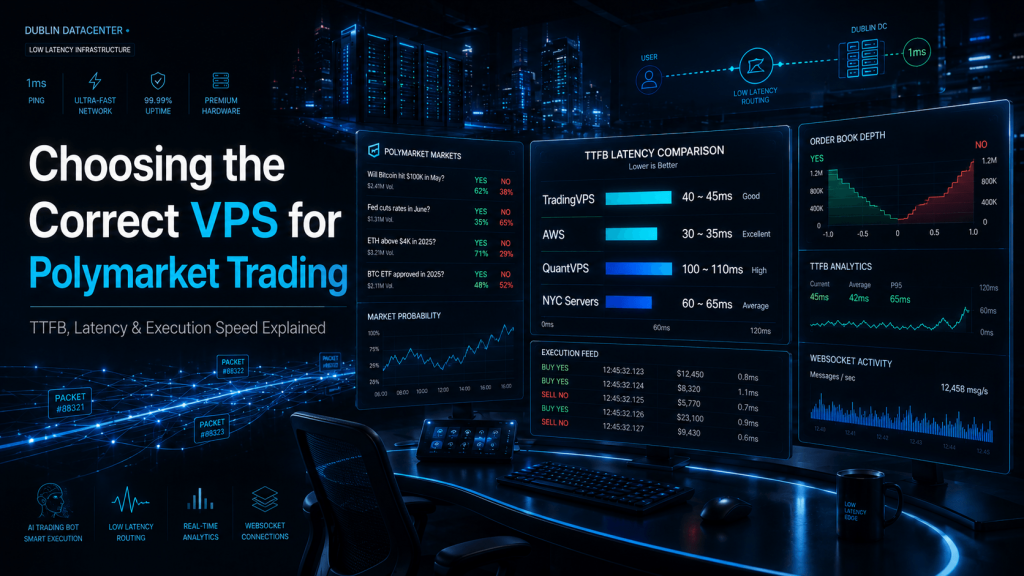
| Feature | TradingVPS | AWS | QuantVPS | NYCServers |
| CPU Performance | AMD Ryzen / Intel | Intel CPU Model | AMD Ryzen / Epyc | AMD Epyc |
| Estimated TTFB to clob.polymarket.com | 40 ~ 45ms | 30 ~ 35ms | 100 ~ 110ms | 60 ~ 65ms |
| Ease of Setup | Very Easy | Difficult | Moderate | Easy |
| Starting From | $17/mon | $14/mon | $59/mon | $20/mon |
TradingVPS
TradingVPS is designed specifically for low-latency trading workloads. Unlike general-purpose hosting companies, the provider focuses heavily on infrastructure optimized for financial trading systems and automated trading bots.
One of the major advantages of TradingVPS is its Dublin-based infrastructure, which offers extremely low TTFB to Polymarket systems.
For many traders, this translates into:
- Faster order execution
- Better arbitrage performance
- Improved market-making efficiency
- Lower slippage
- More stable WebSocket synchronization
TradingVPS also focuses on high-performance Ryzen hardware, which is particularly useful for advanced algorithmic trading systems.
Another important advantage is deployment simplicity. Many traders prefer providers that allow fast Ubuntu deployment and easy bot configuration instead of requiring enterprise-level cloud engineering knowledge.
For beginners and intermediate traders, this simplicity can dramatically reduce setup time.
TradingVPS is particularly well suited for:
- Market making
- Arbitrage systems
- High-frequency trading
- AI-assisted trading bots
- Multi-market strategies
AWS (Amazon Web Services)
AWS is one of the most powerful cloud platforms in the world and provides exceptional scalability and global infrastructure coverage.
Many institutional systems use AWS because of its flexibility and reliability.
However, AWS is not always the ideal solution for individual Polymarket traders.
Although AWS offers excellent networking capabilities, it often requires substantial technical expertise to optimize properly.
Users frequently need to configure:
- Security groups
- Routing rules
- Instance scaling
- Storage management
- Monitoring systems
- Firewall policies
Without careful optimization, AWS can become unnecessarily expensive while still underperforming compared to specialized trading VPS providers.
For advanced developers and institutional teams, AWS can still be a powerful option, especially when running large-scale infrastructure or multi-service architectures.
However, for traders seeking fast deployment and optimized Polymarket latency, specialized providers are usually more practical.
QuantVPS
QuantVPS markets itself heavily toward algorithmic traders and low-latency trading environments.
The provider offers dedicated resources, trading-oriented VPS plans, and infrastructure designed for automated systems.
QuantVPS performs reasonably well for Polymarket workloads, especially from European regions such as Dublin.
The platform is often used by traders running:
- Automated bots
- Quantitative models
- Arbitrage systems
- Crypto trading infrastructure
Compared to AWS, QuantVPS is generally easier to deploy and manage.
However, setup complexity can still vary depending on the user’s experience level and application requirements.
For intermediate traders seeking a balance between performance and operational simplicity, QuantVPS can be a solid option.
NewYorkCityServers
NewYorkCityServers is more focused on traditional VPS hosting rather than specialized trading infrastructure.
The provider can still be useful for:
- Testing environments
- Development servers
- Casual trading systems
- Low-frequency automation
However, because the infrastructure is primarily based in North America, latency to Polymarket systems is typically much higher than Dublin-based providers.
For serious competitive trading, this additional latency can negatively affect execution quality.
While the provider may be cost-effective for basic workloads, it is generally less suitable for advanced Polymarket strategies where every millisecond matters.
Final Thoughts
As Polymarket trading becomes increasingly competitive, infrastructure quality is becoming a major edge for serious traders.
Many traders spend enormous amounts of time optimizing strategies while completely ignoring the performance limitations of their VPS infrastructure. In reality, poor latency and unstable routing can destroy the effectiveness of even the best trading models.
A properly optimized low-latency VPS can improve:
- Order execution speed
- Arbitrage opportunities
- Fill quality
- WebSocket synchronization
- Trading consistency
- Market-making efficiency
For most serious Polymarket traders, Dublin-based infrastructure currently offers the best overall performance due to excellent routing proximity and low TTFB to Polymarket systems.
Specialized trading VPS providers generally outperform generic cloud hosting solutions for this type of workload because they optimize specifically for latency-sensitive trading environments.
Ultimately, choosing the correct VPS provider is not just a hosting decision anymore. For many Polymarket traders, it has become a direct part of the trading strategy itself.
FAQs
TTFB (Time To First Byte) affects how quickly your VPS receives responses from Polymarket servers. Lower TTFB means faster order execution, quicker orderbook updates, and better reaction speed during volatile markets. This is especially important for arbitrage bots, market-making systems, and high-frequency trading strategies.
No. Ping only measures basic ICMP network latency, while TTFB measures actual application-level responsiveness between your VPS and Polymarket infrastructure. A VPS may show low ping but still perform poorly due to routing issues or unstable WebSocket connectivity.
It depends on your goals.
– Trading-focused providers like TradingVPS and QuantVPS are usually better for low-latency execution.
– AWS is powerful but requires advanced cloud knowledge.
– Traditional VPS providers are more suitable for testing and casual trading rather than competitive execution.
Yes, but it depends on CPU performance, RAM, and network stability. High-frequency strategies and multiple WebSocket connections can increase system load quickly, so dedicated Ryzen or EPYC VPS plans are often preferred for multi-bot environments.