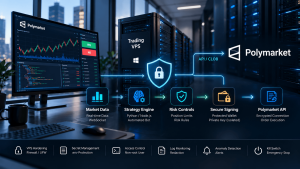
Polymarket trading infrastructure is rapidly evolving.
As BTC 5-minute prediction markets become increasingly competitive, many automated traders are discovering that profitability is no longer determined by strategy logic alone. Infrastructure quality now plays a critical role in execution consistency, hedge timing, slippage reduction, and overall system performance.
This shift is especially noticeable in:
- short-duration BTC markets
- multi-leg execution systems
- adaptive execution bots
- spread compression strategies
- momentum-based prediction engines
- hedge timing frameworks
- microstructure-sensitive execution models
In these environments, latency is not simply a technical metric.
It directly affects risk exposure and execution quality.
For professional Polymarket trading systems, low-latency VPS infrastructure is becoming a core component of the edge itself.
The Evolution of Polymarket Trading Infrastructure
Prediction markets were once viewed primarily as long-duration probabilistic instruments.
However, the emergence of BTC 5-minute markets has changed the structure of execution entirely.
Near expiry, these markets behave less like traditional prediction systems and more like highly reactive microstructure environments.
As settlement approaches:
- probabilities converge rapidly
- orderbooks reprice aggressively
- directional momentum accelerates
- liquidity becomes unstable
- spread opportunities disappear quickly
This creates an environment where execution timing becomes extremely important.
Even relatively small delays in:
- websocket updates
- orderbook synchronization
- hedge execution
- cancellation timing
- secondary leg placement
It can materially impact profitability.
Understanding BTC 5-Minute Market Behavior
BTC 5-minute markets operate on compressed time horizons.
Unlike long-duration prediction markets where traders can tolerate delayed execution, short-horizon markets evolve extremely quickly near settlement.
Typical market behavior often looks like this:
| Time Remaining | Market Characteristics |
|---|---|
| 5 minutes | Relatively balanced pricing |
| 2 minutes | Faster repricing begins |
| 30 seconds | Rapid probability convergence |
| 10 seconds | Near HFT-like execution conditions |
During the final seconds before settlement:
- small BTC price movements trigger immediate repricing
- probabilities converge rapidly toward dominant outcomes
- weaker sides collapse quickly
- spreads compress aggressively
Example:
| Time Left | YES | NO |
|---|---|---|
| 2 min | 0.72 | 0.28 |
| 30 sec | 0.88 | 0.12 |
| 10 sec | 0.95 | 0.05 |
This creates opportunities for:
- spread capture
- temporary directional inefficiencies
- momentum continuation trades
- probability compression strategies
- dynamic hedge execution
But it also creates significant execution risk.
Multi-Leg Execution Systems and Temporary Exposure
One increasingly common execution model used in short-duration Polymarket environments involves multi-leg execution.
Rather than entering both sides simultaneously, the system dynamically executes positions based on real-time repricing behavior.
A simplified example:
| Action | Price |
|---|---|
| Buy YES | 0.78 |
| Wait for NO repricing | — |
| Buy NO later | 0.18 |
| Final combined cost | 0.96 |
The objective is to capture temporary inefficiencies between YES and NO repricing behavior.
However, this introduces temporary directional exposure.
Between the first and second leg:
- the trader carries market risk
- repricing can accelerate unexpectedly
- spread compression may disappear
- adverse momentum can increase losses
The longer the secondary execution is delayed, the greater the risk becomes.
This is why infrastructure quality matters.
Latency Is Not Just Speed — It Is Risk Management
Many traders incorrectly assume latency only affects execution speed.
In reality:
Latency directly affects directional exposure.
For multi-leg systems, every millisecond matters because each delay increases the time spent unhedged.
Example execution sequence:
| Event | Timing |
|---|---|
| BTC price spikes upward | Instant |
| YES reprices aggressively | Instant |
| Bot receives websocket update | +250ms |
| Secondary hedge executes | +700ms |
During this delay:
- the spread may fully compress
- the hedge quality deteriorates
- execution costs increase
- directional exposure expands
A strategy that initially aimed to capture controlled spread inefficiencies can quickly transform into unintended speculation.
In highly compressed markets, latency becomes part of the risk model itself.
Why Local PC Infrastructure Often Fails
Many traders initially run Polymarket bots on local desktop systems.
For casual experimentation this may be sufficient, but serious automated trading systems often encounter major limitations.
Common problems include:
- unstable residential internet
- inconsistent routing quality
- background CPU scheduling interference
- websocket interruptions
- operating system latency spikes
- delayed event-loop execution
- reconnect instability during volatility
Even modern consumer systems can suffer from:
- jitter spikes
- packet buffering
- ISP congestion
- variable latency under load
In short-duration markets, these inconsistencies become costly.
Why VPS Infrastructure Changes Execution Quality
Professional VPS infrastructure addresses many of these issues by providing stable, low-latency environments specifically designed for persistent automated workloads.
Key advantages include:
Stable Persistent Connectivity
Trading bots maintain consistent websocket sessions with fewer interruptions and reduced reconnect risk.
Lower Network Latency
Reduced routing distance improves execution responsiveness and orderbook synchronization.
Reduced Jitter
Consistency is often more important than raw ping.
A stable 12ms connection is frequently superior to a fluctuating 5–40ms connection.
Improved Event Processing
Dedicated virtualized resources improve async processing consistency and websocket responsiveness.
Better Execution Timing
Faster reactions reduce:
- slippage
- stale fills
- delayed hedging
- spread expansion risk
Why Dublin Infrastructure Is Becoming Important for Polymarket
Within the Polymarket trading community, infrastructure location is becoming an increasingly discussed topic.
Many traders operating latency-sensitive systems are prioritizing European infrastructure regions due to routing efficiency and websocket responsiveness.
Dublin, in particular, is frequently referenced for:
- stable connectivity
- closest to Polymarket main server
- low-latency European routing
- cloud infrastructure concentration
- strong network peering environments
For Polymarket automation systems, infrastructure location can significantly affect:
- websocket latency
- orderbook freshness
- hedge timing
- execution synchronization
- cancellation responsiveness
This is especially relevant for:
- maker systems
- spread capture models
- dynamic hedge engines
- event-driven execution frameworks
Some infrastructure providers now specifically optimize VPS environments for crypto and prediction market workloads.
One example is TradingVPS.io, which offers trading-focused VPS infrastructure including Dublin-based deployments optimized for low-latency trading environments.
Their infrastructure includes:
- Ryzen 9 9950X processors
- NVMe SSD storage
- high-speed networking
- trading-focused VPS environments
- infrastructure optimized for persistent automated workloads
WebSocket Latency Is Critically Important
Most Polymarket trading bots rely heavily on websocket-driven orderbook updates.
The execution engine continuously monitors:
- bid/ask changes
- orderbook depth
- spread compression
- directional movement
- liquidity imbalance
- momentum acceleration
When websocket updates become delayed:
- signals become stale
- execution logic degrades
- spreads disappear before execution
- defensive hedges react too slowly
In fast expiry environments, stale market data can completely invalidate otherwise profitable strategies.
Professional systems therefore prioritize:
- websocket-first architectures
- asynchronous processing
- low-latency event loops
- optimized delta handling
- persistent orderbook synchronization
Market Microstructure Matters More Than Most Traders Realize
An important realization among advanced Polymarket traders is that BTC 5-minute markets increasingly resemble microstructure trading systems.
Near expiry:
- liquidity thins rapidly
- aggressive repricing dominates
- momentum accelerates
- queue dynamics matter more
- spread inefficiencies vanish quickly
This changes how bots must be designed.
Simple polling systems often become insufficient.
Instead, professional systems increasingly rely on:
- event-driven execution
- asynchronous networking
- websocket delta processing
- queue-aware maker logic
- adaptive hedge timing
Infrastructure quality becomes tightly connected to execution alpha.
Maker Strategies Are Extremely Latency Sensitive
Latency becomes even more important for maker-style systems.
Why?
Because queue position matters.
Slow infrastructure can lead to:
- stale resting orders
- delayed cancellations
- adverse selection
- poor queue priority
- getting picked off during rapid repricing
Fast cancellation and update responsiveness improve:
- maker fill quality
- queue positioning
- spread capture efficiency
- defensive order management
In highly reactive expiry markets, slow cancellation timing alone can materially impact profitability.
Async Execution Engines and Event-Driven Design
Modern Polymarket bots increasingly use asynchronous architectures to reduce execution delays.
Instead of sequential processing:
- websocket updates arrive continuously
- event loops process orderbook deltas
- execution engines react asynchronously
- hedge systems adjust dynamically
This architecture reduces:
- blocking delays
- stale signal propagation
- synchronization bottlenecks
However, async systems still depend heavily on infrastructure consistency.
Even highly optimized code suffers if:
- websocket packets arrive late
- VPS networking becomes unstable
- CPU scheduling introduces jitter
- execution queues stall during volatility
Infrastructure and software architecture must work together.
Network Jitter Often Matters More Than Raw Ping
Many traders focus only on average ping.
But for automated execution systems, jitter is often more important.
Example:
| Connection Type | Average Ping | Stability |
|---|---|---|
| Residential internet | 18ms | Highly variable |
| Trading VPS | 12ms | Stable |
The second environment is usually superior because execution consistency improves.
High jitter environments cause:
- inconsistent websocket timing
- unstable event-loop processing
- delayed hedge synchronization
- execution unpredictability
Stable infrastructure improves repeatability and execution quality over long trading sessions.
VPS vs Local PC for Polymarket Automation
The infrastructure gap between local systems and trading-focused VPS environments becomes increasingly visible as execution frequency increases.
| Feature | Local PC | Trading VPS |
|---|---|---|
| Internet stability | Variable | Stable |
| Network routing | ISP dependent | Optimized |
| CPU interference | High | Lower |
| 24/7 uptime | Limited | Persistent |
| Websocket reliability | Variable | Higher |
| Jitter consistency | Unstable | More stable |
| Execution timing | Inconsistent | Predictable |
For casual trading this difference may be small.
For latency-sensitive automation systems, it becomes significant.
Why Infrastructure Is Becoming Part of the Edge
As Polymarket participation grows, competition increases.
This changes the nature of execution.
Strategies that once worked under slower conditions may gradually lose effectiveness due to:
- tighter spreads
- faster repricing
- increased automation
- more sophisticated execution systems
- faster market adaptation
As this evolution continues, infrastructure itself becomes increasingly important.
Professional trading systems now frequently optimize:
- VPS location
- websocket responsiveness
- network stability
- event-loop latency
- async execution architecture
- cancellation timing
- queue management
The edge is no longer purely strategic.
It is increasingly infrastructural.
Final Thoughts
In Polymarket BTC 5-minute markets:
- execution quality matters
- websocket latency matters
- hedge timing matters
- infrastructure matters
For multi-leg execution systems especially, latency directly affects execution risk.
The faster and more stable the infrastructure:
- the shorter the temporary exposure
- the lower the slippage
- the more reliable the hedge timing
- the more consistent the execution quality
As prediction market trading becomes increasingly competitive, low-latency VPS infrastructure is evolving from an optional optimization into a core component of professional automated trading systems.
For traders building latency-sensitive Polymarket bots, infrastructure quality is becoming part of the strategy itself.
FAQ
Many traders prefer Dublin-based VPS infrastructure due to strong European routing environments, low-latency connectivity, and stable websocket performance for prediction market trading systems.
BTC 5-minute markets reprice extremely quickly near expiry. Delayed execution can increase slippage, worsen hedge timing, and reduce spread capture opportunities.
For casual trading, a local PC may work adequately. However, professional automated systems often benefit from VPS infrastructure because of improved uptime, network consistency, websocket stability, and lower execution latency.
Polymarket trading systems rely heavily on real-time orderbook updates. Delayed websocket data can lead to stale signals, missed executions, and poor fill quality during fast-moving markets.
Lower latency helps reduce slippage, improve hedge execution timing, maintain fresher orderbook data, and increase consistency in spread capture strategies.