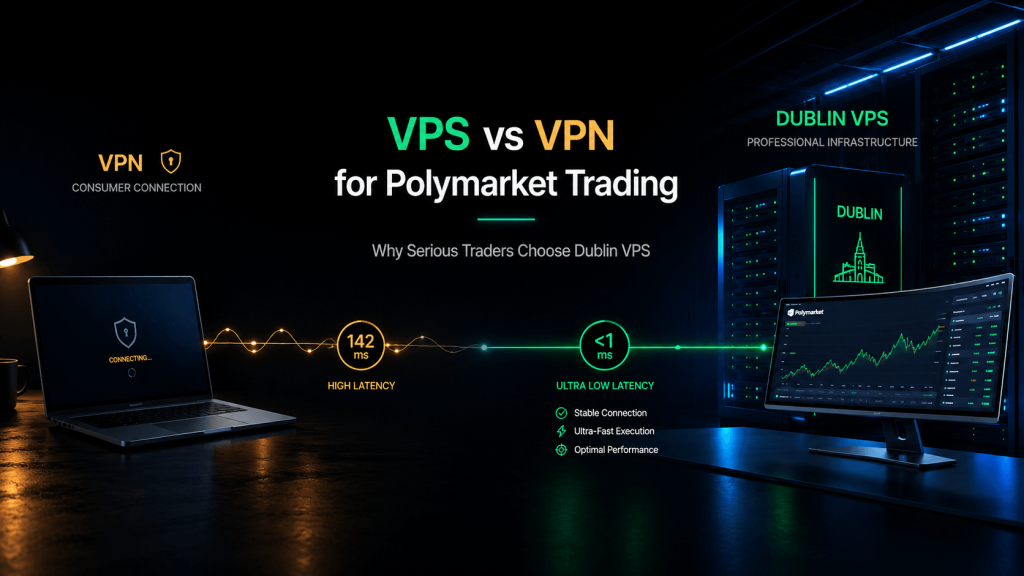
Polymarket traders often start with a VPN because it feels simple. Install an app, connect to another region, and access the platform. But once traders begin using larger positions, faster execution strategies, browser automation, API trading, or multiple tabs with live order books, they quickly realize that a VPN alone is not designed for serious trading infrastructure.
This is where the discussion between VPS vs VPN becomes important.
A VPN is mainly a privacy and routing tool. A VPS is a complete remote trading environment designed for stability, performance, uptime, and low latency. For casual browsing, a VPN may be enough. For active Polymarket trading, especially on the web version, a properly optimized Dublin VPS delivers a significantly better experience.
In recent months, infrastructure quality has become a much bigger topic inside the Polymarket trading community. As prediction markets become more competitive and liquidity grows, traders are paying closer attention to browser responsiveness, websocket stability, and execution consistency. Small delays that were once ignored now become noticeable during fast-moving market conditions. This is especially true during political events, sports outcomes, economic releases, and crypto-related prediction markets where prices can move rapidly within seconds.
Many traders initially assume that all they need is access to the platform, but over time they discover that the quality of the trading environment itself can significantly affect the overall experience. A stable VPS environment helps reduce interruptions, improves long-session reliability, and creates a smoother workflow for active trading.
In this guide, we will explain the difference between VPS and VPN for Polymarket trading, compare latency and stability, discuss execution performance, and explain why many advanced Polymarket traders are moving to dedicated Dublin VPS environments.
Why Location Matters for Polymarket
Polymarket infrastructure performs differently depending on geographic routing, ISP quality, browser networking, and regional connectivity. Many users discovered that some server locations — especially Amsterdam — may experience issues with the Polymarket web version, Cloudflare routing, or inconsistent browser behavior.
Dublin has become one of the most reliable locations for accessing the Polymarket web platform because of its excellent connectivity to major European internet exchanges and hyperscale cloud infrastructure.
For traders using browser-based execution, order monitoring, liquidity analysis, or fast market reaction strategies, network consistency matters just as much as raw speed.
A stable environment reduces:
- page loading interruptions
- websocket disconnects
- browser freezing
- delayed order placement
- failed order confirmations
- session instability during volatile markets
These issues become far more noticeable once traders begin monitoring multiple markets simultaneously. Polymarket continuously updates order books, charts, liquidity, and market data in real time. Even small connectivity inconsistencies can create delays in how quickly information appears inside the browser. While casual users may not notice these differences immediately, active traders usually recognize them very quickly during high-volume events.
This is one reason many traders are now choosing Dublin VPS hosting instead of relying only on local residential internet with a VPN overlay.
Another important factor is routing consistency. Residential internet providers often change traffic routes dynamically depending on congestion or regional network conditions. This can create inconsistent performance throughout the day. Professional datacenter infrastructure inside Dublin usually provides much more predictable network behavior, which helps maintain a stable Polymarket trading experience over longer sessions.
What Is a VPN?
A VPN, or Virtual Private Network, routes your internet traffic through another server location. It changes your apparent IP address and encrypts your connection.
VPNs are useful for:
- privacy protection
- changing geographic routing
- basic platform access
- bypassing ISP restrictions
- simple browser access
However, a VPN does not provide a dedicated computing environment. Your trading still depends on:
- your home PC performance
- your local ISP stability
- Wi-Fi quality
- browser resource usage
- local power interruptions
- local network congestion
Even if the VPN endpoint is fast, your actual trading environment may still be unstable.
For active Polymarket traders, that becomes a major limitation.
A VPN also cannot solve issues related to local hardware limitations. Many traders run Polymarket alongside Discord, Telegram, TradingView, news feeds, charting platforms, browsers with dozens of tabs, and other crypto tools simultaneously. Over time, this can heavily impact browser responsiveness on a local machine, especially during volatile events when CPU usage spikes.
Another limitation is uptime reliability. Residential internet connections are not designed for continuous professional trading workloads. Router restarts, ISP maintenance, Wi-Fi instability, or temporary packet loss can interrupt active sessions unexpectedly. For traders running automation tools or monitoring markets all day, these interruptions can become frustrating.
This is why many experienced traders eventually move beyond VPN-only setups and begin looking for more stable infrastructure solutions.
What Is a VPS?
A VPS, or Virtual Private Server, is a full remote machine hosted inside a professional datacenter.
Instead of routing traffic from your home PC through a VPN, you directly operate your trading environment inside the datacenter itself.
A Polymarket VPS typically includes:
- dedicated CPU resources
- high-speed datacenter networking
- low latency connectivity
- 24/7 uptime
- remote desktop access
- stable browser sessions
- automation support
- multi-monitor workflows
- persistent trading environments
When traders use a Dublin VPS, the browser itself runs in Dublin. This creates a much more stable and consistent connection path compared to using a VPN from a residential ISP.
One of the biggest advantages of a VPS environment is consistency. The system operates inside enterprise-grade infrastructure designed for continuous uptime and professional workloads. Datacenters use redundant networking, backup power systems, optimized cooling, and premium hardware environments that are very different from residential internet conditions.
For active Polymarket traders, this often results in noticeably smoother browser performance. Websocket sessions remain stable longer, market data updates more consistently, and overall responsiveness feels more reliable during periods of heavy volatility.
Another major advantage is flexibility. Traders can access their VPS from anywhere while keeping the trading environment running continuously. Instead of depending on a single local computer, the VPS remains online independently inside the datacenter.
VPS vs VPN for Polymarket Trading
1. Stability
A VPN cannot fix instability caused by local internet conditions. If your home ISP experiences packet loss or routing congestion, your Polymarket session may still lag or disconnect.
A VPS operates directly inside a datacenter with enterprise-grade networking.
This is especially important during:
- breaking news events
- election markets
- sports markets
- macroeconomic announcements
- volatile crypto-related prediction markets
During high-volume trading periods, stable websocket performance becomes critical.
In fast-moving prediction markets, timing matters. Traders constantly monitor price changes, liquidity shifts, and order book movements in real time. If the browser loses synchronization or temporarily freezes, important information may appear late. Even a few seconds of instability during major events can affect execution timing and overall trading efficiency.
Professional VPS environments are designed to reduce these interruptions as much as possible. Stable datacenter routing and better network infrastructure help maintain smoother connections during extended trading sessions.
2. Latency Consistency
Many traders only focus on ping, but Polymarket performance depends more heavily on real-world browser responsiveness and TTFB (Time to First Byte).
Lower latency alone does not guarantee faster execution if the connection quality fluctuates.
A professionally optimized Dublin VPS can provide:
- stable routing
- lower jitter
- consistent TTFB
- smoother websocket synchronization
- faster browser rendering performance
This creates a noticeably better experience for active order management.
A common mistake among newer traders is assuming that a low ping automatically guarantees superior trading performance. In reality, browser-based platforms depend on multiple factors beyond simple ICMP latency tests. Websocket quality, routing consistency, browser rendering speed, and CPU responsiveness all contribute to the overall experience.
This is why some traders with seemingly decent ping numbers still experience laggy browser behavior or inconsistent market updates. The problem is often caused by unstable routing paths or overloaded local systems rather than raw latency itself.
Dublin VPS environments help reduce many of these variables by operating inside optimized datacenter infrastructure with more predictable connectivity.
Understanding Trading Latency
For Polymarket traders, latency is not just about ICMP ping tests.
Important performance metrics include:
- TTFB
- websocket responsiveness
- order confirmation speed
- browser rendering speed
- API response consistency
- routing stability
Many traders discover that a residential VPN setup may show decent ping numbers while still feeling slow in real trading conditions.
This happens because VPNs do not control:
- local ISP congestion
- consumer router buffering
- browser resource limitations
- unstable residential packet routing
A Dublin VPS removes many of these variables entirely.
Real-world trading performance depends heavily on consistency over time. Short bursts of latency spikes, temporary packet loss, or browser stalls may not appear during a quick speed test, but they become very noticeable during active trading sessions that last several hours.
This is one reason why professional traders often focus more on stability and consistency rather than simply chasing the lowest possible ping number.
Why Dublin VPS Works Well for Polymarket
Dublin has become one of the strongest locations for Polymarket browser access due to its connectivity ecosystem and modern datacenter infrastructure.
Advantages include:
Excellent European Connectivity
Dublin is connected to major transatlantic and European backbone networks, helping maintain stable routing performance.
Strong Cloud Infrastructure
Many hyperscale cloud providers operate large infrastructure hubs in Dublin, which improves regional networking quality.
Reliable Browser Performance
Some traders experienced issues using Amsterdam environments with the Polymarket web version. Dublin has proven to be significantly more stable for browser-based trading sessions.
Better Long-Term Session Stability
For traders running Polymarket continuously throughout the day, Dublin VPS environments tend to maintain stable websocket sessions longer than many residential VPN setups.
Another reason traders prefer Dublin is overall infrastructure maturity. The region hosts major international cloud infrastructure, carrier networks, and enterprise datacenter ecosystems. This creates a strong environment for low-latency browser workloads and real-time applications.
For active Polymarket users, these infrastructure advantages become increasingly valuable as trading intensity grows.
VPS vs VPN for Automated Trading
If you are running:
- browser automation
- API scripts
- trading bots
- monitoring dashboards
- arbitrage systems
- market scanners
then a VPN is usually not sufficient.
Automation systems require:
- continuous uptime
- persistent sessions
- stable websocket connectivity
- uninterrupted execution
- predictable network behavior
A VPS is specifically designed for these workloads.
Many Solana and crypto traders already use VPS environments for trading infrastructure because local PCs and VPN setups are difficult to scale reliably.
Automation workloads place much higher demands on system stability compared to casual browser usage. Scripts often rely on uninterrupted websocket streams, persistent API communication, and long-running sessions that remain active for days or weeks at a time.
A residential environment is rarely ideal for this kind of workload. Power interruptions, internet instability, forced system updates, or local hardware problems can easily interrupt automated systems unexpectedly.
A VPS environment solves many of these issues by operating continuously inside a professionally managed datacenter.
Why CPU Performance Matters
Polymarket trading is not only network-dependent.
Modern browser trading also depends heavily on CPU performance.
Real-time order books, charts, websocket streams, browser tabs, and trading dashboards can consume significant resources.
This is why high-frequency traders increasingly prefer high-performance VPS infrastructure using modern processors like AMD Ryzen 9 systems.
High clock speed CPUs help improve:
- browser responsiveness
- chart rendering
- multi-tab performance
- automation execution
- script processing
- websocket handling
For active traders, the difference becomes noticeable very quickly.
Browser-based trading platforms today are much heavier than traditional websites. Multiple live charts, constant websocket updates, JavaScript rendering, and simultaneous browser tabs all create significant CPU load. During active market periods, weaker systems can become sluggish very quickly.
This is one reason why traders increasingly prioritize high-frequency CPU infrastructure for trading workloads rather than using generic low-performance VPS plans.
Why Traders Use Ubuntu VPS for Polymarket
Many advanced crypto traders prefer Ubuntu-based VPS environments because they are lightweight, efficient, and optimized for automation workloads.
Ubuntu environments are commonly used for:
- browser automation
- Docker deployments
- Python trading scripts
- websocket monitoring
- Node.js trading tools
- API integrations
Ubuntu also consumes fewer system resources than traditional desktop environments, allowing traders to maximize VPS performance.
For Polymarket automation setups, Ubuntu has become one of the most popular operating systems.
Many traders also prefer Ubuntu because of its flexibility and developer ecosystem. Most crypto trading tools, automation frameworks, and open-source trading libraries are designed primarily for Linux environments. This makes deployment easier and improves compatibility for advanced trading workflows.
Comparing VPN and VPS for Polymarket
| Feature | VPN | Dublin VPS |
|---|---|---|
| Changes IP location | Yes | Yes |
| Dedicated trading environment | No | Yes |
| Stable browser sessions | Limited | Excellent |
| 24/7 uptime | No | Yes |
| Automation support | Weak | Strong |
| Multi-tab trading | Limited by local PC | Optimized |
| Low-latency datacenter routing | Partial | Yes |
| Websocket stability | Inconsistent | Stable |
| Professional trading setup | No | Yes |
| Remote access from anywhere | Partial | Yes |
The comparison becomes more important as trading activity scales. Casual users may not immediately notice the difference, but advanced traders typically recognize the advantages of VPS infrastructure once they begin running more complex workflows or longer trading sessions.
When a VPN Is Enough
A VPN may still be acceptable if you:
- trade casually
- place occasional positions
- do not automate anything
- use only a few browser tabs
- do not need continuous uptime
For light usage, a VPN is the simpler option.
However, once trading becomes more active, most users eventually hit performance limitations.
For occasional users, the convenience and simplicity of a VPN may outweigh the benefits of a dedicated VPS. But serious traders who spend many hours monitoring markets often prioritize consistency and stability over simplicity.
When You Need a Dublin VPS
A VPS becomes the better solution if you:
- actively trade prediction markets
- need stable browser performance
- run automation tools
- monitor multiple markets
- keep sessions running all day
- care about execution consistency
- want lower TTFB
- use multiple dashboards simultaneously
This is especially true for traders who rely on rapid market reactions during volatile events.
As trading intensity increases, infrastructure quality becomes increasingly important. A stable VPS environment reduces many of the unpredictable variables associated with residential internet connections and local hardware limitations.
Why Traders Choose TradingVPS Dublin VPS
Our Dublin VPS environment is specifically optimized for active trading workloads.
Key advantages include:
- low-latency European connectivity
- optimized browser performance
- Ryzen 9 9950X infrastructure
- stable websocket sessions
- excellent Polymarket web compatibility
- fast VPS deployment
- enterprise-grade datacenter networking
- remote access from anywhere
Many users who previously struggled with Amsterdam routing issues have reported significantly better stability after migrating to Dublin VPS infrastructure.
We also provide VPS details within 5 minutes after purchase, helping traders get online quickly during active market conditions.
Our infrastructure is designed specifically for traders who require strong browser responsiveness, stable long-duration sessions, and reliable execution environments for modern prediction market trading.
Final Thoughts
The difference between VPS vs VPN for Polymarket trading becomes obvious once trading activity scales beyond casual usage.
A VPN is mainly a routing tool.
A VPS is a professional trading environment.
For serious Polymarket traders who value stability, uptime, browser performance, and consistent execution, a Dublin VPS offers a much stronger foundation than relying on residential internet combined with a VPN.
As prediction markets continue growing and competition increases, infrastructure quality becomes part of trading performance itself.
The traders with the most stable environments often react faster, maintain better execution consistency, and avoid many of the connectivity issues that interrupt less optimized setups.
If you are actively trading Polymarket every day, a properly optimized Dublin VPS can provide a major upgrade in both reliability and overall trading experience.
FAQs
A VPN can be enough for casual Polymarket usage if you only place occasional trades and do not require continuous uptime or advanced trading tools. However, active traders often experience limitations related to browser stability, websocket performance, routing consistency, and local internet reliability. For serious trading, a VPS usually provides a much smoother and more stable environment.
Traders use a VPS because it provides a dedicated remote trading environment inside a professional datacenter. This helps improve browser responsiveness, uptime, websocket stability, and overall trading consistency. A VPS also allows traders to keep their trading environment online 24/7 without depending on their local computer or residential internet connection.
A VPN only routes your internet traffic through another location while your trading still runs on your local PC. A VPS is a complete remote server where the browser and trading environment operate directly inside the datacenter itself. This creates a more stable and professional setup for active trading.
Dublin VPS environments are known for strong European connectivity, excellent datacenter infrastructure, and stable routing performance. Many traders reported better compatibility and smoother browser performance on Dublin servers compared to some Amsterdam environments, especially for the Polymarket web version.