
Micro futures are no longer a niche corner of the futures market.
By 2026, smaller-sized contracts such as Micro E-mini S&P 500 (MES), Micro E-mini Nasdaq-100 (MNQ), Micro Gold (MGC), and Micro WTI Crude Oil (MCL) have become major trading products in their own right. CME Group reported that Micro E-mini equity index futures and options represented 45% of overall Equity Index average daily volume in September 2026, while Micro Metals accounted for 53% of Metals volume and Micro Energy accounted for 8% of Energy volume. During Q3, Micro Nasdaq-100 futures averaged roughly 2.6 million contracts per day, up 101% year over year, while Micro WTI averaged about 190,000 contracts per day, up 238%.
The appeal is straightforward: Micro contracts provide exposure to many of the same benchmark markets as larger futures while reducing the dollar value of each point or tick. A trader who finds one E-mini Nasdaq contract too large can use MNQ. Someone who wants Gold exposure without trading a 100-ounce GC contract can use 10-ounce MGC. A crude-oil trader can move from the 1,000-barrel CL contract to the 100-barrel MCL.
But smaller does not mean low risk.
Micro futures are still leveraged derivatives. Their smaller size gives traders finer control over position sizing, stop distance, scaling and account exposure, but opening too many Micro contracts can quickly recreate—or exceed—the risk of the larger contract.
The real story of 2026 is therefore not simply that futures have become “cheaper.”
It is that the futures market increasingly offers a size ladder, allowing traders to choose exposure that better matches their strategy and account.
Why Micro Futures Are Growing So Fast in 2026
The strongest evidence of the Micro trend is actual trading activity.
In Q1 2026, CME reported record average daily volume of approximately 1.5 million MES contracts and 2.1 million MNQ contracts. Micro Gold averaged a record 714,000 contracts per day, Micro Silver averaged 263,000, Micro Bitcoin averaged 83,000, and Micro Ether averaged 98,000.
The trend remained strong later in the year. During Q3, MNQ volume increased 101% year over year to about 2.6 million contracts per day, MES averaged around one million, MCL volume rose 238% to approximately 190,000 contracts, and Micro Gold volume increased 43% to roughly 336,000. September alone saw MCL average approximately 240,000 contracts per day, up 376% from a year earlier.
These numbers show why it is increasingly inaccurate to describe Micro futures as simply beginner products.
Retail traders certainly benefit from smaller contract sizes, but professional traders can also use Micros to fine-tune hedges, scale positions, reduce residual exposure, or adjust a portfolio in smaller increments.
For example, one E-mini S&P 500 contract is equivalent in multiplier to ten MES contracts. A trader who wants roughly 30% of one E-mini’s exposure cannot accomplish that cleanly with ES alone, but three MES contracts provide that granularity.
The same logic applies across metals, energy and cryptocurrencies.
And in August 2026, CME went even smaller by launching E-nano equity index futures, sized at one-tenth of the existing Micro E-mini contracts for the S&P 500, Nasdaq-100, Russell 2000 and Dow.
That tells us something important about where derivatives markets are heading:
Contract sizing is becoming increasingly granular.
MES, MNQ, MGC and MCL: The Core Micro Contracts
The most recognizable Micro futures contracts cover U.S. equities, Gold and crude oil.
| Contract | Market | Contract Size / Multiplier | Minimum Tick | Tick Value |
|---|---|---|---|---|
| MES | S&P 500 | $5 × index | 0.25 | $1.25 |
| MNQ | Nasdaq-100 | $2 × index | 0.25 | $0.50 |
| M2K | Russell 2000 | $5 × index | 0.10 | $0.50 |
| MYM | Dow Jones | $0.50 × index | 1 point | $0.50 |
| MGC | Gold | 10 troy ounces | $0.10/oz | $1.00 |
| MCL | WTI Crude Oil | 100 barrels | $0.01/barrel | $1.00 |
| SIL | Silver | 1,000 ounces | $0.01/oz | $10.00 |
| MHG | Copper | 2,500 pounds | $0.0005/lb | $1.25 |
| MBT | Bitcoin | 0.10 BTC | $5/BTC | $0.50 |
| MET | Ether | 0.10 ETH | $0.50/ETH | $0.05 |
CME lists MES at $5 times the S&P 500 Index, making its 0.25-point tick worth $1.25. MNQ is $2 times the Nasdaq-100 and therefore moves $0.50 per 0.25-point tick. M2K has a $5 multiplier and a $0.50 minimum tick value, while MYM moves $0.50 for each Dow point.
Micro Gold is 10 troy ounces, one-tenth the size of the traditional 100-ounce Gold contract. A $0.10-per-ounce minimum move therefore changes the contract value by $1.
Micro WTI is similarly one-tenth of standard CL. It represents 100 barrels rather than 1,000, with a $0.01-per-barrel minimum price move equal to $1 per contract.
These smaller dollar movements are the main reason Micros can substantially change risk management.
MES and MNQ: The Center of the Micro Futures Market
For active equity-index traders, MES and MNQ are often the first Micro products encountered.
MES tracks the S&P 500, giving exposure to a broad basket of large U.S. companies. MNQ tracks the technology-heavy Nasdaq-100 and generally experiences larger point swings.
The difference in tick value is important:
MES: 0.25 points = $1.25
MNQ: 0.25 points = $0.50
At first, that can make MNQ appear less risky because each tick is smaller. But the Nasdaq-100 can move far more index points during an active session, so risk must be calculated from stop distance × point value, not simply the tick value.
Suppose a MES strategy uses a 10-point stop:
10 points × $5 = $50 risk per contract
before commissions and slippage.
If an MNQ strategy requires a 50-point stop:
50 points × $2 = $100 risk per contract.
The smaller per-tick value did not make the MNQ trade smaller overall.
This is one of the most important habits for Micro futures traders: calculate risk in dollars using the actual market structure and stop distance rather than choosing a contract because its individual tick looks inexpensive.
Liquidity also matters. MES and MNQ have developed into exceptionally active contracts. In September 2026, MNQ averaged approximately 2.4 million contracts per day and MES about 1.1 million, while Micro E-mini equity futures and options as a group represented 45% of CME’s equity-index volume.
That is far beyond the level of a lightly traded specialty product.
MGC and MCL Bring the Same Sizing Concept to Gold and Oil
Micro Gold has become another standout market.
The full COMEX Gold contract represents 100 troy ounces. MGC represents 10 ounces, which reduces the dollar effect of price movements by 90%.
If Gold moves $25 per ounce:
GC: 100 × $25 = $2,500
MGC: 10 × $25 = $250.
That makes it easier to build a position gradually or use wider technical stops without immediately taking the same dollar risk as a full-size Gold contract.
Demand has been significant. CME reported record Micro Gold ADV of roughly 714,000 contracts in Q1 2026, and September volume remained about 378,000 contracts per day. CME’s Micro Gold, Silver and Copper products also reached historically high year-to-date average daily activity during 2026.
Micro WTI offers a similar alternative for energy traders.
The traditional CL contract controls 1,000 barrels of crude oil, so a $1 move equals $1,000 per contract.
MCL controls only 100 barrels:
$1 move in oil = $100 per MCL contract.
Its tick is $1 compared with $10 for CL.
That smaller scale can make MCL much easier to use around volatile events such as inventory reports, geopolitical headlines, OPEC developments, or sudden changes in energy demand.
However, MCL has a different settlement structure from CL. CME lists MCL as financially settled, while the standard WTI contract has physical-delivery mechanics.
For short-term retail traders this distinction may not change normal intraday execution, but traders holding futures near expiration should understand exactly how the contract settles and when trading terminates.
Micro Futures Now Extend Far Beyond Stocks, Gold and Oil
The Micro ecosystem has expanded well beyond MES, MNQ, MGC and MCL.
Equity traders also have M2K for Russell 2000 small-cap exposure and MYM for the Dow. CME has further expanded its Micro E-mini family to additional equity indexes, while its August 2026 E-nano launch created even smaller versions of the four major U.S. equity-index products. The E-nano Nasdaq-100 contract, for example, uses only a $0.20-per-point multiplier, compared with $2 for MNQ and $20 for the larger NQ contract.
Metals traders can use Micro Silver and Micro Copper. Current CME specifications list Micro Silver at 1,000 ounces and Micro Copper at 2,500 pounds.
FX traders have contracts such as Micro EUR/USD (M6E), which represents €12,500 and has a $1.25 minimum tick.
Cryptocurrency futures have developed their own Micro ecosystem. Micro Bitcoin represents 0.10 BTC, while Micro Ether represents 0.10 ETH. CME has continued expanding smaller crypto contracts across additional digital assets as regulated crypto-derivatives demand has grown.
The common theme is not the underlying market.
It is position-size precision.
A trader can increasingly choose the contract size instead of allowing the contract size to dictate the trading strategy.
Micro Futures vs E-mini and Standard Futures
The easiest way to understand the advantage is to compare equivalent exposure.
For the S&P 500:
1 ES = 10 MES
For the Nasdaq-100:
1 NQ = 10 MNQ
For Gold:
1 GC = 10 MGC
For WTI:
1 CL = 10 MCL in basic exposure terms.
That gives traders several ways to use Micro contracts.
A trader could replace one larger contract with several Micros, allowing partial exits.
For example:
5 MES long
could be managed as:
- exit 2 contracts at target one,
- exit 2 contracts at target two,
- trail 1 final contract.
Trying to implement the same scaling strategy with one ES contract is impossible because a futures contract cannot be divided.
Micros also allow more precise risk adjustments.
Suppose your strategy’s risk model says the correct position is equivalent to 0.4 ES.
You cannot trade 0.4 ES.
But you can trade:
4 MES.
This is one of the strongest advantages of Micro contracts for systematic traders.
The downside is that commissions and exchange fees apply per contract. Ten Micro contracts can therefore be more expensive to trade than one corresponding larger contract, depending on broker pricing.
Once a strategy regularly uses 10, 20 or 30 Micros at a time, it may be worth comparing the total transaction cost and liquidity against the larger contract.
The goal should not be to trade the smallest product automatically.
It should be to select the contract that provides the best combination of risk precision, liquidity and trading cost.
Smaller Contracts Do Not Eliminate Leverage Risk
Micro futures solve a position-sizing problem.
They do not solve a discipline problem.
If one MNQ contract feels small, a trader can easily begin trading five, ten or twenty. At ten MNQ contracts, the exposure has become equivalent to one NQ contract.
The same relationship applies to MES and ES.
Another misunderstanding involves margin.
Micro contracts generally require less margin than their larger equivalents because their notional exposure is smaller. But exchange performance bond requirements change with volatility, and brokers may apply their own intraday or overnight margin policies.
A broker advertising very low intraday margin does not mean that amount represents the maximum amount a trader can lose.
A futures position can lose more than the margin posted to open it.
Risk should therefore be calculated from:
position size × stop distance × contract point value
and then considered alongside potential slippage, gaps and exceptional volatility.
For example, a five-contract MES position with a 20-point stop has approximately:
5 × 20 × $5 = $500
of planned price risk before commissions or slippage.
That calculation is much more useful than simply saying:
“MES only costs $1.25 per tick.”
Do Micro Futures Need a VPS?
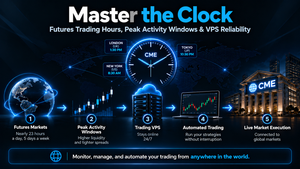
Micro futures themselves do not require a VPS.
A trader manually trading one MES contract through a browser or desktop platform usually gains little from renting a server simply because the contract is a Micro.
A VPS becomes relevant when the trading software needs to stay online.
Examples include:
- NinjaTrader automated strategies,
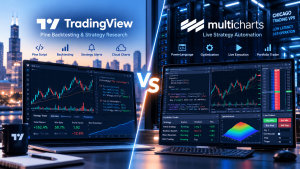
- MultiCharts systems,
- Quantower Algo strategies,
- Sierra Chart ACSIL systems,
- Python or API trading bots,
- trade copiers,
- multi-account prop setups,
- locally managed stops or OCO logic,
- or monitoring applications.
The architecture may look like:
Trader → Remote Desktop → Windows VPS → trading platform → broker/connectivity → CME
For CME-focused automation, Chicago is a logical region to evaluate because of the broader Chicago/Aurora futures infrastructure ecosystem.
The important distinction is that trading MES instead of ES does not change the network path.
Both ultimately depend on the same broader futures execution infrastructure.
A high-clock CPU, sufficient RAM, NVMe storage, stable network connectivity and a dedicated IPv4 address are typically more relevant to an automated futures VPS than simply purchasing the highest possible number of CPU cores.
TradingVPS’s Chicago infrastructure is designed around this type of always-on futures workflow, but traders should size the server according to the actual number of platform instances, charts, strategies and data-intensive tools they run.
The Next Step Beyond Micro Futures: E-nano Contracts
One of the clearest signs that smaller contract sizing is not a temporary trend came in August 2026, when CME launched E-nano Equity Index futures.
These are one-tenth the size of the already-small Micro E-mini contracts.
For example:
| Index | E-mini Multiplier | Micro Multiplier | E-nano Multiplier |
|---|---|---|---|
| S&P 500 | $50/point | $5/point | $0.50/point |
| Nasdaq-100 | $20/point | $2/point | $0.20/point |
| Russell 2000 | $50/point | $5/point | $0.50/point |
| Dow | $5/point | $0.50/point | $0.05/point |
CME launched NES, NNQ, N2K and NDOW on August 24, 2026, describing them as tools for greater precision as equity-market levels increased.
This gives equity traders three distinct sizing tiers:
E-mini → Micro E-mini → E-nano
For Nasdaq exposure, that means:
NQ → MNQ → NNQ
A trader can therefore move between $20, $2 and $0.20 of exposure per Nasdaq-100 index point.
That degree of granularity would have been unusual in mainstream futures markets only a few years ago.
Frequently Asked Questions About Micro Futures
Micro futures are smaller-sized futures contracts designed to provide the same or similar market exposure as larger benchmark contracts with reduced notional exposure and smaller dollar movements.
Their smaller size can make risk easier to control, but Micro futures are still leveraged derivatives. Beginners still need to understand margin, tick value, expiration, stop placement and the possibility of losses exceeding the amount initially posted.
Many are extremely active. MES and MNQ trade millions of contracts on busy days and have become major parts of CME’s equity-index ecosystem. Liquidity varies significantly by product and contract month, so each market should be evaluated separately.
Not automatically. Micros provide finer sizing, while larger contracts can be more cost-efficient when the desired exposure is already large. The best choice depends on risk, liquidity, commissions and strategy requirements.
Final Thoughts: Micro Futures Are Becoming a Core Part of the Futures Market
The Micro futures story in 2026 is no longer simply about giving small accounts access to futures.
It is about giving all types of traders more precise control over exposure.
MES and MNQ have developed into major equity-index markets.
Micro Gold has reached hundreds of thousands of contracts in average daily trading activity.
Micro WTI recorded triple-digit year-over-year growth during 2026.
Smaller metals, FX and cryptocurrency contracts continue expanding the range of markets available at reduced contract sizes.
And CME’s introduction of E-nano equity futures shows that the trend toward more granular position sizing is continuing rather than slowing down.
For traders, the benefit is flexibility.
Instead of allowing one oversized contract to determine risk, it becomes possible to select a contract that fits the strategy.
A trader can scale into positions.
Scale out gradually.
Use wider technical stops while maintaining the same dollar risk.
Build multi-market portfolios with smaller allocations.
And move between Micro and larger contracts as account size and strategy requirements change.
The key is remembering that a smaller contract is only a risk-management tool.
It is not protection from overtrading.
Ten MNQ contracts can recreate the exposure of one NQ.
Ten MES contracts can recreate one ES.
Ten MGC contracts can approximate one standard Gold contract.
The advantage of Micros exists only if traders actually use the smaller size to control exposure rather than simply multiplying the number of contracts.
That is why the Micro futures boom matters.
It gives traders more control over one of the few variables they can control before every trade:
position size.
This article is provided for general educational and technical purposes only and does not constitute financial, investment, legal or trading advice. Futures trading involves substantial leverage and risk, and losses can exceed the amount initially deposited. Contract specifications, exchange margins, broker intraday margins, trading hours and product availability can change. Always verify current exchange and broker information before trading.