
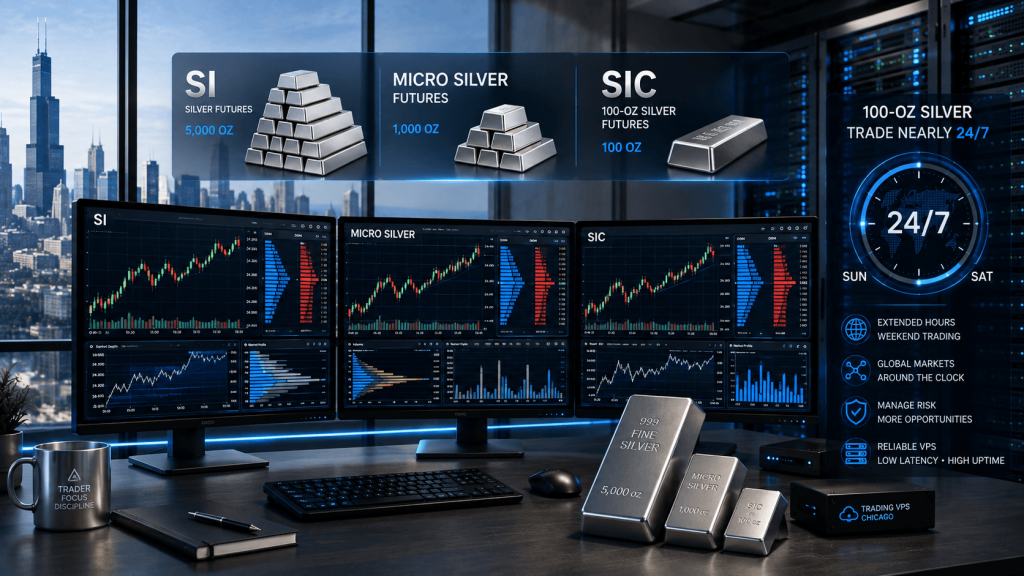
Silver futures trading has become considerably more flexible in 2026. Traders who want exposure to the COMEX silver market are no longer limited to choosing between the benchmark 5,000-ounce Silver futures contract and the smaller Micro Silver contract. CME Group introduced 100-Ounce Silver futures in February 2026, creating a third contract size that dramatically reduces the amount of silver represented by a single futures position.
The three contracts—Silver Futures (SI), Micro Silver Futures (SIL), and 100-Ounce Silver Futures (SIC)—all provide exposure to movements in silver prices, but their contract sizes, tick values, settlement structures, trading schedules, and practical use cases are very different. SI represents 5,000 troy ounces of silver. Micro Silver represents 1,000 ounces, or one-fifth of SI. The newer SIC contract represents just 100 ounces, making it one-tenth the size of Micro Silver and one-fiftieth the size of benchmark SI.
The differences are becoming even more important in September 2026. CME has announced that 100-Ounce Silver futures will expand to 24/7 trading beginning September 11, 2026, subject to completion of the applicable regulatory process. SI and Micro Silver will continue following the established Sunday-through-Friday metals schedule with a daily maintenance break.
For traders, that means choosing a silver futures contract is no longer simply a question of whether the standard or Micro contract offers the right size. The decision can now involve desired dollar exposure, liquidity, tick value, physical versus financial settlement, weekend market access, broker support, margin requirements, and the infrastructure used to keep a trading platform available during longer sessions.
SI vs Micro Silver vs 100-Ounce Silver: Quick Comparison
The easiest way to understand the three silver contracts is to compare how much silver each contract represents and how changes in the quoted silver price affect the position.
| Contract | Symbol | Contract size | Outright minimum price move | Approx. minimum tick value | Settlement | Trading schedule |
|---|---|---|---|---|---|---|
| Silver Futures | SI | 5,000 troy oz | $0.005/oz | $25 | Physical delivery | Sunday-Friday |
| Micro Silver Futures | SIL | 1,000 troy oz | $0.005/oz | $5 | Physical delivery via ACE structure | Sunday-Friday |
| 100-Ounce Silver Futures | SIC | 100 troy oz | $0.01/oz | $1 | Financial settlement | 24/7 from Sept. 11, 2026, subject to final implementation |
The size difference becomes much easier to understand when silver makes a meaningful move.
If silver rises by $1 per ounce, the approximate change in contract value would be:
SI: $5,000
Micro Silver: $1,000
100-Ounce Silver: $100
If silver moves by just $0.10 per ounce, the approximate change becomes $500 for SI, $100 for Micro Silver, and $10 for SIC.
Those numbers demonstrate why contract size matters more than simply looking at a broker’s required margin. Futures are leveraged instruments, so the amount required to open a position can be much smaller than the full notional exposure being controlled. A trader who focuses only on the required margin may underestimate how quickly gains or losses can change when the underlying silver price moves.
The contract multiplier provides the clearer starting point. Determine how much silver exposure one contract represents, understand the dollar effect of a normal market move, and then evaluate margin and account requirements afterward.
Silver Futures (SI): The 5,000-Ounce Benchmark
Silver Futures, symbol SI, are the benchmark COMEX silver futures contract. Each contract represents 5,000 troy ounces of silver, making SI substantially larger than either Micro Silver or the new 100-Ounce contract.
The minimum outright price movement is $0.005 per troy ounce. Because the contract contains 5,000 ounces, a one-tick move is worth approximately $25 per contract.
The larger multiplier means even apparently small changes in the quoted silver price can translate into substantial changes in contract value. A $0.05-per-ounce move represents approximately $250 for one SI contract. A $0.50 move represents approximately $2,500, while a $1 move represents approximately $5,000.
Suppose silver is trading at $80 per ounce. One SI contract represents approximately $400,000 in notional silver exposure because $80 multiplied by 5,000 ounces equals $400,000. The trader does not normally deposit that full amount because futures use margin, but the position still responds economically to changes across all 5,000 ounces.
This is why margin should never be confused with position size. A relatively small margin deposit can control a much larger notional exposure, which can amplify both gains and losses.
SI is also a physically deliverable futures contract. Traders who carry an eligible position into the delivery process can become involved in delivery obligations under COMEX rules. Many active or short-term traders close or roll their positions before delivery becomes relevant, but anyone trading physically delivered futures should still understand expiration timing and their broker’s specific liquidation or delivery policies.
When the Larger SI Contract Can Matter
SI can be useful when the intended exposure itself is large enough to justify a 5,000-ounce contract. Institutional participants, commercial hedgers, professional traders, and other market participants may prefer the benchmark contract because of its established market structure and ability to create substantial exposure using relatively few contracts.
The disadvantage is position granularity.
A trader cannot hold half an SI contract. One contract immediately creates exposure to 5,000 ounces. Reducing the position by one contract removes the entire 5,000-ounce block.
This is one reason smaller silver futures products exist. Micro Silver allows exposure to be adjusted in 1,000-ounce increments, while SIC takes that granularity down to just 100 ounces.
The benchmark contract is therefore not automatically the best choice simply because it is the primary silver futures market. The appropriate size depends on how much dollar sensitivity the trader actually intends to accept.
Micro Silver Futures (SIL): One-Fifth the Size of SI
Micro Silver Futures, symbol SIL, represent 1,000 troy ounces of silver, making one Micro contract exactly one-fifth the size of the standard 5,000-ounce SI contract.
The outright minimum price movement is $0.005 per ounce, producing a minimum tick value of approximately $5 per contract. That is one-fifth of SI’s $25 tick value, reflecting the one-fifth contract multiplier.
If silver moves $0.10 per ounce, one Micro Silver contract changes in value by approximately $100. A $0.50 move corresponds to approximately $500, while a $1 move corresponds to approximately $1,000.
This smaller multiplier provides significantly more flexibility when adjusting silver exposure.
Instead of choosing between zero and 5,000 ounces with a single SI contract, a trader can use Micro Silver in 1,000-ounce increments. Two SIL contracts represent 2,000 ounces, three represent 3,000 ounces, and five Micro contracts represent the same nominal 5,000-ounce quantity as one standard SI contract.
That flexibility can be useful for scaling into or out of positions or matching exposure more closely to the amount a trader intends to control. However, several Micro contracts can ultimately create the same exposure as one standard contract, so the word “Micro” should not be interpreted as meaning the position itself cannot become large.
Micro Silver is also physically deliverable, but its delivery mechanism differs somewhat from simply delivering an independent 1,000-ounce bar for every contract. CME uses an Accumulated Certificate of Exchange, or ACE, structure. An ACE represents a fractional ownership interest connected to the standard 5,000-ounce Silver futures delivery system. Five ACEs can ultimately correspond to the delivery structure associated with one standard Silver futures warrant.
For most traders who close their positions well before delivery, that process will remain in the background. It still reinforces an important distinction between Micro Silver and the newer SIC contract: Micro Silver is not cash settled.
SI vs Micro Silver: Same Silver Market, Different Dollar Sensitivity
Consider silver moving from $80.00 to $80.30 per ounce. That is a $0.30 move.
For one SI contract:
$0.30 × 5,000 ounces = approximately $1,500
For one Micro Silver contract:
$0.30 × 1,000 ounces = approximately $300
For one 100-Ounce Silver contract:
$0.30 × 100 ounces = approximately $30
The direction and size of the underlying silver move are exactly the same. Only the contract multiplier changes.
This is why comparing SI vs Micro Silver should begin with intended dollar exposure rather than with whichever product displays the lowest margin requirement. A trader who understands the multiplier can calculate how a $0.10, $0.50, $1, or larger silver movement will affect each contract before deciding which instrument fits the intended setup.
100-Ounce Silver Futures (SIC): CME’s Smallest Silver Contract
The biggest development for silver futures traders in 2026 is 100-Ounce Silver futures, symbol SIC.
CME launched the contract in February 2026 as a substantially smaller way to access its silver futures market. One SIC contract represents exactly 100 troy ounces of silver, making it one-tenth the size of Micro Silver and one-fiftieth the size of standard SI.
The contract is quoted in dollars and cents per troy ounce. Its minimum outright trading fluctuation is $0.01 per ounce, which produces a $1 minimum tick value because the contract multiplier is 100 ounces.
This produces very different dollar sensitivity from the larger silver contracts.
If silver rises by $0.10 per ounce, SIC changes by approximately $10 per contract. A $0.50 move represents approximately $50, while a $1 move represents approximately $100.
Compare that $1 silver movement across all three contracts:
SI: approximately $5,000
SIL: approximately $1,000
SIC: approximately $100
The 100-ounce size gives traders much finer control over exposure. A trader who wants 500 ounces of nominal silver exposure could theoretically use five SIC contracts. Someone seeking 1,000 ounces could use ten SIC contracts or one Micro Silver contract. Someone seeking 5,000 ounces could theoretically use fifty SIC contracts, five Micro Silver contracts, or one SI contract.
Those positions may represent similar underlying quantities, but they are not operationally identical. Commission costs, available liquidity, bid-ask spreads, order-book depth, tick structure, and the number of orders being managed can differ considerably.
Smaller contracts therefore provide more granularity, but using a large number of small contracts does not automatically make them more efficient than using a larger contract.
SIC Is Financially Settled
Another major difference is settlement.
Unlike SI and Micro Silver, 100-Ounce Silver futures are financially settled. The contract is settled based on the benchmark 5,000-ounce COMEX Silver futures market rather than through physical silver delivery.
This makes SIC structurally different from both SI and SIL.
A trader still needs to understand expiration dates and broker policies, but holding SIC does not lead to an obligation to receive or deliver physical silver through the same mechanism used by the deliverable contracts.
CME lists SIC contract months based on the active March, May, July, September, and December cycle within its defined listing window. Trading terminates before the corresponding contract month, which is another reason traders should confirm expiration details rather than assuming all silver futures terminate on exactly the same schedule.
100-Ounce Silver Is Moving to 24/7 Trading in September 2026
The most important schedule development for silver traders is happening this month.
CME has announced that 100-Ounce Silver futures will expand to 24/7 trading beginning Friday, September 11, 2026, subject to final regulatory implementation.
That timing requires an important clarification. As of early September 2026, SIC is already an active futures contract, but its production weekend trading has not yet begun. The first weekend session is scheduled to begin Friday, September 11.
For the initial transition, CME plans an extended maintenance period on September 11 from 4:00 p.m. to 4:30 p.m. Central Time, with the first production weekend session beginning at 4:30 p.m. CT. After that initial transition, the normal Friday reopening is expected to occur at 4:02 p.m. CT following the shorter weekday maintenance period.
Under the continuous structure, 100-Ounce Silver will trade through weekends with scheduled system maintenance rather than closing for the entire period between Friday afternoon and Sunday evening.
SI and Micro Silver are not moving to that same schedule at this stage.
They continue to follow the established COMEX metals session, generally operating from Sunday at 5:00 p.m. CT through Friday at 4:00 p.m. CT, with a daily one-hour maintenance break beginning at 4:00 p.m. CT.
This creates a major distinction in silver futures trading hours. After September 11, searching for “CME silver trading hours” will no longer produce one answer that applies equally to every silver futures product.
Why Weekend Silver Trading Matters
Silver is unusual because it sits between the precious-metals and industrial-metals worlds. Its price can react to changes in interest-rate expectations, currency markets, inflation expectations, geopolitical events, precious-metals demand, manufacturing conditions, solar demand, electronics demand, and broader commodity sentiment.
Many of those developments can occur outside traditional U.S. futures sessions.
Weekend access means a SIC trader may be able to interact with the silver futures market during periods when SI and SIL remain closed.
That does not mean weekend trading automatically provides the same conditions as a heavily traded weekday session. Market availability and market liquidity are different concepts.
A contract can be open while bid-ask spreads are wider, order-book depth is thinner, or overall participation is lower than during major U.S. or European market hours. Traders should evaluate actual market conditions rather than assuming a 24/7 contract behaves identically at every hour of the week.
Physical Delivery vs Financial Settlement
The settlement structure is one of the clearest differences between the three contracts.
SI is physically deliverable. Micro Silver is also physically deliverable through its ACE-based structure. SIC is financially settled.
That distinction may not materially affect a day trader who consistently opens and closes positions within the same session, but it becomes increasingly important as an expiration approaches.
A trader holding SI or SIL should understand when the relevant contract enters its delivery process and how their broker handles positions in physically deliverable futures. A broker may require customers who do not intend to make or take delivery to close or roll positions before an internal deadline that occurs before the exchange’s final delivery procedures.
With SIC, the final obligation is handled financially rather than through delivery of silver.
That simplicity may appeal to certain traders, but it should not be interpreted as making the product universally superior. Settlement method is only one part of the decision. Liquidity, contract size, transaction costs, availability on the trader’s platform, and actual market depth can be more important for a particular strategy.
The most useful way to think about the three contracts is that they provide different ways of expressing exposure to the same underlying silver market rather than three interchangeable versions of one instrument.
Which Silver Futures Contract Fits Different Trading Setups?
There is no single best Silver futures contract for every trader.
SI provides the largest exposure. One contract controls 5,000 ounces, making it the benchmark choice when a participant intentionally needs substantial silver exposure and wants to operate in the established standard contract.
Micro Silver provides a middle ground. Its 1,000-ounce multiplier is one-fifth of SI, giving traders significantly more flexibility while retaining a physically delivered structure linked closely to the benchmark Silver futures market.
SIC provides the smallest exposure by a wide margin. At 100 ounces, it is useful when much finer position granularity is desired, and its financial settlement removes the physical-delivery mechanism associated with SI and SIL. From September 11, its planned weekend availability will differentiate it even further.
The correct comparison should also include transaction costs.
Suppose a trader wants exposure equivalent to one SI contract. That could mean one SI, five Micro Silver contracts, or fifty SIC contracts. Even if all three combinations represent 5,000 ounces, trading fifty separate contracts can create a very different commission and execution profile from trading one benchmark contract.
Similarly, liquidity may not be identical. SI remains the benchmark product, while smaller contracts may have different trading volume and order-book characteristics. A trader should examine the current bid and ask, depth, and recent activity for the exact expiration being traded.
Broker support can also differ. A contract being listed on CME Globex does not guarantee that every futures broker or trading platform has enabled it immediately. This is particularly relevant for a newer product such as SIC.
For most traders, the decision should therefore begin with the amount of silver exposure needed and then incorporate liquidity, tick value, settlement, transaction costs, broker availability, and trading schedule.
Silver Futures Trading Infrastructure in 2026
Silver futures already require infrastructure capable of supporting long trading sessions. SI and Micro Silver trade for approximately 23 hours per day during the normal Sunday-through-Friday futures week. SIC’s move toward 24/7 access extends that requirement even further because the platform may need to remain available throughout the weekend as well.
A trader using NinjaTrader, Quantower, Sierra Chart, Rithmic-connected software, charts, alerts, or permitted automated processes may not want the entire trading environment to depend on a personal computer remaining powered and connected for several days at a time.
A home setup introduces multiple dependencies. Residential Internet can disconnect. A router can restart. Windows can perform maintenance. A desktop can lose power, and a laptop can enter sleep mode. Each event can interrupt the platform even when the futures market itself remains available.
A remotely hosted environment can reduce those local dependencies.
TradingVPS can provide a persistent Windows environment for supported futures trading platforms, charts, market monitoring, and other permitted trading applications. The trader connects remotely to the server, while the primary platform environment can continue operating independently of whether a personal laptop or desktop remains switched on.
This becomes especially relevant as CME expands selected metals contracts into weekend trading. When a market can remain active on Saturday or Sunday, the infrastructure supporting charts, alerts, and platform connections may need to remain available during periods that were previously outside the normal futures week.
A VPS does not eliminate exchange maintenance, broker outages, software problems, market-data interruptions, slippage, or trading risk. It should therefore be viewed as infrastructure rather than as a method for improving trading results.
Why Monitoring Matters for Longer Silver Sessions
Server uptime alone does not guarantee that the trading platform is functioning correctly.
A VPS can remain online while the futures platform is disconnected from the broker. The trading application can be open while market data is frozen. A scheduled exchange maintenance period can end while the platform fails to reconnect automatically.
For a contract operating on a 24/7 schedule, monitoring becomes particularly useful because no trader wants to stare at the platform every hour of the weekend simply to confirm that it remains connected.
A better infrastructure model combines remote hosting with monitoring. The server should remain responsive, but the trader should also understand whether the platform, broker connection, and market data are functioning as expected.
Scheduled maintenance should also be distinguished from unexpected downtime. When SIC transitions to the continuous schedule, normal maintenance periods will temporarily interrupt market availability. A correctly configured platform should recover after those periods rather than converting a short scheduled break into an extended platform outage.
This is the practical reason longer market hours increase the importance of reliable infrastructure: not because the trader must trade continuously, but because the environment may need to remain ready for longer periods.
Common Misunderstandings About SI, Micro Silver and SIC
One misconception is that Micro Silver represents only a tiny amount of exposure. It is smaller than SI, but one Micro contract still represents 1,000 ounces of silver. At a hypothetical silver price of $80 per ounce, that corresponds to approximately $80,000 in notional exposure.
Another misunderstanding is that the new 100-Ounce contract is simply “Micro Micro Silver.” Its smaller multiplier is certainly one major feature, but SIC also differs because it is financially settled and is being moved to a continuous weekend-trading schedule.
Not all Silver futures will trade 24/7 after September 11. The change applies specifically to SIC. Standard SI and Micro Silver remain on their established Sunday-through-Friday schedules unless CME announces a separate change.
Traders can also confuse smaller contract size with lower overall risk. One SIC contract produces much smaller dollar movement than one SI contract, but fifty SIC contracts represent the same 5,000 ounces as one standard SI contract. Position quantity matters just as much as the size of each individual contract.
Another common mistake is using margin as the primary measure of risk. Futures margin is collateral required to support the position, not the total economic exposure. Margin requirements can also change as volatility, clearing requirements, or broker policies change.
Finally, physically deliverable contracts should not be treated exactly like cash-settled futures. Anyone holding SI or SIL near expiration should understand the relevant delivery procedures and their broker’s rules rather than assuming the position will simply become a cash adjustment automatically.
Frequently Asked Questions About Silver Futures Trading
SI represents 5,000 troy ounces of silver, while Micro Silver represents 1,000 ounces. Micro Silver is therefore one-fifth the size of the benchmark SI contract. Both are physically deliverable futures.
100-Ounce Silver futures, symbol SIC, are CME’s smallest Silver futures contract. Each contract represents 100 troy ounces and is financially settled rather than physically delivered.
No. Benchmark SI generally trades from Sunday evening through Friday afternoon with a daily one-hour maintenance break.
No. Micro Silver currently follows the established Sunday-through-Friday COMEX metals schedule rather than a seven-day schedule.
CME has announced that production weekend trading for 100-Ounce Silver futures is scheduled to begin on September 11, 2026, subject to completion of the applicable regulatory process.
Yes. SIC launched in February 2026 and is already an active CME futures contract. The September change concerns the expansion to weekend and continuous 24/7 trading rather than the original launch of the contract.
Supported futures platforms can operate from an appropriately configured VPS. A remote server can reduce dependence on a trader’s home computer, local electricity, and residential Internet, which may be useful for futures markets with long or weekend trading sessions.
Final Thoughts: SI vs Micro Silver vs 100-Ounce Silver in 2026
Silver futures trading in 2026 offers more choice in contract size and market access than traders have historically had through the COMEX silver market.
SI remains the benchmark contract at 5,000 troy ounces. Its $0.005 outright price increment produces an approximately $25 minimum tick, and a $1-per-ounce silver move changes the value of one contract by approximately $5,000.
Micro Silver reduces the contract to 1,000 ounces. The same $0.005 outright increment produces an approximately $5 tick, and a $1 silver move corresponds to approximately $1,000 per contract. Its smaller multiplier provides significantly more flexibility while retaining a physically delivered structure.
SIC changes the scale again. One contract represents just 100 ounces, its $0.01 minimum price movement produces a $1 tick, and a $1 move in silver changes the contract value by approximately $100. The contract is financially settled and, beginning September 11, 2026, is scheduled to expand into 24/7 trading with weekend access.
That creates three very different ways to participate in the same underlying market.
SI provides benchmark 5,000-ounce exposure. Micro Silver provides 1,000-ounce increments. SIC provides 100-ounce exposure together with a different settlement model and upcoming weekend trading.
The smallest contract is not automatically the best contract, just as the benchmark contract is not automatically the best choice for every trading setup. Traders should compare desired exposure, tick value, liquidity, commissions, margin, settlement, trading hours, and broker availability before deciding which silver futures product fits their needs.
Longer market access also makes trading infrastructure increasingly relevant. For traders running supported futures platforms, alerts, charts, or permitted automation over extended sessions, TradingVPS can provide a persistent remote environment that is independent of the trader’s home computer and residential connection.
The VPS does not determine whether SI, SIL, or SIC is the right trade. It simply provides the technical environment used to access the market.
Understanding the contracts themselves comes first—and in 2026, understanding the differences between SI vs Micro Silver vs 100-Ounce Silver is more important than ever.
This article is provided for general informational purposes and does not constitute financial, investment, legal, or trading advice. Futures trading involves substantial risk. Contract specifications, trading schedules, margin requirements, and broker policies can change.