Latency — the time it takes for data and transactions to travel between systems — is one of the most critical factors determining whether a Solana trading bot wins or loses money. For ultra-fast strategies like copy trading, sniper bots, arbitrage, and MEV (miner/extractor value) bots, even milliseconds (ms) of delay can mean missed profits or losing trades.
In this guide you’ll learn how to measure total transaction latency on Solana, why each component matters, and how to optimize every layer — from RPC infrastructure to VPS hosting and programming language choice.
What Is Total Transaction Latency — and Why You Should Care
When your bot executes a trade on Solana, there are multiple delay points in the pipeline:
- RPC latency — time to send a request to and from the Solana node.
- Network/VPS latency — time needed for servers to reach RPC endpoints and validators.
- Code latency — how fast your bot’s code processes data and prepares transactions.
The total transaction latency is the sum of all these plus Solana’s inherent slot time (~400 ms). If your total latency is high, your bot might be reacting to stale prices, submitting late, or losing arbitrage races.
In fast markets like crypto, even 50 ms of extra lag can cost significant profit because prices can change before your transaction lands in a block.
RPC Latency — The Gateway to Solana’s Blockchain
RPC (Remote Procedure Call) providers supply the APIs that let your bot:
- Fetch on-chain data (accounts, pool state, price feeds)
- Submit transactions
- Watch confirmations (via WebSockets or streaming)
Your choice of RPC directly impacts how fresh data is and how fast transactions can be broadcast.
5 Best Solana RPC Providers (2026)
Here are top providers used by bots and dApps, with pricing and performance insights:
| Provider | Free Tier | Paid Plans | Best For | Approx Latency |
| Chainstack | 3M req/mo, 25 RPS | Custom tiers (flat-fee) | Balanced performance + reliability | Low, 99.99% uptime |
| Helius | 1M credits, 10 RPS | $49–$999+ | Solana-native speed | 140–225 ms+ |
| Alchemy | 30M compute units | Pay-as-you-go | Dev toolkit + broad ecosystem | ~40–170 ms |
| QuickNode | 10M credits | $42–$424+ | Fast global RPC | Low latency with WebSockets |
| Ankr | 200M credits | $10 per 100M | Budget access + geo nodes | Mid-level |
Provider Highlights
- Chainstack — highly reliable, scalable plans, dedicated node options for low queueing.
- Helius — strong Solana-native performance with APIs specialized for tokens and streaming.
- Alchemy — best developer experience with tools for debugging and analytics.
- QuickNode — excellent global footprint for low ping times and many add-ons.
- Ankr — value-oriented choice with high throughput and multi-chain support.
Tip: For latency-critical bots (arbitrage/sniper), you’ll usually need premium or dedicated RPC nodes. Shared free endpoints often delay during peak network traffic.
VPS Latency — Host Location and Performance Matter
Your VPS (Virtual Private Server) is where your bot code runs — so physical proximity to RPC nodes, validator clusters, and low-latency network paths matters tremendously.
In Solana’s ecosystem, validators and major node clusters are concentrated in:
- Amsterdam
- Frankfurt
- New York (US East)
Hosting in these locations can dramatically reduce round-trip times, sometimes by tens of milliseconds compared to U.S. West or Asia-Pacific servers.
Why Amsterdam & Frankfurt Are Popular for Solana
- The majority of Solana validator clusters and RPC endpoints have European data centers.
- Server proximity cuts propagation latency — which is a major piece of total collision time.
Real-World VPS Latency Benefits
High-performance VPS configurations — with NVMe SSD, fast CPUs, and premium networking — help bots process data and submit trades faster and with consistent uptime.
- Direct fiber routes — lower ping to Solana nodes
- Premium NICs — reduce packet queueing
- Predictable execution — no CPU or I/O spikes
Ideal VPS specs for low latency bots
- Single-digit millisecond ping to Solana endpoints
- 24/7 uptime SLA
- High CPU clock speeds + DDR5 RAM
Code Latency — The Final Frontier
Even with the fastest RPC and hosting, slow bot logic will ruin performance because time spent computing decisions adds to total latency.
The languages you choose shape how fast your code executes.
Top Programming Languages for Low-Latency Bots
Here are languages commonly used in latency-sensitive trading systems:
| Language | Strength | Typical Use Case |
| C++ | Ultra-fast, low-level control | High-frequency arbitrage & execution engines |
| Rust | Fast with memory safety | Speed + safety, MEV bots |
| Go | Good concurrency + fast | Real-time services & APIs |
| Java | Stable with strong threading | Enterprise trading systems |
| Python | Easy dev + rich libraries | Prototyping & analytics (not optimal for execution) |
Performance Insights:
- C++ remains the gold standard for ultra-low latency because it compiles directly to machine code and allows fine-grained control over memory and CPU timing.
- Rust offers performance close to C++ while reducing common bugs like memory leaks.
- Python is easy for development and testing but slower due to interpreter overhead — ideal for strategy logic or data handling, but best paired with C++/Rust execution layers.
Measuring Your Bot’s Total Latency
Total transaction latency = RPC Latency + VPS/Network Delay + Code Execution Time + Blockchain Propagation Delay
Example rough breakdown:
- RPC round trip: 50–200 ms
- Network/VPS hops: 1–10 ms
- Code logic: 5–30 ms (depends on language & algorithm)
- Solana block time: ~400 ms
Reducing any of these — especially RPC and routing delay — gives your bot a real edge in fast-moving markets.
TradingVPS for Your Solana Trading Bot: Ultra-Low Latency in Amsterdam & Frankfurt
When milliseconds determine whether your bot captures profit or misses the trade, infrastructure is everything. At TradingVPS, we built our VPS solutions specifically for latency-sensitive environments like Solana trading bots, copy trading systems, sniper bots, and arbitrage engines.
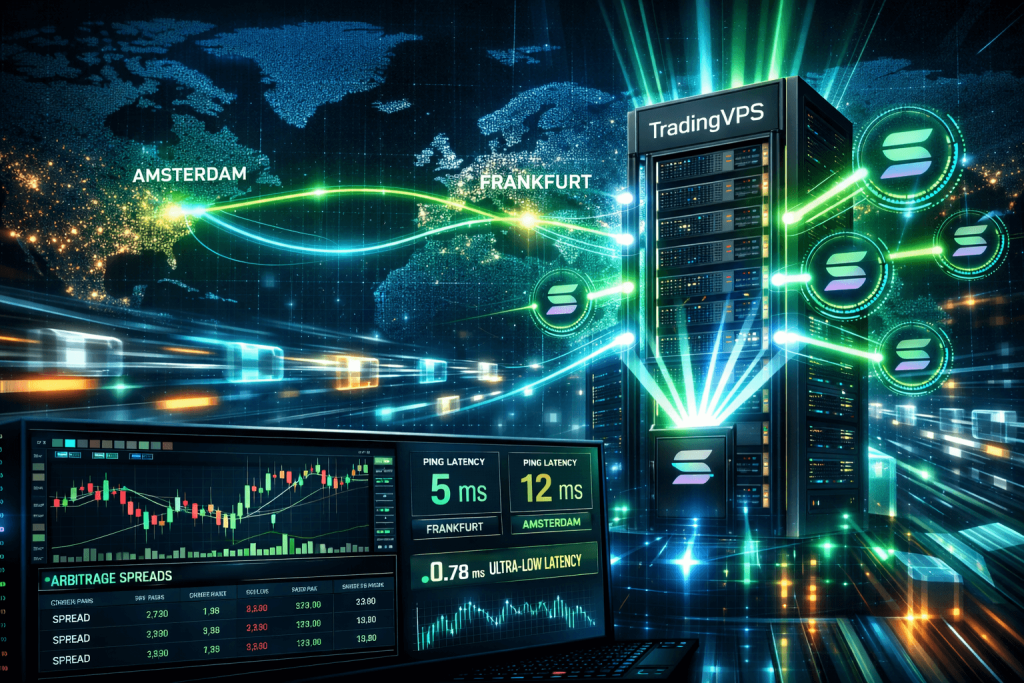
Our infrastructure in Amsterdam and Frankfurt is optimized to deliver the lowest possible round-trip latency to major Solana RPC nodes and validator clusters — giving your bot the competitive edge it needs.
Strategic Data Center Locations: Amsterdam & Frankfurt
Solana validators and premium RPC providers heavily operate within European data hubs. That’s why TradingVPS deploys infrastructure in:
- Amsterdam (NL) – One of Europe’s largest internet exchange hubs (AMS-IX), offering extremely fast routing to Solana validator clusters.
- Frankfurt (DE) – Home to DE-CIX, one of the world’s biggest internet exchanges, ensuring premium peering and minimal packet travel time.
Why this matters:
Physical proximity reduces network hops. Fewer hops mean lower latency. Lower latency means your transaction reaches validators faster — critical for:
- Sniper bot token launches
- Copy trading reaction speed
- Arbitrage spread capture
Our clients consistently experience single-digit millisecond ping times to major Solana RPC endpoints, significantly reducing total transaction latency.
High-Performance Hardware Designed for Trading
We don’t use generic cloud configurations. TradingVPS servers are tailored for high-frequency and blockchain trading workloads.
Key Infrastructure Features:
- High clock-speed AMD Ryzen 9 9950X CPUs (optimized for single-thread performance)
- NVMe SSD storage for ultra-fast read/write operations
- DDR4/DDR5 RAM for smooth multi-thread execution
- Dedicated resources (no noisy neighbor issues)
- Premium Tier-1 network routing
- 24/7 uptime monitoring
Why it matters for your bot:
Solana trading strategies require instant processing of mempool data, rapid signature generation, and fast broadcasting. CPU spikes or slow disk I/O can add invisible milliseconds — and invisible milliseconds cost real money.
Ultra-Low Network Latency to Solana Nodes
Our Amsterdam and Frankfurt VPS instances are engineered with optimized routing paths to major Solana RPC providers and validator clusters.
Performance Advantages:
- Reduced packet propagation delay
- Lower jitter (consistent latency)
- Faster transaction submission
- Improved WebSocket stream stability
For arbitrage bots especially, consistency is just as important as raw speed. A stable 3ms latency is far more valuable than fluctuating 2–15ms performance.
Stability for 24/7 Automated Trading
Solana markets never sleep — and neither should your infrastructure.
TradingVPS ensures:
- High uptime SLA
- DDoS protection
- Automatic network monitoring
- Scalable resources as your bot grows
This means your bot can operate continuously without performance degradation during high-volume market events.
Built for Developers & Advanced Traders
Whether you’re coding in Rust, C++, Go, or running hybrid Python execution engines, our VPS environments support:
- Custom OS configurations
- Low-level system tuning
- Dedicated IPs
- Secure remote access
- Full root control
Developers appreciate the flexibility. Traders appreciate the speed. Both appreciate the results.
The Bottom Line: Latency = Profit
When calculating your total Solana transaction latency:
Total Latency = RPC Delay + Network/VPS Delay + Code Execution Time
By hosting in Amsterdam or Frankfurt with TradingVPS, you drastically reduce the network component — one of the most controllable latency factors.
In high-speed environments like:
- Sniper trading
- Arbitrage bots
- Copy trading systems
The fastest infrastructure often wins the trade.
Final Notes: Latency = Profit in Fast Markets
For Solana bots, latency isn’t just technical jargon — it’s money. A tiny delay can be the difference between capturing an arbitrage loop or watching it vanish.
Here’s a quick checklist:
- Pick an RPC provider with low P95 latency and strong throughput
- Host your bot on low-latency VPS near Solana nodes (Frankfurt/Amsterdam)
- Optimize your code with compiled languages for execution logic
- Measure each part of your pipeline and remove bottlenecks
Frequently Questions
For competitive trading strategies like arbitrage or sniper bots, under 100ms total infrastructure latency (excluding block time) is considered strong.
A well-optimized setup typically includes:
– 10–50ms RPC latency
– 1–5ms VPS network latency (if hosted in Amsterdam or Frankfurt)
– Under 20ms code execution time
Since Solana’s average slot time is around ~400ms, reducing your infrastructure latency ensures your transaction is submitted early within that slot rather than late.
Total transaction latency is calculated as:
Total Latency = RPC Round Trip + VPS Network Delay + Code Execution Time + Blockchain Propagation Time
Yes — significantly.
Hosting your bot in Amsterdam or Frankfurt reduces physical distance to major Solana validators and premium RPC nodes.
To minimize latency:
✔ Use a premium or dedicated RPC provider
✔ Host your VPS in Amsterdam or Frankfurt
✔ Optimize your code with compiled languages
✔ Use WebSockets instead of polling
✔ Reduce unnecessary API calls
Continuous benchmarking is essential for maintaining a competitive edge.