Whether you trade futures, cryptocurrency, forex, or prediction markets, execution speed and system stability now play a major role in trading performance. As more traders automate strategies and run platforms continuously, VPS trading infrastructure has become a core part of professional trading setups.
In 2026, many active traders no longer run trading platforms from home computers. Instead, they use low-latency VPS servers located near major financial exchanges and trading infrastructure.
This guide explains what VPS trading is, why traders use it, and how low-latency VPS infrastructure improves execution quality, uptime, and trading reliability.
What Is VPS Trading?
VPS trading refers to running trading platforms, trading bots, or algorithmic systems on a Virtual Private Server (VPS).
A VPS is a remote cloud-based computer that stays online 24/7 inside a professional datacenter. Traders connect to the VPS remotely and use it to run:
- NinjaTrader
- MetaTrader 4 (MT4)
- MetaTrader 5 (MT5)
- TradeStation
- Sierra Chart
- Tradovate
- MultiCharts
- TradingView automation
- crypto trading bots
- futures trading systems
- arbitrage bots
- API-based trading software
- …
Unlike a home PC, a VPS is designed for continuous uptime, stable internet connectivity, and low-latency execution.
Why Traders Use VPS Infrastructure
There are several reasons why traders move to VPS infrastructure.
1. Lower Latency
Latency is the time required for trading data and orders to travel between your system and the broker or exchange.
Lower latency can improve:
- order execution speed
- slippage reduction
- queue priority
- market-making efficiency
- hedge timing
- arbitrage execution
- bot responsiveness
This is especially important for:
- futures trading
- scalping
- high-frequency trading
- automated execution
- Polymarket trading
- crypto market-making
Professional trading VPS providers place servers close to exchange infrastructure.
For example:
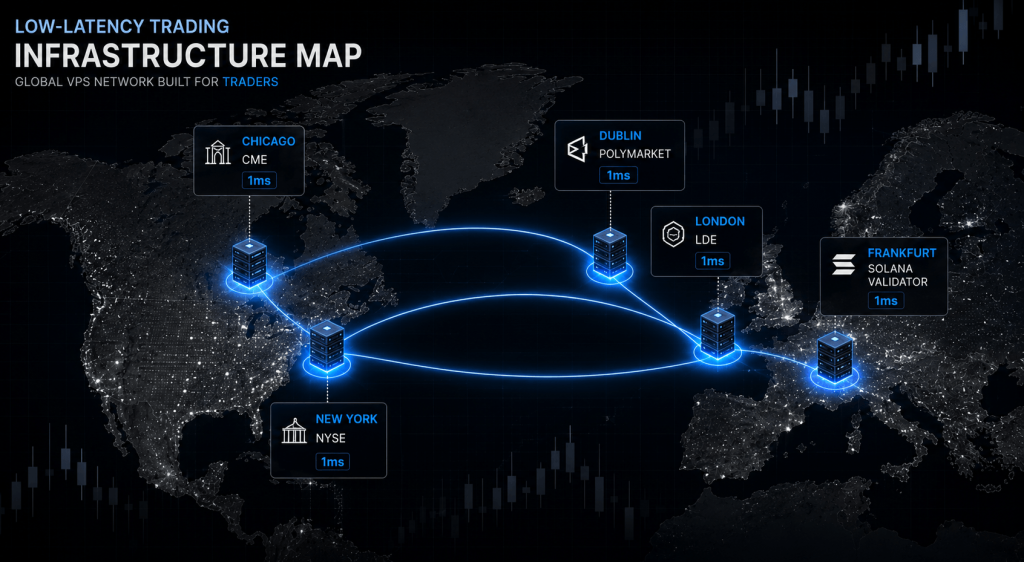
- Chicago VPS locations are often used for CME futures trading
- Dublin VPS locations are commonly used for Polymarket infrastructure
- Frankfurt VPS servers are frequently used for crypto trading systems
2. 24/7 Trading Uptime
Home internet connections and personal computers are not designed for uninterrupted trading operations.
A trading VPS allows strategies to continue running even if:
- your local PC shuts down
- electricity fails
- your internet disconnects
- Windows updates restart your machine
- you travel away from home
This is critical for:
- automated strategies
- copy trading
- funded account trading
- overnight futures positions
- crypto bots
- VPS-hosted APIs
Professional VPS datacenters provide redundant power systems, backup networking, and enterprise-grade infrastructure.
3. Better Stability for Trading Platforms
Many trading platforms become unstable when running continuously on overloaded home systems.
Trading VPS environments typically offer:
- dedicated CPU resources
- fast NVMe SSD storage
- DDR5 memory
- optimized Windows Server environments
- lower background system load
This improves platform responsiveness and reduces freezes during volatile market conditions.
4. Remote Access From Anywhere
A VPS allows traders to access their trading environment from:
- desktop computers
- laptops
- tablets
- mobile devices
This is useful for traders who travel frequently or monitor positions while away from their primary workstation.
VPS Trading for Futures Traders
Futures traders are among the biggest users of low-latency VPS infrastructure.
Platforms like NinjaTrader and Tradovate benefit significantly from low-latency routing to CME infrastructure.
Many professional futures traders choose Chicago VPS servers because they are geographically close to CME exchange infrastructure in Aurora, Illinois.
Benefits include:
- lower execution latency
- improved fill consistency
- reduced slippage
- more stable Rithmic and CQG connectivity
- better performance during high-volatility events
For short-term futures traders, latency can directly affect profitability.
VPS Trading for Algorithmic Trading
Algorithmic trading systems often require continuous uptime and fast execution.
Examples include:
- momentum bots
- spread trading systems
- arbitrage bots
- signal execution systems
- API-based strategies
- machine learning execution models
A VPS provides a controlled environment where these systems can operate continuously without interruption.
Many professional traders also separate:
- research systems
- execution systems
- data collection systems
across multiple VPS environments for better reliability.
VPS Trading for Polymarket
Prediction market trading has become increasingly competitive.
Polymarket traders now use automated systems for:
- market making
- event arbitrage
- BTC 5-minute markets
- hedge execution
- API-based prediction trading
Latency matters significantly in these markets because pricing can move rapidly during:
- economic releases
- elections
- breaking news
- social media events
Dublin VPS infrastructure is commonly used because it provides lower latency to Polymarket infrastructure compared to many US locations.
What To Look For in a Trading VPS
Not all VPS providers are optimized for trading.
When choosing a VPS for trading, traders should evaluate:
CPU Performance
Modern trading systems benefit from high-frequency CPUs such as:
- AMD Ryzen 9950X
- AMD Ryzen 7950X
Single-core performance is especially important for trading platforms.
Low-Latency Network Infrastructure
The provider should offer locations close to trading infrastructure.
Popular trading locations include:
- Chicago
- New York
- London
- Frankfurt
- Amsterdam
- Dublin
Fast Storage
NVMe SSD storage improves:
- platform responsiveness
- historical data loading
- chart rendering
- strategy startup speed
Reliability
Look for:
- 99.99% uptime
- DDoS protection
- enterprise datacenters
- redundant networking
- hardware monitoring
Human Support
Many traders are not infrastructure experts.
Responsive support becomes important when:
- configuring platforms
- troubleshooting latency
- migrating trading systems
- optimizing VPS performance
Is VPS Trading Worth It?
For casual investors, probably not.
For active traders, algorithmic traders, funded traders, and professional trading operations, a VPS is often worth the cost.
Even small improvements in:
- slippage
- uptime
- execution quality
- fill consistency
- bot stability
can compound significantly over time.
As trading becomes increasingly automated and competitive, infrastructure quality becomes a larger competitive advantage.
Final Thoughts
VPS trading is no longer limited to institutional firms.
Retail traders now use professional low-latency VPS infrastructure to improve execution speed, increase uptime, and run trading systems continuously.
Whether you trade futures, crypto, forex, or prediction markets, the right VPS environment can provide a more stable and professional trading setup.
For traders using automation, latency-sensitive strategies, or funded accounts, VPS infrastructure has become an important part of modern trading operations.
FAQ
VPS trading means running trading platforms or trading bots on a remote virtual server instead of a personal computer.
Yes. Many futures traders use low-latency Chicago VPS servers to improve connectivity to CME-related infrastructure and reduce execution delays.
Yes. NinjaTrader is commonly deployed on Windows VPS environments optimized for trading.
A VPS can improve execution consistency by reducing latency, improving uptime, and providing a more stable trading environment.
It depends on the market:
Chicago → Futures trading, Kalshi trading
Frankfurt, Amsterdam, New York → Crypto trading
New York, London, Amsterdam → Forex trading
Dublin, Amsterdam → Polymarket trading