
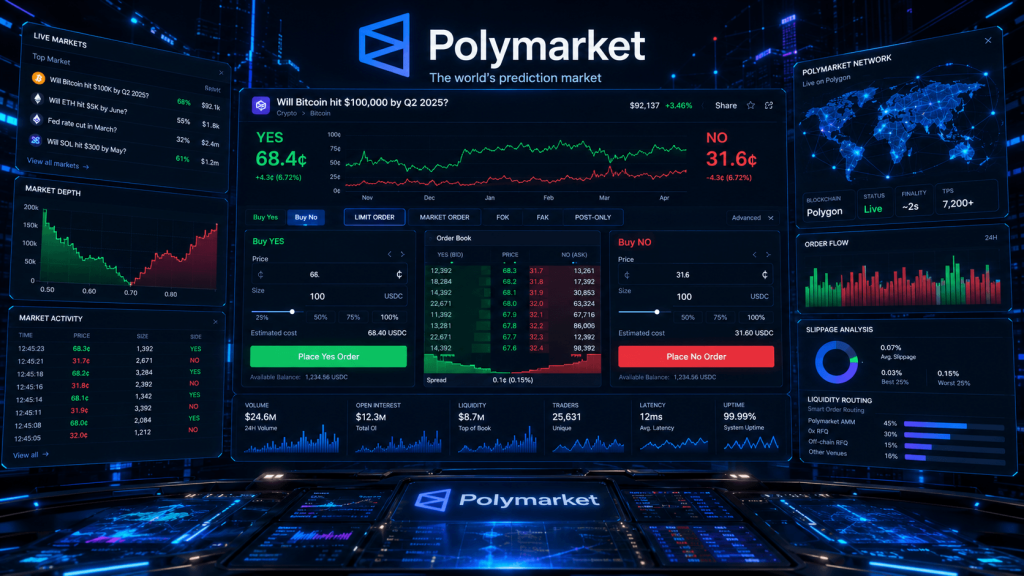
Trading on Polymarket is very different from trading on traditional cryptocurrency exchanges or stock market platforms. On most exchanges, traders focus primarily on price direction. But in prediction markets, execution quality plays an equally important role.
A trader can correctly predict the outcome of an event and still lose money because of:
- Poor order execution
- Slippage
- Low liquidity
- Incorrect order type selection
- Slow reaction during volatile market conditions
This is why understanding Polymarket order types is essential for both beginner and advanced traders.
Many users only understand the surface-level concepts of “market order” and “limit order”, but Polymarket’s architecture is actually much more sophisticated. The platform uses a central limit order book (CLOB) system where all trades are ultimately built on top of limit orders with different execution constraints.
In this guide, we will cover:
- How orders work on Polymarket
- The difference between market orders and limit orders
- What GTC, GTD, FOK, and FAK orders mean
- How post-only orders work
- Real trading scenarios for each order type
- Common execution mistakes traders make
- Advanced execution strategies used by professional traders
How Orders Work on Polymarket
Before discussing individual order types, it is important to understand how trading infrastructure works on Polymarket.
Unlike traditional centralized exchanges, Polymarket uses a hybrid model:
- Orders are created and signed off-chain
- Matching occurs through the order book
- Final settlement happens onchain
This design provides:
- Transparency
- Security
- Faster matching performance
- Lower settlement trust requirements
However, it also introduces several important execution mechanics that traders need to understand.
The Central Limit Order Book (CLOB)
Polymarket operates using a central limit order book system.
This means:
- Buyers place bids
- Sellers place asks
- Trades occur when prices match
Every market contains:
- YES shares
- NO shares
Prices range between:
- $0.00 and $1.00
The price represents the market-implied probability of an outcome occurring.
For example:
- YES at $0.72 implies roughly 72% probability
- NO at $0.28 implies roughly 28% probability
Why Execution Matters in Prediction Markets
Prediction markets behave differently from traditional asset markets because:
- Price movement is heavily event-driven
- Liquidity can disappear quickly
- Volatility spikes around news events
Because of this:
- Entry price matters enormously
- Slippage can significantly reduce profitability
- Order selection directly affects long-term performance
Professional traders often spend more time optimizing execution than predicting outcomes.
Limit Orders on Polymarket (Advanced Explanation)
Unlike simplified trading platforms that treat limit orders as just one optional feature, on Polymarket, limit orders are actually the foundation of the entire trading system.
Every order submitted to the platform is fundamentally a limit order with different execution conditions layered on top.
How Limit Orders Work
When placing a limit order:
- Traders define the exact price at which they are willing to buy or sell
- The order is submitted to the order book
- Execution only occurs if another trader accepts that price
For example:
Current YES price:
- $0.65
You place:
- Buy limit order at $0.60
Your order:
- Waits in the order book
- Executes only if sellers are willing to sell at $0.60
If the market never reaches your price:
- The order remains unfilled
Key Characteristics of Limit Orders
Limit orders:
- Provide complete price control
- Reduce slippage risk
- Can remain open for long periods
- May receive partial fills over time
- Add liquidity to the market
This makes them ideal for:
- Precision entries
- Passive trading strategies
- Market making
- Accumulating positions gradually
Strategic Advantages of Limit Orders
One of the biggest advantages of limit orders is execution discipline.
Instead of chasing price movement emotionally, traders:
- Define acceptable pricing in advance
- Allow the market to come to them
This becomes extremely important during:
- High-volatility events
- Thin liquidity conditions
- Large position entries
Even a few cents difference in prediction market pricing can significantly affect expected value over hundreds of trades.
When Limit Orders Work Best
Limit orders are highly effective in:
- Stable market conditions
- Range-bound trading environments
- High-liquidity markets
- Structured trading strategies
Professional traders commonly use layered limit orders to:
- Scale into positions gradually
- Reduce price impact
- Improve average entry price
Weaknesses of Limit Orders
Limit orders are not always ideal.
Problems can occur when:
- Markets move too quickly
- Liquidity suddenly disappears
- Price never reaches the order level
During breaking news events, traders using limit orders may:
- Miss entries completely
- Lose execution priority
Market Orders on Polymarket (Advanced Explanation)
Unlike traditional exchanges, Polymarket does not offer true native market orders.
Instead:
- Market behavior is simulated using aggressive limit orders combined with FOK or FAK execution logic.
This is a very important distinction because many traders incorrectly assume Polymarket behaves like a traditional crypto exchange.
How Market-Style Execution Works
To simulate a market order:
- Traders submit a limit order at an aggressively favorable price
- The system instantly matches available liquidity from the order book
For example:
- If YES shares are trading at $0.63
- A trader may place a buy order at $0.80
The system immediately fills against the lowest available asks.
As a result:
- The order behaves like a market order
Important Differences From Traditional Market Orders
Unlike traditional exchanges:
- Full execution is not guaranteed
- Price can vary depending on liquidity
- Large orders may experience severe slippage
- Thin markets can produce unpredictable fills
This means traders cannot blindly rely on “instant execution.”
Slippage Risk
Slippage occurs when:
- Execution price differs from expected price
This usually happens because:
- Available liquidity at the best price is insufficient
Large market-style orders may:
- Sweep multiple price levels
- Produce significantly worse fills
This is especially dangerous in:
- Low-volume markets
- Fast-moving political events
- Breaking news scenarios
When Market-Style Orders Are Useful
Despite the risks, aggressive execution remains important in:
- Momentum trading
- News-based trading
- Fast arbitrage opportunities
- Rapid exits during volatility
In these situations:
- Speed becomes more important than precision
GTC Orders (Good-Til-Cancelled)
GTC stands for:
- Good-Til-Cancelled
This means the order remains active until:
- Fully executed
- Or manually canceled
How GTC Orders Work
GTC orders:
- Rest on the order book
- Continue waiting indefinitely for matching liquidity
They are commonly used for:
- Long-term positioning
- Passive entry strategies
- Market making
Strategic Benefits of GTC Orders
GTC orders allow traders to:
- Pre-position around important probability levels
- Avoid emotional trading decisions
- Participate passively in the market
Many professional traders maintain:
- Multiple layered GTC orders simultaneously
This allows systematic scaling:
- Into positions
- Out of positions
GTD Orders (Good-Til-Date)
GTD stands for:
- Good-Til-Date
These orders automatically expire at a predefined time.
Why GTD Orders Matter
Prediction markets revolve around time-sensitive events.
Examples include:
- Elections
- Court rulings
- Economic announcements
- Sports outcomes
An order that makes sense before an event may become dangerous afterward.
GTD helps traders:
- Avoid stale exposure
- Automatically remove outdated orders
Common GTD Use Cases
GTD orders are especially useful for:
- Event-driven trading
- Overnight risk management
- Temporary liquidity positioning
Professional traders frequently use GTD orders around:
- CPI releases
- Federal Reserve meetings
- Debate events
- Election updates
FOK Orders (Fill-Or-Kill)
FOK stands for:
- Fill-Or-Kill
This order type must:
- Execute completely immediately
- Or cancel entirely
Why FOK Orders Are Important
FOK orders are designed for:
- Precision execution
- Large-size trading
- Arbitrage systems
They prevent:
- Partial fills
- Incomplete positioning
Real Example of FOK Usage
Suppose:
- YES shares trade at $0.47
- NO shares trade at $0.56
This creates a temporary pricing inefficiency.
An arbitrage trader may:
- Need full execution instantly
Partial execution could:
- Introduce unwanted directional exposure
- Eliminate profitability
This is why FOK is commonly used in professional trading systems.
FAK Orders (Fill-And-Kill)
FAK stands for:
- Fill-And-Kill
These orders:
- Execute as much as possible immediately
- Cancel the remaining unfilled portion
How FAK Differs From FOK
FOK:
- Requires complete execution
FAK:
- Allows partial execution
This makes FAK more flexible in lower-liquidity environments.
Why Traders Use FAK
FAK is commonly used for:
- Fast market entry
- Momentum trading
- Partial liquidity taking
It behaves similarly to a market order while reducing the risk of unwanted resting orders.
Real Trading Scenarios
Scenario 1: Breaking News Event
Best choice:
- FAK or aggressive market-style execution
Reason:
- Speed matters more than precision
Scenario 2: Range Trading
Best choice:
- GTC limit orders
Reason:
- Buy support
- Sell resistance
Scenario 3: Arbitrage Opportunity
Best choice:
- FOK orders
Reason:
- Requires guaranteed full execution
Scenario 4: Market Making Strategy
Best choice:
- Post-only GTC orders
Reason:
- Capture spread while providing liquidity
Common Mistakes Traders Make
Using Aggressive Orders in Thin Markets
This often leads to:
- Severe slippage
- Poor average fills
Ignoring Order Book Depth
Many traders:
- Focus only on current price
Instead, they should analyze:
- Available liquidity
- Nearby price levels
Overusing Market-Style Execution
Professional traders rarely chase price unnecessarily.
They prioritize:
- Efficient entries
- Risk-adjusted execution
Why Infrastructure Matters for Execution
Because Polymarket is:
- API-driven
- Order-book dependent
- Latency-sensitive
Execution quality heavily depends on:
- Network performance
- API latency
- Infrastructure stability
This becomes especially important for:
- Arbitrage bots
- High-frequency strategies
- Automated trading systems
Even small latency improvements can:
- Improve fill quality
- Reduce missed opportunities
- Increase long-term profitability
Final Thoughts
Understanding order types on Polymarket is far more important than most traders realize.
Prediction market success depends not only on:
- Predicting outcomes correctly
But also on:
- Executing efficiently
- Managing liquidity
- Choosing the right order type for the situation
At a professional level:
- Execution quality becomes a competitive edge
The traders who consistently succeed are usually the ones who:
- Understand order book dynamics
- Control slippage carefully
- Use the right execution strategy for each market condition
FAQs
Limit orders are generally safest because they provide complete price control.
FOK orders are preferred because they require full execution immediately.
Possible reasons include:
– Low liquidity
– Incorrect pricing
– Large spread
– Thin order book conditions
Slippage occurs when:
– Available liquidity at the expected price is insufficient
– Large orders move through multiple order book levels