Modern financial markets operate at extremely high speeds.
Whether you trade futures, forex, stocks, cryptocurrencies, or prediction markets, every trade depends on one critical factor:
Latency.
In electronic trading, even small delays can affect order execution, pricing, and trading efficiency. Professional firms spend millions of dollars optimizing infrastructure and reducing delays between traders and exchanges.
But latency is not only important for institutions.
Retail traders, algorithmic traders, and even beginners increasingly encounter latency-related issues when using online brokers, APIs, trading platforms, or cloud infrastructure.
This guide explains what latency means in trading, how it works, why it matters, and how traders can measure and improve it.
The goal is educational understanding — not marketing hype.
What Is Latency?
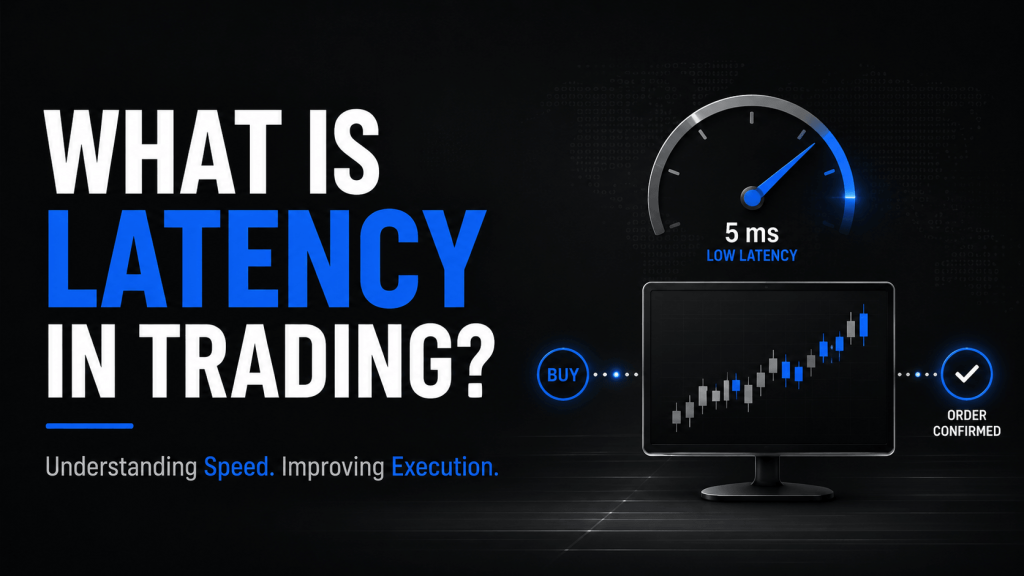
Latency is the amount of time it takes for data to travel from one point to another.
In trading, latency usually refers to the delay between:
- sending a trading request
- receiving market data
- executing an order
- receiving confirmation from the exchange or broker
Latency is commonly measured in milliseconds (ms).
One millisecond equals:
0.001 seconds.
Although milliseconds sound extremely small, electronic financial markets move very quickly. In some trading environments, delays of even a few milliseconds can affect execution quality.
A simple way to think about latency is:
Latency is the “travel time” of information.
Simple Analogy: Latency Like a Phone Call
Imagine speaking to someone on a satellite phone.
You say something.
A short delay occurs.
Then the other person hears it.
That delay is latency.
Trading systems work similarly.
When you click a buy or sell button, your request must travel:
- from your computer
- through your internet provider
- through multiple network routes
- to your broker
- to the exchange matching engine
The response then travels back.
All of this takes time.
Why Latency Matters in Trading
Latency affects how quickly traders receive information and execute orders.
In fast-moving markets, prices can change rapidly within milliseconds or seconds.
Lower latency can help traders:
- receive market updates faster
- reduce slippage
- improve execution consistency
- react to volatility more efficiently
- improve synchronization between systems
However, latency importance depends heavily on trading style.
When Latency Matters Most
Different trading strategies have different sensitivity to latency.
| Trading Style | Latency Importance |
|---|---|
| Long-term investing | Very low |
| Swing trading | Low |
| Manual day trading | Moderate |
| Scalping | High |
| Algorithmic trading | Very high |
| High-frequency trading (HFT) | Critical |
For example:
A swing trader holding positions for weeks may not care about a 50 ms delay.
A futures scalper trading short-term momentum may care significantly more.
A market-making algorithm may rely heavily on extremely low-latency infrastructure.
Types of Latency in Trading
Latency is not just one thing.
Several different delays exist within trading systems.
1. Network Latency
Network latency refers to the time required for data to travel across the internet or private networks.
This is often what traders mean when discussing “ping.”
Factors affecting network latency include:
- geographic distance
- internet routing
- fiber infrastructure
- network congestion
- ISP quality
- server location
Execution latency refers to how long it takes an order to process after reaching a broker or exchange.
2. Execution Latency
This may include:
- risk checks
- order validation
- exchange queue processing
- broker internal systems
3. Platform Latency
Trading software itself can introduce delays.
Examples include:
- overloaded charting software
- inefficient indicators
- slow plugins
- insufficient CPU resources
- memory bottlenecks
4. Data Feed Latency
Market data providers distribute price information to traders.
Sometimes market data arrives slightly delayed depending on:
- provider quality
- subscription level
- routing infrastructure
- server load
5. Human Reaction Latency
Humans also introduce latency.
Even professional traders require time to:
- interpret information
- move a mouse
- click a button
- make decisions
Human reaction time is usually much slower than computer execution speed.
How Trading Data Travels
When a trader places an order, the request travels through multiple systems.
Typical path:
Trader PC → ISP → Internet Backbone → Broker → Exchange → Matching Engine
Each step adds small delays.
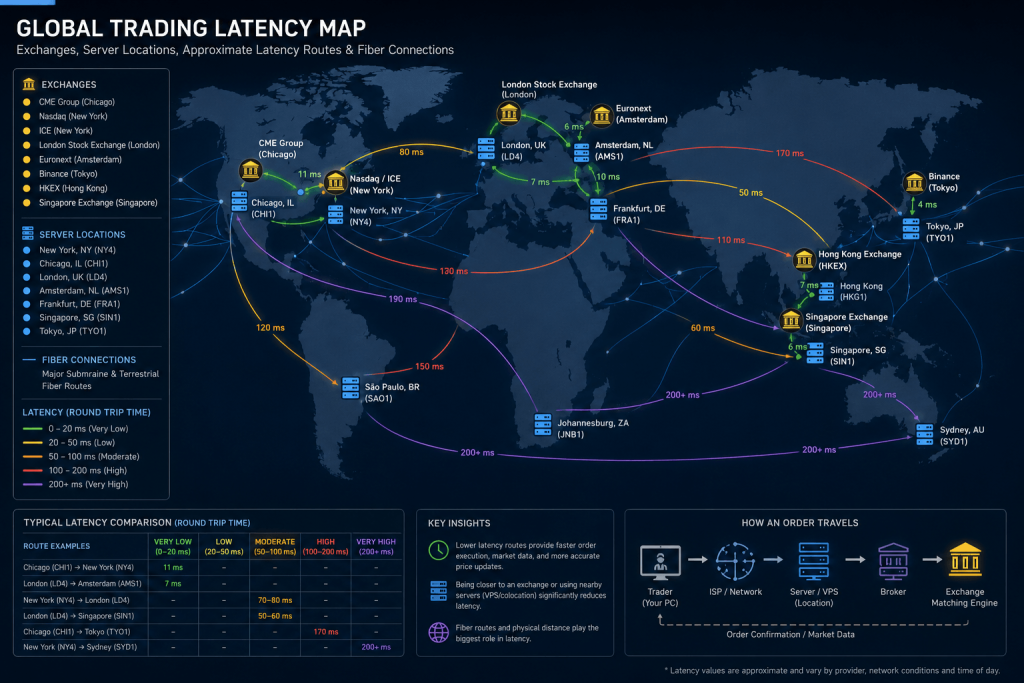
Even the physical distance between cities matters.
Geography and Latency
Physical distance strongly affects latency.
Data cannot travel instantly.
Information traveling through fiber optic cables is limited by physics and routing infrastructure.
For example:
- Chicago to New York generally has lower latency than Chicago to Tokyo
- London to Frankfurt is faster than London to Singapore
This is one reason professional trading firms often place servers near exchanges.
What Is Ping?
Ping is a basic network measurement tool.
It measures the time required for a small packet of data to travel to a server and back.
This is called:
Round-trip time (RTT).
Ping is usually measured in milliseconds.
Lower ping generally means lower network latency.
Example Ping Command (Windows)
ping google.com
Example output:
Reply from 142.250.72.14:
time=18ms
This means the round-trip communication took approximately 18 milliseconds.
How Traders Use Ping
Traders commonly use ping to:
- test broker connectivity
- compare VPS locations
- diagnose network issues
- evaluate routing quality
However, ping alone does not measure total execution quality.
It only measures network communication delay.
Real Trading Example: Futures Scalping
Imagine two futures traders trading short-term momentum during a major economic news release.
Trader A:
- home internet
- 80 ms latency
Trader B:
- professionally hosted infrastructure
- 5 ms latency
When prices move rapidly:
- Trader B may receive updates earlier
- orders may arrive sooner
- slippage may be reduced
This does not guarantee profitability.
But lower latency can improve execution efficiency.
Real Trading Example: Cryptocurrency Trading Bots
Crypto trading bots often rely on APIs.
Bots continuously:
- monitor prices
- send requests
- update positions
- manage risk
High API latency may cause:
- delayed entries
- stale prices
- missed arbitrage opportunities
- slower hedging
For algorithmic systems, latency becomes increasingly important.
Real Trading Example: Prediction Markets
Prediction markets can also be latency-sensitive during volatile events.
Examples:
- elections
- economic releases
- geopolitical news
- sports outcomes
During rapid price movements, delayed execution can impact fill quality.
What Causes High Latency?
Many factors contribute to latency.
1. Geographic Distance
Longer distances generally increase latency.
2. Poor Internet Routing
Internet traffic often takes indirect routes.
This can increase delays.
3. Wi-Fi Connections
Wireless connections may introduce instability and packet loss.
Wired Ethernet connections are usually more stable.
4. Network Congestion
Heavy traffic can slow communication.
5. Slow Hardware
Old CPUs or overloaded systems can increase delays.
6. Background Applications
Streaming, downloads, updates, and antivirus scans can interfere with trading performance.
7. Overloaded Trading Platforms
Too many indicators or charts may slow execution.
What Is Low-Latency Trading?
Low-latency trading refers to systems optimized to minimize delays.
Professional firms reduce latency using:
- colocated servers
- optimized fiber routes
- direct market access
- specialized hardware
- high-performance networking
Retail traders typically use simpler approaches such as:
- stable internet
- optimized computers
- nearby server infrastructure
- VPS hosting
VPS Infrastructure and Trading
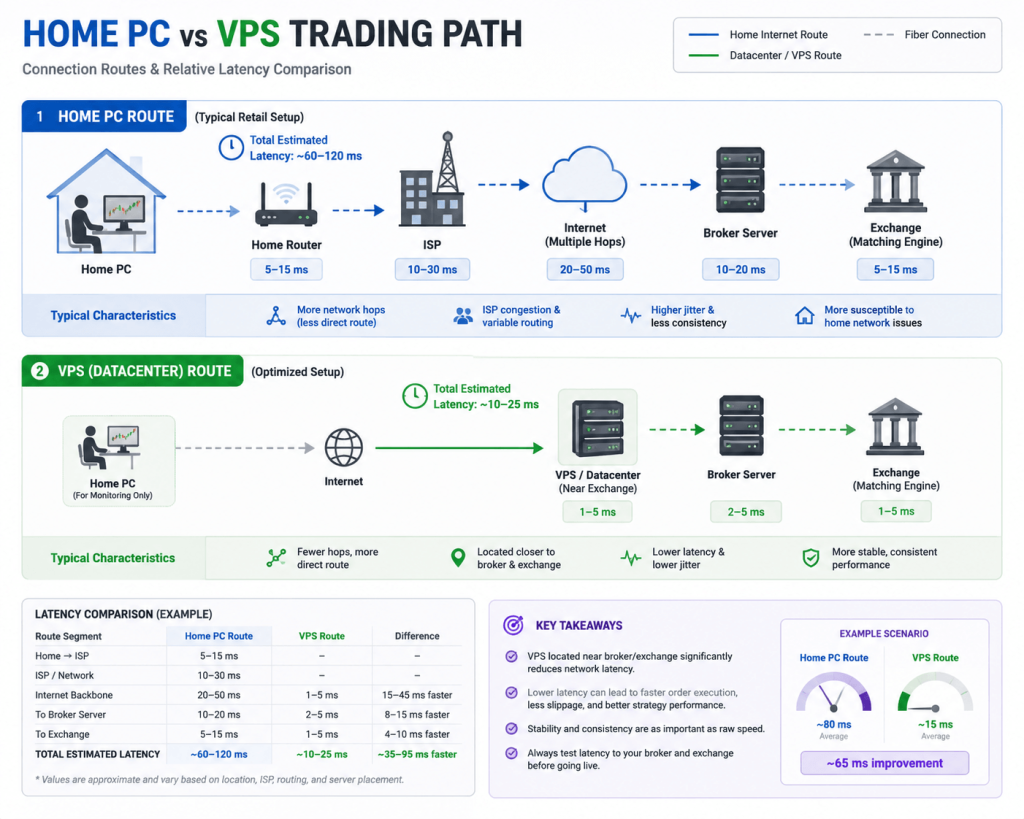
Some traders use VPS (Virtual Private Server) infrastructure to improve consistency and reduce latency.
A VPS is a remotely hosted server running in a datacenter.
Benefits may include:
- stable internet connectivity
- lower geographic distance to exchanges
- 24/7 uptime
- reduced home network interruptions
For example:
A futures trader may prefer infrastructure located closer to major exchange hubs.
A crypto trader may choose infrastructure near exchange API regions.
The goal is usually consistency and reliability rather than “magic speed.”
How to Measure Latency
Several tools can help traders measure latency.
1. Ping
Basic connectivity testing.
ping example.com
2. Traceroute
Shows routing path between systems.
Windows:
tracert example.com
Linux:
traceroute example.com
3. PathPing
Combines ping and traceroute analysis.
pathping example.com
4. PowerShell Latency Test
Test-NetConnection google.com
5. Continuous Ping
Useful for monitoring instability.
ping -t example.com
Press:
CTRL + C
to stop.
| Command | Purpose |
|---|---|
ping | Measure latency |
ping -t | Continuous monitoring |
tracert | Show routing path |
pathping | Advanced route analysis |
ipconfig | View network settings |
Test-NetConnection | PowerShell connectivity test |
Understanding Ping Results
General interpretation:
| Ping | Quality |
|---|---|
| 1–5 ms | Extremely low |
| 5–20 ms | Excellent |
| 20–50 ms | Good |
| 50–100 ms | Moderate |
| 100+ ms | High |
Actual acceptable latency depends on trading style.
Latency vs Bandwidth
Many beginners confuse latency with bandwidth.
They are different.
Bandwidth:
- amount of data transferable
Latency:
- speed of communication
A fast internet plan with high bandwidth can still have poor latency.
Why Lower Latency Does Not Guarantee Profitability
This is one of the biggest misconceptions in trading.
Lower latency improves infrastructure quality.
It does not create profitable strategy logic.
A losing strategy remains a losing strategy even with extremely fast execution.
Professional trading success still depends on:
- risk management
- strategy quality
- discipline
- market understanding
- execution consistency
Common Latency Myths
Myth 1: Lower Ping Always Means More Profit
Not necessarily.
Strategy quality matters more.
Myth 2: Home Internet Is Always Bad
Some home connections are excellent.
Myth 3: VPS Automatically Creates HFT Performance
Professional HFT infrastructure is vastly more complex.
Myth 4: Latency Only Matters for Institutions
Retail traders can also benefit from stable infrastructure.
Beginner Tips to Reduce Latency
Use Wired Ethernet
Avoid Wi-Fi when possible.
Close Background Applications
Reduce unnecessary CPU and bandwidth usage.
Keep Trading Platforms Optimized
Too many indicators can slow systems.
Choose Nearby Infrastructure
Geographic proximity may help reduce latency.
Restart Systems Regularly
Long-running systems may accumulate issues over time.
Monitor Connection Stability
Consistency matters as much as raw speed.
Troubleshooting High Latency
Problem: Ping Suddenly Increased
Possible causes:
- ISP congestion
- routing issues
- exchange traffic spikes
Problem: Packet Loss
Symptoms:
- lag
- disconnects
- unstable execution
Possible fixes:
- reboot router
- use Ethernet
- contact ISP
Problem: Trading Platform Feels Slow
Possible causes:
- overloaded indicators
- insufficient RAM
- CPU bottlenecks
Problem: VPS Latency Increased
Possible causes:
- network routing changes
- datacenter congestion
- exchange-side delays
- contact support
FAQ
It depends on trading style.
Long-term traders may not care about latency.
Scalpers and algorithmic traders often prefer lower latency.
Usually not significantly.
Execution speed is generally less critical for longer holding periods.
Not necessarily.
For many retail traders, 100 ms is still usable.
For high-frequency strategies, it may be considered slow.
Ping measures network communication delay between systems.
Sometimes.
A VPS located closer to exchanges or broker infrastructure may improve consistency and reduce network delays.
Lower latency generally improves communication speed.
But trading success depends on many additional factors.
Glossary
API
Application Programming Interface used for software communication.
Bandwidth
Maximum amount of transferable data.
Colocation
Hosting infrastructure physically near exchanges.
Execution
The completion of a trade order.
Latency
Delay in communication between systems.
Matching Engine
Core exchange system that matches buy and sell orders.
Ping
Round-trip network communication measurement.
Round-Trip Time (RTT)
Total time required for data to travel to a destination and back.
Slippage
Difference between expected and actual execution price.
VPS
Virtual Private Server hosted in a datacenter.
Conclusion
Latency is one of the foundational concepts of modern electronic trading.
It affects how quickly information travels between traders, brokers, exchanges, and market infrastructure.
For some traders, latency has minimal importance.
For others — especially short-term and algorithmic systems — it can significantly affect execution quality and consistency.
Understanding latency helps traders make better decisions about:
- infrastructure
- connectivity
- platform optimization
- server location
- execution expectations
Most importantly, traders should remember:
Lower latency is a tool — not a guarantee of trading success.
Strong risk management, disciplined execution, and sound strategy design remain far more important over the long term.