For years, automated trading was all about retail trading platforms, such as MetaTrader, NinjaTrader, and cTrader. Traders would buy an Expert Advisor (EA), load it on a Windows VPS, and wait for trades to be sent automatically throughout the day.
The best trading bots today are built as custom applications using Python, C++, Rust, Go, or Node.js. Rather than using charting software, these bots connect with exchanges and brokers via APIs, analyze the real-time market information, and execute trades automatically with very little human involvement.
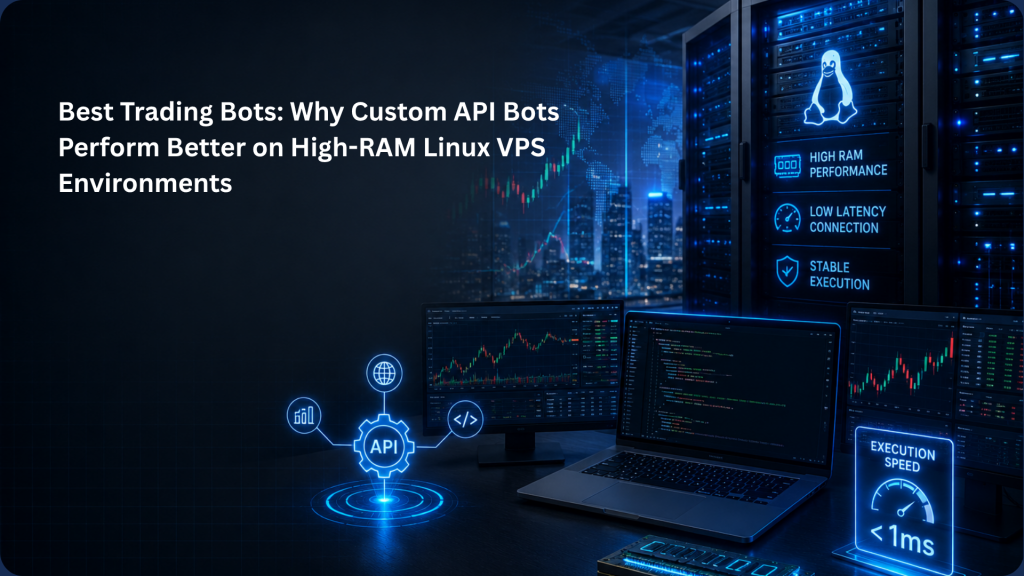
With the evolution of these systems, Linux has become the operating system of choice. When paired with a high-RAM VPS near the exchange nodes, Linux can deliver the stability, flexibility and performance demanded for modern algorithmic trading.
But why is it that professional traders prefer to use Linux over Windows? In what way do custom API bots require so much memory? And why can a properly configured Linux VPS outperform a much more expensive Windows server?
This guide explains the infrastructure behind professional trading bots and why a Linux VPS is the preferred choice for serious algorithmic traders.
Retail Trading Bots vs Custom API Trading Bots
The majority of retail trading platforms contain charts, indicators, order windows, drawing instruments, notifications, and graphical dashboards, which make it easier to trade manually.
Custom API bots are built in a completely different manner. Rather than interacting with charts, they communicate directly with the broker/exchange infrastructure using:
- REST APIs
- WebSocket connections
- FIX Protocol
- Proprietary broker APIs
This eliminates some of the redundant software between the exchange and the trading strategy. Unlike a trading platform, which might need to process market data and update charts before submitting orders, the bot provides real-time updates of the price data, makes calculations, and submits orders straight to the exchange.
This provides the developer with full control of:
- Order execution
- Risk management
- Position sizing
- Portfolio management
- Multi-exchange trading
- Strategy customization
Many custom systems can be the best trading bots for advanced quantitative trading, particularly for professional traders.
The Hidden Performance Cost of Graphical Trading Platforms
Trading platforms such as MT4, MT5, TradeStation, and NinjaTrader offer trading based on graphical user interfaces (GUIs). Windows is constantly redrawing visual objects in the background for all charts, watchlists, notifications, and indicators.
In times of high volatility, Windows has to allocate CPU resources to update charts, run desktop services, etc., at the same time your trading platform is trying to process hundreds or thousands of incoming market events.
This extra work is sometimes referred to as the GUI Tax. While each separate task may be small, they add up to precious CPU cycles and system memory that could be devoted solely to the trading logic.
This overhead may not be apparent to retail traders. On the other hand, for algorithmic traders who make hundreds of API calls per second, every unnecessary process counts.
Why Linux Eliminates the GUI Tax?
Typically, professional API bots operate in a headless Linux operating system such as Ubuntu Server or Debian.
There is no desktop environment on a headless server. There are:
- No charts
- No graphical windows
- No background animations
- No desktop rendering
- No unnecessary visual services
Rather, all available resources are focused on:
- Receiving market data
- Running trading algorithms
- Processing calculations
- Managing network connections
- Executing orders
This enables Linux VPS environments to be much more predictable during high-volume trading sessions.
Linux Is Built for High-Performance Networking
A modern trading bot can simultaneously keep dozens of WebSocket connections and communicate with multiple exchanges. Because of its very efficient networking architecture, Linux has always been preferred over other operating systems for these workloads.
An important feature is epoll, which is a Linux event notification system that makes it possible to handle thousands of simultaneous network connections without consuming a lot of CPU power.
For instance, a crypto arbitrage bot can stream at the same time:
- Binance order books
- Bybit futures prices
- Kraken spot markets
- Coinbase liquidity
- Broker risk feeds
The Linux operating system manages all these data streams concurrently with very little overhead, thus making it a good choice for custom API trading.
High RAM Matters More Than CPU Speed
Most beginners think that if they get the most powerful processor, then they will have a faster trading system. In practice, RAM is often the first thing to be limiting, rather than CPU capacity.
Many modern algorithmic trading strategies churn through huge amounts of real-time data all the time. While retail platforms get simplified bids and ask prices, custom bots can often build market structures within memory.
If there is not enough RAM, the execution performance soon starts to degrade.
1. In-Memory Order Book Mapping
Professional crypto trading systems are connected to Level 2 or Level 3 market data via WebSocket.
These feeds provide all of the following:
- New order
- Order modification
- Cancellation
- Bid update
- Ask update
- Volume change
The trading bot doesn’t ask for market depth from the exchange again and again, but rather builds a full order book on its own, in memory. With multiple exchanges monitored at the same time, memory usage increases quickly.
When VPS has no more RAM, processing slows down, and the bot starts processing stale market information.
2. Python’s Data Science Ecosystem Consumes Memory
Python is now the top programming language for quantitative trading. The downside is that Python is memory-intensive.
For large data sets, all the data is generally loaded into RAM before calculations are made.
For instance, a strategy can consider the following at once:
- Tick history
- Order flow
- Volatility
- Market correlations
- Liquidity changes
- Historical execution quality
These data sets are stored in memory and can be accessed much faster than reading them from storage.
This has a significant impact on processing speed, but it also demands more RAM. With sufficient RAM, memory pressure will be lower, and execution will be smoother during volatile markets.
3. Redis Keeps Trading Data in Memory
Professional trading systems will not write constantly changing market information directly to storage. Redis is an in-memory database that provides extremely fast data access and is widely used by many developers. It serves as a communications link or bridge between various portions of the trading infrastructure.
For example:
- One service is used for WebSocket market data.
- Redis stores the most up-to-date prices in memory.
- The signal engine immediately reads those prices.
- Trading instructions are sent to the execution engine without waiting to query the database.
This architecture is one of the reasons that many professional trading firms choose to deploy Linux VPS environments with 16 GB, 32 GB, or 64 GB of memory rather than focusing on the speed of the processor.
Common Linux VPS Mistakes That Kill Trading Performance
Just renting a Linux server and installing Python is not sufficient. Many traders switch to custom API bots only to discover that their execution isn’t as fast as it was on MetaTrader, due to poor server configuration.
Mistake 1: Relying on Swap Space
If the system has no more physical memory, Linux will use ‘Swap,’ a hard-drive partition set aside for overflow memory.
Swap is the end of the road for a trading bot. If your server has to swap your trading algorithm to disk during a sudden market move, you’ll add hundreds of milliseconds of latency to your algorithm’s performance.
- The Fix: Always over-provision physical RAM! Switch off Swap completely (swapoff -a) in Linux kernel configuration so that the server is compelled to operate in RAM only, or set vm.swappiness to almost 0.
Mistake 2: Ignoring Clock Drift (NTP Sync)
APIs used by cryptocurrency exchanges are time-sensitive and use strict cryptographic timestamps to avoid replay attacks. However, if your own Linux server’s clock is even a few hundred milliseconds off from the exchange’s server, your API requests will be rejected outright with a “Timestamp out of bounds” error.
- The Fix: Avoid default time settings. Install and configure a high-precision Network Time Protocol (NTP) daemon, or Chrony, and connect to a stratum 1 time server that is geographically near your VPS.
Why a “Fast” VPS Doesn’t Always Mean Better Performance?
A fast server located in Dallas is useless if you are executing trades on a matching engine in Tokyo. TradingVPS provides traders with various locations around the world, allowing them to select a server closer to their broker or exchange to minimize latency issues.
The Myth of Raw Speed
In API trading, your script will interact with the broker’s matching engine directly through HTTP requests (for orders) and WebSockets (for data).
If your VPS is located outside of the exchange region, you’ll be subject to fiber-optic network latency. The time it takes for light to travel from New York to London is about 65 milliseconds. This is a physical constraint and can’t be overcome by any amount of RAM or CPU power.
Routing vs. Proximity
Even when you’re using a VPS in the same city as the exchange, generic cloud providers use cheap, convoluted network routing (peering). Your data packet could go through three different consumer ISP hubs before arriving at the exchange.
- The Optimization: Opt for a specialized trading VPS provider with explicit data center colocation. When you trade crypto at Binance, you want your Linux VPS to be in AWS Tokyo, where their main matching engine is. Traders using a FIX API with a prime broker in London should ensure that their VPS is located in the Equinix LD4 data center, with access through premium financial cross-connects.
Real-World Setup: Structuring a Professional Linux Environment
A professional API trading environment is not about having all of the components in one application, but about isolation, reliability, and monitoring. This is the type of environment many Professional traders build on a high-performance Linux VPS from TradingVPS.
| Component | Tool / Technology | Purpose in the Trading Stack |
| Operating System | Ubuntu Server 22.04 LTS | Provides a stable, headless, long-term supported base with no GUI overhead. |
| Process Manager | PM2 or systemd | If the script crashes or the server is rebooted, the bot will automatically restart within seconds. |
| Containerization | Docker | Separates the trading logic from the data-ingestion logic, so that a memory leak in one script doesn’t bring down the other. |
| Data Broker | Redis | An ultra-fast, in-memory data broker that serves as a bridge to pass price ticks from the WebSocket script to the execution algorithm. |
| Monitoring | Prometheus + Grafana | Real-time monitoring of infrastructure bottlenecks, such as VPS RAM usage, API ping latency, and CPU load. |
Conclusion
The future of automated trading is shifting from the traditional desktop platforms to tailor-made API-driven solutions built for today’s financial markets.
The advantages of Linux are its lightweight operating system, its robust networking features, the flexibility of automation tools, and the support of modern programming languages. When paired with a high-RAM VPS server that is positioned near exchange infrastructure, it provides the setting required to cope with enormous data volumes, keep up a live order book, and carry out strategies with higher consistency.
TradingVPS is designed particularly for algorithmic traders that require regular performance for custom API bots. With AMD Ryzen™ 9 9950X processors, DDR5 RAM, ultra-fast NVMe storage, and strategically located data centers, it delivers the stable Linux environment that is essential for Python, C++, Node.js, Docker, Redis, and other modern trading technologies.
Frequently Asked Questions
Linux provides reduced system overhead, efficient networking, great automation features, and compatibility with programming languages like Python, C++, Go, and Node.js. These benefits make it a good candidate for API-based algorithmic trading.
Simple API bots can use 4-8 GB of RAM, but systems with multiple exchanges, level 2 market data, machine learning models, or large amounts of historical data may need to use 16 GB, 32 GB, or more.
Yes. If the CPU, RAM, and storage are adequate, a Linux VPS can be used for running several trading bots. Containers and/or separate services can isolate workloads and increase stability.
Platforms like MetaTrader and NinjaTrader still use Windows. For custom API bots designed to run without a GUI and directly interact with exchanges or brokers, Linux might be more appropriate.
Traders should also consider factors like VPS location, network routing quality, latency to the brokers/exchanges, storage performance, uptime guarantees, and monitoring capabilities.