The futures market is breaking records almost every month. CME Group finished 2025 with its highest-ever average daily volume of 28.1 million contracts, then came back with a vengeance in May 2026, with an average daily volume of 33.2 million contracts. That growth is driven by a lesser-known trend: retail traders are now trading big money using proprietary trading firms. This means that the best trading bots need to do things differently.
How Prop Firms Changed the Rules of the Game?
During 2025 and 2026, there was a paradigm shift in terms of volume and the behavior of market participants in the futures market, especially the Chicago Mercantile Exchange (CME).
Two factors helped this evolution: institutional liquidity improvement in benchmark indices such as the S&P 500 (ES) and Nasdaq 100 (NQ), and the skyrocketing of proprietary trading firms.
The proprietary trading firms (also called prop firms) have transformed retail futures trading. These firms have democratized access to the markets by enabling traders to manage their own capital after passing an evaluation phase. But with this capital comes institutional risk restrictions like trailing max drawdowns, daily loss limits, and consistency rules.
The companies that made it through the recent changes in market conditions tightened their rules. Many transitioned from intraday drawdown monitoring to monitoring drawdowns at EOD, so that your risk limit is only updated at the end of the trading day. Others imposed consistency rules, such as no more than 30-40% of the total profit may be generated on any one day before a payout is approved.
What Passing an Evaluation Actually Requires Now?
Here’s the problem: most retail bots were never built to check for this. A bot can make an excellent strategy and still end up failing an evaluation due to one lucky trading day that violated a consistency rule that the algorithm didn’t ensure. The top trading bots in 2026 use the firm’s rule set as a real-time input and dynamically reduce position sizing if a day’s profit is at risk of causing a consistency violation. They will need characteristics such as:
- EOD drawdown awareness: The bot re-evaluates its risk ceiling at the end of the session, according to the firm’s own rule, and not some kind of generic trailing stop.
- Consistency-rule throttling: Adjusts position size when a given day’s profit is close to the firm’s daily profit limit.
- Rule-set switching: If a trader is using different rule sets for two or three firms, they will need a bot that uses each firm’s limits.
Beyond the Win Rate: The Metrics Quants Actually Use
The biggest mistake retail traders make is evaluating a trading algorithm based solely on its “win rate” or absolute net profit in a backtest.
Any bot can be programmed to achieve a 90% win rate through large stop losses and small take profits, which is what the professional quantitative analysts know. To spot the best trading bots, you need to consider risk-adjusted returns and statistical robustness.
1. Sharpe and Sortino Ratios
The Sharpe ratio is an indicator of a bot’s performance relative to a risk-free asset, which takes into account the bot’s risk. A Sharpe ratio of over 1.5 means that the bot’s returns are coming from a true trading advantage and not from too much volatility. But quants like the Sortino ratio better, since it only punishes downside volatility. If an algorithm experiences large upside moves with low drawdowns, the Sortino ratio can correctly capture the algorithm’s dominance.
2. Recovery Factor
The Recovery Factor is the bot’s highest historical drawdown divided by the total net profit. When an algorithm makes $50,000 in profit with a $25,000 drawdown, that’s a recovery factor of 2.0. Premium algorithms typically have a recovery factor of 3.0 or above, which demonstrates that the system can quickly and efficiently overcome the inevitable losing streaks.
3. Surviving the “Curve Fitting” Trap
A curve fit is when a developer over-optimizes a bot’s parameters to precisely fit historical market data. In real-time trading, a curve-fitted bot will be immediately ineffective, as it was essentially learning from the past and not identifying some underlying universal market principle.
The best trading bots are tested using Out-of-Sample (OOS) testing and Monte Carlo simulations. The more important test is to observe the degree of correlation between live performance and the backtest in the first 60-90 days:
- Live-to-backtest divergence is the difference between what the strategy forecasted and the results that it actually achieved after real spreads, real fills, and real latency were introduced. The small stable gap indicates that the strategy is a good representation of the market. A gap that widens month over month usually means the original backtest leaned on data the live market can’t reproduce.
- Walk-forward validation takes this a step further. The data is divided into rolling windows: train on one window, validate on the next window, and then move forward and repeat. A strategy that performs over multiple time frames is much more compelling than one that’s optimized to a specific favorable price period.
Institutional Risk Controls You Can’t Ignore
The primary difference between amateur retail scripts and institutional algorithms is how they handle failure. Automated systems have to be programmed defensively for API disconnects, flash crashes, and black swan liquidity vacuums.
- Dynamic ATR Position Sizing
Fixed lot sizing is not efficient. Higher-level futures bots use dynamic position sizing that is calculated from the Average True Range (ATR) of the asset. When the market volatility increases, e.g., in the case of a VIX spike, the bot automatically decreases the number of contracts it deals with to keep the fractional risk (e.g., 1 percent of account equity per trade) unchanged.
- Server-Side API Stop-Losses
Each and every order that is created by a trading algorithm should be accompanied by a hard stop-loss and should be sent to the broker’s matching engine at the exact millisecond of entry. If the bot is able to execute stop-loss orders internally (client-side) and your server goes down, the position is totally unprotected in the live market.
Proprietary trading firms impose a daily loss limit, so the bot itself should also have a programmatic kill switch. Once the algorithm reaches 80% of the daily drawdown limit, the kill switch is initiated, which means that all open positions are squared off, all pending limit orders are canceled, and the API connection is terminated until the next trading session. This mechanical discipline is what separates consistently funded traders from those who constantly blow accounts.
The Infrastructure Edge: Matching Hardware to Your Strategy
When you’re trying to manage correlated risks across several accounts, heavy, real-time data processing is required. But if your server crashes during an important market action, all the automatic safety measures are futile. That’s why your infrastructure must be on par with your strategy.
- The infrastructure of TradingVPS is based on the AMD Ryzen™ 9 9950X CPU, which is an improvement over the previous generation of Ryzen™ 9 7950X CPU. Each server is equipped with DDR5 RAM and NVMe SSD storage, which means that historical data reads and execution logs don’t cause input/output delays during volatile sessions.
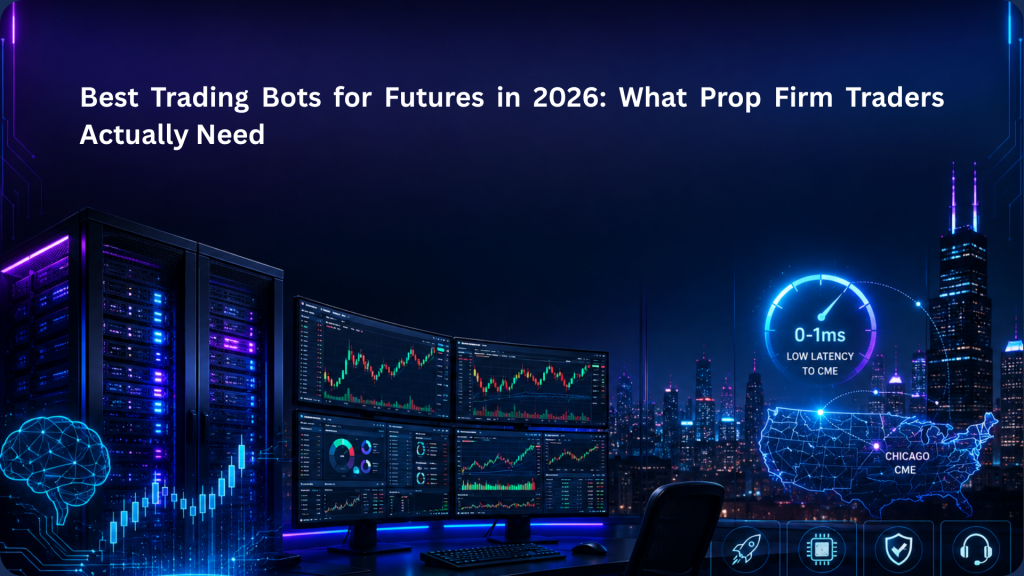
- For futures traders in particular, we have dedicated infrastructure in Chicago in that 0-1ms window to the CME matching engine. London, Amsterdam, Frankfurt, and New York are for traders who also trade forex-adjacent strategies from the same platform. Multi-account futures traders who are running multiple funded evaluations simultaneously can leverage resources by using our flexible pricing tiers instead of paying for unused capacity.
- All plans come with complimentary DDoS protection and 24×7 user support by a technical team with expertise in API routing, platform configuration and prop firm connectivity requirements. They are able to support traders’ platforms, including NinjaTrader, TradeStation, Sierra Chart, Quantower and MetaTrader.
Final Thoughts
The deployment of the best trading bots involves evaluating systems using advanced quantitative measures, such as the Sharpe ratio, Recovery factor, and out-of-sample robustness. If there is no premium and the server environment is not isolated and not right next door to the exchange, latency and slippage will put an end to any algorithmic edge you might have achieved.
By securing high-performance hardware, you eliminate the technical bottlenecks that cause system failures during peak volatility. TradingVPS is the best option for traders in futures, forex, cryptocurrencies, and prediction markets when all trading requirements are taken into account.
Frequently Asked Questions
A curve-fitted bot will have almost a straight-line equity curve during historical back-testing, but will not produce any profits in real-time markets. Curve fitting can be detected with Monte Carlo simulations or out-of-sample (OOS) testing. If the bot fails to perform well when it receives data it has never seen, then it’s over-optimized and not safe to use on real money.
Analyze each bot for its risk management (position sizing, stop loss, kill switches), market compatibility (specifically the market you’re trading), and the speed of execution required by the market (can your hosting support that speed).
Yes, generally. Those who trade futures prefer a server closer to the CME matching engine, which is located in Chicago, while forex traders prefer a server in London, Amsterdam, Frankfurt, or New York, and those who trade on Polymarket often prefer a server in Dublin.
A daily loss limit is a daily maximum capital loss that a bot can suffer in one day of trading. A maximum drawdown kill switch is a permanent “overarching” failsafe that monitors the overall drawdown from the highest point of equity in the account. When the drawdown limit is hit, the Kill switch completely turns off the bot, and a user has to see how the edge of the algorithm is working.
Yes. Firms are now turning to End-of-Day drawdown rules and consistency rules that restrict the amount of profit a single day can generate. A bot that doesn’t pay attention to these can pass all technical trades and fail the evaluation.