Developing a futures trading strategy is relatively straightforward when the rules are simple. Turning those rules into a strategy that performs consistently across different market conditions is much more difficult. Traders need to test entry conditions, exits, stop distances, trading sessions, transaction costs, and the possibility that strong historical results occurred by chance.
For traders working with E-mini S&P 500 (ES) and E-mini Nasdaq-100 (NQ) futures, this research process can become especially demanding. Both markets provide extensive trading opportunities, but volatility, changing market regimes, economic announcements, and execution costs can significantly affect automated strategy performance.
AlphaPrime is a Windows-based futures strategy research platform designed to help traders generate, backtest, filter, and validate candidate strategies without writing code during the research process. Rather than manually programming every possible indicator combination, traders define the markets and trading conditions they want to explore, and AlphaPrime searches for potential strategies based on those settings.
The resulting strategies can be exported as readable, editable code for platforms including NinjaTrader, MultiCharts, TradeStation, and TradingView.
An important distinction is that AlphaPrime does not execute live orders. It handles the research side of algorithmic trading, while supported trading platforms handle the subsequent testing and execution workflow.
For traders who eventually choose to run an independently validated NinjaTrader strategy continuously, a Windows VPS can provide a persistent environment for the trading platform. This creates a practical division between strategy research with AlphaPrime and platform hosting with TradingVPS.
Why ES and NQ Are Popular for Algorithmic Futures Trading
ES and NQ are two of the most widely followed equity-index futures contracts at CME Group. ES tracks the S&P 500, providing exposure to a broad collection of large U.S. companies, while NQ tracks the Nasdaq-100, which has greater exposure to large technology and growth-oriented businesses.
Both markets offer substantial trading activity, extended trading hours, and standardized contract specifications. Those characteristics make them useful for researching systematic strategies, although liquidity and historical data availability do not guarantee that a strategy will perform well.
The contracts have different multipliers and tick values:
| Specification | ES Futures | NQ Futures |
|---|---|---|
| Underlying index | S&P 500 | Nasdaq-100 |
| Contract multiplier | $50 per index point | $20 per index point |
| Minimum tick | 0.25 points | 0.25 points |
| Tick value | $12.50 | $5.00 |
| Main research considerations | Index trends, volatility, sessions | Momentum, volatility, technology-sector sensitivity |
| Common strategy styles | Trend, breakout, pullback, mean reversion | Momentum, breakout, trend, pullback |
Although NQ has a smaller dollar value per tick, that does not automatically make it less risky. NQ can experience larger index-point swings, so position risk needs to be calculated using the full stop distance and contract multiplier.
For example, a 10-point ES stop represents $500 per contract, while a 50-point NQ stop represents $1,000 per contract, before commissions and slippage.
These differences influence strategy design. A stop distance or parameter set that makes sense on ES may not be appropriate for NQ, even when both markets respond to similar economic events.
This is why automated futures research should begin with the contract’s actual characteristics rather than simply applying the same indicator settings to every market.
How AlphaPrime Generates Futures Trading Strategies Without Coding
Traditional algorithmic strategy development often begins with an idea that a trader must translate into programming logic. Testing several variations can require hours of coding, debugging, backtesting, and manual parameter adjustment.
AlphaPrime approaches the process differently.
Traders select a market, timeframe, historical testing period, indicator families, and preferred strategy characteristics. AlphaPrime then automatically explores candidate entry and exit conditions and evaluates them using its backtesting engine.
The software provides 48 built-in trading styles, allowing traders to explore approaches such as trend following, breakouts, pullbacks, and other systematic trading patterns. Traders can also adjust research settings to match their own ideas instead of accepting a single predefined strategy template.
A practical ES research project might begin with:
Market: E-mini S&P 500 futures
Timeframe: 15-minute bars
Trading approach: Trend pullback
Trading session: Selected U.S. trading hours
Risk settings: Defined stop-loss and take-profit rules
Trading costs: Commission and slippage assumptions
AlphaPrime can then generate and evaluate multiple candidate strategies based on those settings.
The objective is not to produce the largest possible collection of profitable-looking historical results. It is to identify candidates worth examining more carefully.
Traders can review trade lists, equity curves, drawdowns, and performance reports before deciding which strategies should proceed to additional validation.
CPU and GPU research
AlphaPrime offers CPU and GPU editions. Both support the research workflow, but the GPU edition uses compatible NVIDIA graphics hardware to evaluate many candidate strategies in parallel.
This can be useful when exploring large combinations of indicator conditions and parameters. However, faster processing should be treated as a research productivity improvement, not evidence that the resulting strategies are more profitable.
AlphaPrime runs on 64-bit Windows 10 or Windows 11. Its GPU edition requires an NVIDIA GeForce GTX 10-series or newer graphics card.
The key benefit is that traders can explore and compare systematic trading ideas without manually coding each candidate from the beginning, while retaining access to editable strategy code after export.
Backtesting ES and NQ Strategies With Realistic Trading Costs
Generating candidate strategies is only the first part of the research process.
A backtest needs to reflect the economic and operational characteristics of the market being studied. Otherwise, the results can become misleading even when the entry and exit rules are technically correct.
For ES and NQ, five settings deserve particular attention.
| Research setting | Why it matters |
|---|---|
| Trading session | Regular and extended hours can produce different signals |
| Contract multiplier | Converts index movements into the correct dollar P&L |
| Commissions and fees | Reduce net results, particularly for frequent trading |
| Slippage | Models execution away from the expected price |
| Contract rollover | Prevents artificial price gaps from distorting research |
Trading sessions are especially important. ES and NQ trade on CME Globex through much of the futures trading week, with scheduled maintenance periods. A strategy using the U.S. regular trading session may behave differently from one that includes overnight data. Moving averages, volatility calculations, and opening-range definitions can change when session templates differ.
Trading costs also deserve attention from the first test. A strategy producing frequent small trades may look attractive before costs but deteriorate significantly after commissions and slippage are included.
Suppose a strategy captures an average of four ES ticks per winning trade. That represents $50 in gross price movement per contract. If the research ignores fees and execution slippage, the resulting net performance may be substantially overstated.
AlphaPrime allows traders to configure trading costs during backtesting rather than assuming every historical entry and exit occurs without friction.
Contract rollover is another important issue. ES and NQ use quarterly futures contracts. Long-term historical research typically involves continuous futures data, which requires a consistent rollover method and an understanding of price adjustments between contract months.
A price difference created by rolling from one futures contract into another is not automatically trading profit or loss.
The goal is to make the backtest resemble the intended trading environment as closely as the available data permits.
Why Strategy Validation Matters More Than Finding a Profitable Backtest
One of the biggest risks in algorithmic trading is overfitting.
Overfitting occurs when a strategy performs well on historical data partly because its rules or parameters have adapted to random patterns that may not repeat.
The problem becomes more serious when software can evaluate large numbers of candidate strategies. The more combinations tested, the more likely it becomes that some will look impressive by chance.
AlphaPrime addresses this by providing additional validation tools rather than relying only on the initial backtest.
These include:
Out-of-sample testing: A portion of historical data is withheld from strategy generation and used later to evaluate whether a candidate behaves reasonably on data it has not previously encountered.
Walk-forward analysis: Strategy parameters are evaluated over successive historical periods, with results checked on subsequent periods. This helps assess whether a strategy is excessively dependent on one market regime.
Monte Carlo analysis: Alternative trade sequences or testing assumptions can be examined to estimate how sensitive performance may be to variation and uncertainty.
AlphaPrime also offers Basic, Standard, and Extensive validation settings, allowing traders to choose how thoroughly candidate strategies should be screened.
These tests do not prove that a strategy will be profitable in the future. They provide additional evidence about whether its historical behavior is fragile.
For example, consider two hypothetical NQ strategies:
| Metric | Strategy A | Strategy B |
|---|---|---|
| Initial backtest | Strong | Moderate |
| Out-of-sample results | Deteriorates | Remains comparatively stable |
| Walk-forward results | Inconsistent | More consistent |
| Parameter sensitivity | High | Lower |
| Research decision | Reevaluate or reject | Candidate for further testing |
Strategy A initially looks more attractive, but Strategy B may provide a more useful basis for continued research because its results depend less on one particular historical configuration.
That is an important change in mindset.
The goal of automated strategy generation should not be to find the most impressive backtest. It should be to find strategies that justify further testing.
From AlphaPrime Research to NinjaTrader Strategy Testing
Once a candidate strategy has passed the trader’s selected research checks, AlphaPrime can export it as readable, editable source code.
Supported export targets include:
| Trading platform | Strategy language |
|---|---|
| NinjaTrader | NinjaScript |
| MultiCharts | PowerLanguage |
| TradeStation | EasyLanguage |
| TradingView | Pine Script |
Exporting the code is a bridge from the research environment to the destination platform. It does not automatically mean the strategy is ready for live execution. In particular, a Pine Script export is not equivalent to native automated broker execution, while supported desktop platforms may provide their own live strategy engines.
For NinjaTrader traders, the workflow is straightforward in principle.
Step 1: Generate and validate the strategy in AlphaPrime. Select ES or NQ, configure the relevant trading costs and research settings, and review the candidate’s results.
Step 2: Prepare NinjaTrader for exported code. Import the required AlphaPrime function library into NinjaTrader before using the exported strategies for the first time.
Step 3: Export the selected strategy as NinjaScript. The resulting source code can be reviewed and adjusted rather than treated as an inaccessible trading system.
Step 4: Import and compile the strategy in NinjaTrader. Resolve any compatibility or compilation issues before attempting further testing.
Step 5: Run the strategy through NinjaTrader Strategy Analyzer. Use comparable historical data, session templates, contract settings, order assumptions, and costs. Review individual trades and investigate differences from the AlphaPrime research results.
Step 6: Test in simulation before considering live operation. Evaluate the strategy with live market-data updates, actual platform behavior, connection interruptions, and realistic risk settings.
The most important step is comparing what happened in the research environment with what happens in the execution platform.
If AlphaPrime shows an entry at a particular historical bar but NinjaTrader produces a different trade, the difference should be understood before deployment.
Potential causes include indicator calculations, timestamps, session templates, contract rollovers, order timing, and historical fill assumptions.
A successful export is not the end of validation. It is the beginning of platform-specific verification.
Where TradingVPS Fits Into the Algorithmic Trading Workflow
AlphaPrime and TradingVPS handle different stages of the trading process.
AlphaPrime is the strategy research environment. It generates candidates, evaluates historical data, applies validation tests, and produces code for supported trading platforms.
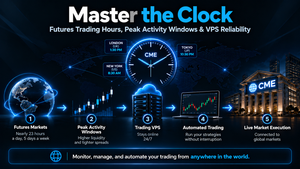
TradingVPS provides remote infrastructure for running the trading platform. Once a strategy has been independently verified and configured, a compatible VPS can keep NinjaTrader and its local automated strategies operating without depending on the trader’s personal computer.
The combined workflow looks like:
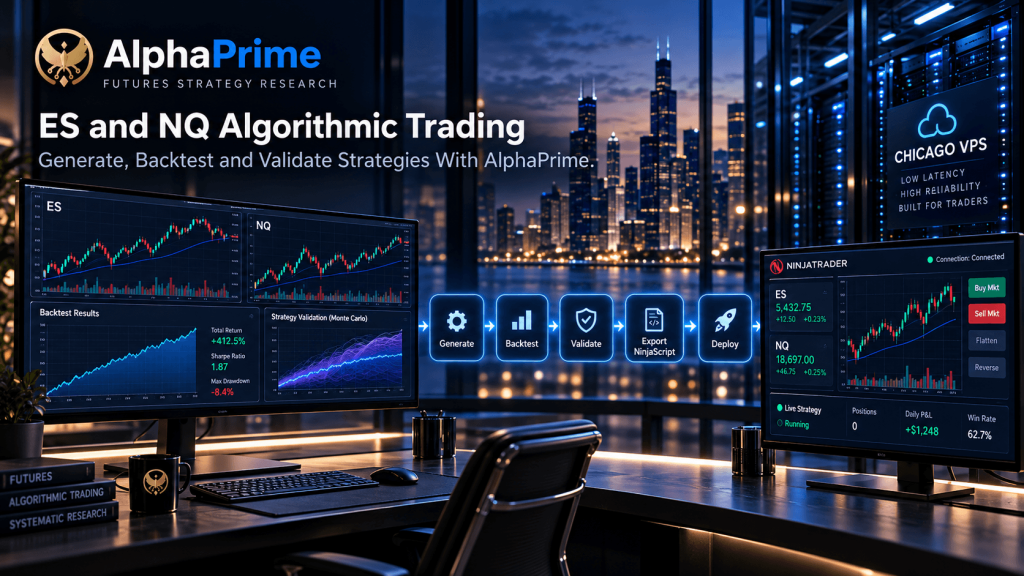
AlphaPrime Research → Backtesting → Validation → NinjaScript Export → NinjaTrader Strategy Analyzer → Simulation → VPS-Hosted NinjaTrader
This separation matters.
AlphaPrime’s CPU or GPU research does not need to run on the same VPS as the trading application. A trader can perform computational research on a local Windows workstation, then export selected strategies for NinjaTrader.
For futures traders, a Chicago VPS can be useful because much of CME’s execution and connectivity infrastructure is concentrated around Chicago and Aurora, Illinois.
TradingVPS offers Chicago configurations with high-frequency AMD Ryzen 9 9950X CPU resources, DDR5 memory, NVMe storage, dedicated IPv4 networking, and Windows Server options suitable for supported NinjaTrader workflows.
For a lightweight NinjaScript deployment, two fast CPU cores and 8 GB RAM may provide a reasonable starting point. More strategies, charts, indicators, and data-intensive tools can justify four cores and 16 GB RAM or additional resources.
A VPS may help maintain platform availability when the trader’s home computer is shut down, asleep, or disconnected from the Internet. However, it cannot guarantee broker connectivity, exchange availability, order execution, or profitable strategy performance.
Traders should also monitor NinjaTrader’s process health, market-data freshness, broker connection, strategy status, and actual account positions. Restart recovery needs to be tested so that an interrupted strategy does not accidentally duplicate or mismanage positions.
The practical division is simple: research locally with AlphaPrime, then use a suitable TradingVPS environment for the verified NinjaTrader strategy when continuous platform operation is required.
Who Can Benefit From AlphaPrime for ES and NQ Research?
AlphaPrime can be useful for several types of systematic futures traders.
Traders without programming experience can explore structured strategy ideas without writing NinjaScript, PowerLanguage, EasyLanguage, or Pine Script during the initial research phase.
Experienced algorithmic traders can use automated generation to broaden their research beyond manually selected indicator combinations while retaining access to editable strategy code.
Futures traders focused on ES and NQ can compare candidate strategies across different sessions, volatility conditions, and historical periods while accounting for the markets’ actual contract specifications.
Developers building strategy portfolios can evaluate multiple candidates and examine whether the results remain meaningful after additional validation and diversification checks.
However, AlphaPrime should not be confused with a guaranteed strategy generator or a live execution bot.
The trader still decides which research settings to use, which candidates deserve further examination, whether the exported code behaves correctly, and whether any strategy is appropriate for a real account.
Frequently Asked Questions About AlphaPrime and ES/NQ Trading
Yes. Traders can choose the futures market, timeframe, indicator conditions, trading style, costs, and validation settings. AlphaPrime then searches for candidate strategies without requiring the trader to write code during the research process.
Yes. AlphaPrime provides NinjaScript exports for NinjaTrader. The required AlphaPrime function library must be imported before using exported strategies, and the results should be independently checked through NinjaTrader’s testing tools.
No. AlphaPrime is strategy research software. Live trading is handled separately through the supported destination platform and broker configuration.
No. It has a CPU edition as well as a GPU edition. GPU acceleration requires a compatible NVIDIA graphics card and can help evaluate large numbers of strategy candidates more quickly.
Yes. AlphaPrime offers a seven-day free trial without requiring a credit card. The trial includes strategy generation, backtesting, reporting, and supported code exports, with 15 common indicator families covering approximately 3,170 conditions.
Final Thoughts: Research, Validation, and Execution Are Different Responsibilities
Successful systematic trading requires more than discovering a strategy that looks profitable on historical charts.
Traders need to understand the market, model realistic costs, test the strategy under different conditions, inspect the results, and verify that the destination trading platform reproduces the intended behavior.
AlphaPrime helps with the research-intensive part of that process. Its automated strategy generation, configurable trading styles, historical backtesting, validation tools, CPU/GPU computation, and editable exports provide a structured way to explore ES and NQ algorithmic trading ideas without manually coding every candidate.
NinjaTrader, MultiCharts, TradeStation, and TradingView then provide different environments for reviewing and using the exported strategies, subject to their individual execution capabilities.
For traders selecting NinjaTrader, the next responsibility is independent platform validation through Strategy Analyzer and simulation.
Only after that work has been completed does continuous hosting become relevant.
A Chicago TradingVPS environment can help keep the NinjaTrader application and its automated strategies operating independently of the trader’s home computer, while the strategy itself remains responsible for its trading rules and risk behavior.
The complete workflow is therefore:
Generate → Backtest → Validate → Export → Verify → Simulate → Deploy → Monitor
Each stage has a distinct purpose.
AlphaPrime helps traders find and evaluate candidate strategies.
NinjaTrader provides the platform-specific testing and trading environment.
TradingVPS provides the infrastructure for continuous operation when that environment needs to remain online.
Together, they illustrate a disciplined approach to futures automation: separate strategy discovery from execution, and validate the strategy before investing in live-trading infrastructure.
AlphaPrime offers a seven-day free trial for traders interested in exploring its research workflow. TradingVPS offers Chicago-hosted NinjaTrader VPS configurations for traders who need persistent execution-platform infrastructure.
This article is for technical and educational purposes only and does not constitute investment, financial, or trading advice. Futures trading involves leverage and substantial risk. Generated strategies, historical backtests, walk-forward analysis, and out-of-sample validation cannot guarantee future results. Always review exported code, verify the applicable exchange specifications and broker requirements, and test strategies thoroughly before live deployment.