
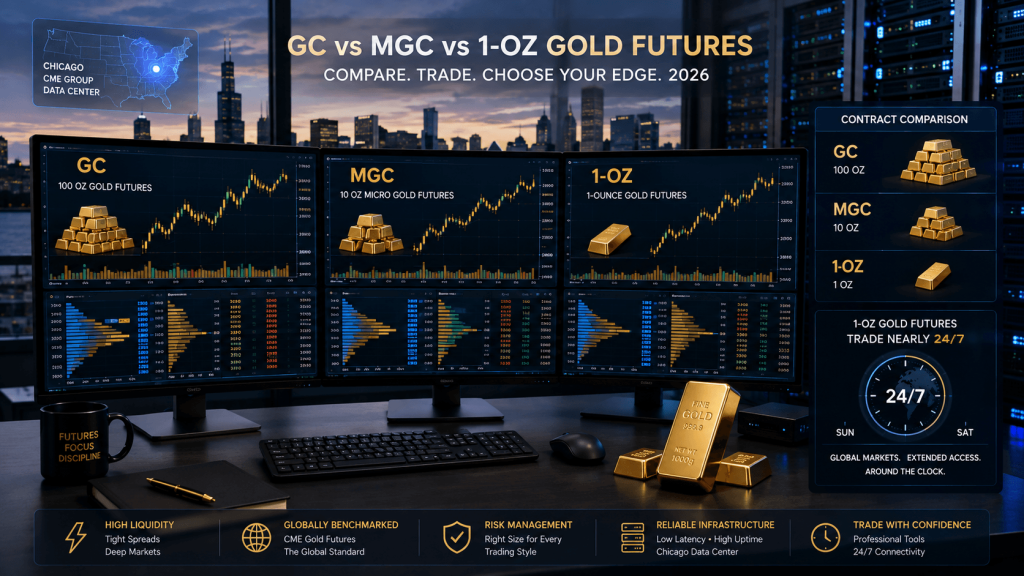
Gold futures trading looks different in 2026 than it did only a few years ago. Traders who want exposure to CME Group’s gold market are no longer choosing primarily between the benchmark 100-ounce Gold futures contract and the smaller Micro Gold contract. CME now offers 1-Ounce Gold futures, creating three distinctly different contract sizes for traders who want exchange-traded gold exposure without buying physical bullion.
The three main contracts—Gold Futures (GC), Micro Gold Futures (MGC), and 1-Ounce Gold Futures (1OZ)—track the same underlying gold market but behave very differently from a risk-management and operational perspective. GC represents 100 troy ounces, MGC represents 10 troy ounces, and 1OZ represents just one troy ounce. GC and MGC use a minimum price increment of $0.10 per ounce, while 1OZ moves in $0.25 increments. The settlement structure also differs: GC and MGC are physically deliverable futures, while 1OZ is financially settled.
The biggest change for 2026 is trading availability. 1-Ounce Gold futures now trade 24/7, except for scheduled CME maintenance windows. GC and MGC continue to trade on the traditional Sunday-through-Friday metals schedule with a daily one-hour break.
That means choosing a gold futures contract is no longer only about contract size. Traders also need to consider dollar exposure, tick value, liquidity, settlement, broker support, trading hours, margin requirements, and whether their trading infrastructure is designed to remain available during the sessions they intend to trade.
GC vs MGC vs 1-Ounce Gold: Quick Comparison
The simplest way to understand the three contracts is to compare how much gold each one represents and how much a minimum price movement changes the contract’s value.
| Contract | Symbol | Contract size | Minimum price move | Value per minimum move | Settlement | Typical trading schedule |
|---|---|---|---|---|---|---|
| Gold Futures | GC | 100 troy ounces | $0.10/oz | $10.00 | Physical | Sunday-Friday, approximately 23 hours/day |
| Micro Gold Futures | MGC | 10 troy ounces | $0.10/oz | $1.00 | Physical | Sunday-Friday, approximately 23 hours/day |
| 1-Ounce Gold Futures | 1OZ | 1 troy ounce | $0.25/oz | $0.25 | Financial | 24/7 except maintenance |
CME confirms that MGC is one-tenth the size of benchmark GC, while 1OZ is one-tenth the size of MGC and one-hundredth the size of GC.
The contract multiplier becomes especially important when gold makes a larger move. If the futures price moves by $1 per ounce, one GC contract changes in value by approximately $100, one MGC contract changes by approximately $10, and one 1OZ contract changes by approximately $1. A $10 move in gold translates to approximately $1,000 for GC, $100 for MGC, and $10 for 1OZ.
This difference is why contract size deserves more attention than the margin number displayed by a broker. Margin tells traders how much collateral may be required to maintain a futures position, but the contract multiplier determines how strongly the position responds to movements in the underlying gold price. Margin can also change as volatility and exchange risk requirements change, while the underlying contract size remains defined by the product specifications.
A trader should therefore understand the full exposure represented by a contract rather than judging affordability from the required deposit alone.
Gold Futures (GC): The 100-Ounce Benchmark Contract
Gold Futures, ticker GC, are CME Group’s benchmark COMEX Gold futures contract. Each contract represents 100 troy ounces of gold and is quoted in U.S. dollars and cents per troy ounce. The minimum price fluctuation is $0.10 per ounce, making the value of one minimum tick $10 per contract.
That multiplier gives GC substantial dollar sensitivity. If gold moves from $4,000 to $4,001 per ounce, the value of one GC contract moves by approximately $100. A $5 move represents about $500, and a $20 move represents approximately $2,000.
This does not mean those amounts represent the trader’s required margin or maximum possible loss. They simply demonstrate how the contract responds to movement in gold. Because futures use leverage, the cash deposited to support the position can be substantially smaller than the contract’s full notional value. That makes understanding the multiplier particularly important.
GC’s larger size can make it useful for traders and institutions that intentionally want significant gold exposure or want to operate in the primary benchmark futures market. It can also allow a trader to achieve a desired level of exposure using fewer contracts than would be necessary with MGC or 1OZ.
The trade-off is that the contract offers less granularity. One GC contract immediately creates exposure to 100 ounces of gold. A trader cannot reduce that position to half of a GC without moving to another contract size such as MGC.
GC is also physically deliverable. CME’s contract specifications state that the contract represents deliverable gold and that delivery can occur during the applicable delivery period for positions carried into that process.
Many active futures traders do not intend to take or make physical delivery. They generally close or roll their positions before delivery becomes relevant. However, the fact that a contract is physically settled should not be ignored. Traders need to understand their broker’s rules regarding expiration, first notice considerations, forced liquidation policies, and how far in advance a broker requires speculative positions to be closed or rolled.
What Does a GC Price Move Actually Mean?
Consider gold trading at $4,100 per ounce. The notional value of one GC contract would be approximately $410,000 because the contract represents 100 ounces. If gold rises to $4,105, the underlying price has moved $5 per ounce. Multiplying that $5 move by 100 ounces produces approximately $500 in contract-value movement.
If gold instead fell $5, the contract-value change would be approximately $500 in the opposite direction.
This simple calculation makes GC easier to understand:
Gold price movement × 100 ounces = approximate GC contract-value movement.
The same calculation can then be scaled down for MGC and 1OZ.
Micro Gold Futures (MGC): One-Tenth of GC
Micro Gold Futures, ticker MGC, were designed to provide smaller exposure to the same gold market. Each MGC contract represents 10 troy ounces, exactly one-tenth the size of GC. MGC is quoted in the same $0.10-per-ounce minimum increment as GC, but because the contract represents only 10 ounces, the value of one minimum tick is $1 instead of $10.
That smaller multiplier changes position sizing significantly. A $1-per-ounce gold move changes the value of one MGC contract by approximately $10. A $5 move corresponds to approximately $50, while a $20 move corresponds to approximately $200.
This makes MGC useful when a trader wants finer control over exposure without reducing position size all the way to one ounce.
For example, five MGC contracts represent 50 ounces of gold. That creates half the exposure of one GC contract. Three MGC contracts represent 30 ounces. Seven represent 70 ounces. With GC alone, those intermediate exposure levels are not possible using whole futures contracts.
MGC therefore gives traders a way to scale positions in smaller increments, but the smaller size should not be confused with the absence of risk. Several MGC contracts can quickly create the same or greater exposure than a single GC contract. Ten MGC contracts represent the same nominal gold quantity as one GC contract.
Like GC, MGC is physically settled rather than cash settled. CME’s Micro Gold specifications state that delivery uses an Accumulated Certificate of Exchange, or ACE, rather than requiring each individual Micro contract to correspond directly to a separate 10-ounce physical bar.
For short-term traders who close positions before delivery becomes relevant, this distinction may have little effect on ordinary intraday activity. It still matters when understanding the actual product structure and managing expiring positions.
GC vs MGC: Same Market Move, Different Exposure
Suppose gold rises from $4,000 to $4,012 per ounce during a trading session. That is a $12 move.
For one GC contract, the approximate contract-value change is:
$12 × 100 ounces = $1,200
For one MGC contract:
$12 × 10 ounces = $120
For one 1OZ contract:
$12 × 1 ounce = $12
The market move itself is identical. What changes is the multiplier applied to that move.
This is one of the most important concepts in gold futures trading because traders sometimes focus heavily on which contract has the lower margin without first determining how much exposure they actually want. The better comparison begins with dollar sensitivity and then considers margin as part of the wider account-risk picture.
1-Ounce Gold Futures: CME’s Smallest Gold Contract
1-Ounce Gold Futures, ticker 1OZ, represent exactly one troy ounce of gold. The contract is one-tenth the size of MGC and one-hundredth the size of GC, making it CME’s smallest Gold futures contract.
That size creates much finer position granularity than either GC or MGC. If gold moves $1 per ounce, the approximate change in contract value is only $1. A $10 gold move corresponds to approximately $10 per contract.
However, 1OZ does not simply take the GC or MGC design and shrink it again. It has several structural differences.
The minimum price increment is $0.25 per ounce, giving the contract a $0.25 minimum tick value. In comparison, GC and MGC both use $0.10-per-ounce increments. CME’s official product specifications identify 1OZ as a one-ounce contract with a $0.25 minimum price increment.
The other major difference is settlement. 1OZ is financially settled, meaning that positions reaching final settlement are resolved in cash rather than through physical delivery of gold.
This creates a distinctly different product from physically delivered GC and MGC. A trader still needs to understand expiration and their broker’s policies, but the contract does not lead to physical gold delivery.
1OZ also uses a different listing structure. CME lists contracts in February, April, June, August, October, and December within its defined listing period.
For traders, the most important practical characteristic in 2026 may be neither the contract size nor the settlement mechanism. It is the trading schedule.
1-Ounce Gold Now Trades 24/7
CME’s 1-Ounce Gold contract now trades 24 hours a day, seven days a week, apart from scheduled system-maintenance periods. CME expanded 1OZ to weekend trading in July 2026, making it structurally different from GC and MGC.
Under the current schedule, 1OZ has a short maintenance window from 4:00 p.m. to 4:02 p.m. Central Time Monday through Friday. On Saturday, CME uses a longer maintenance period from 2:00 a.m. to 4:00 a.m. CT. The corresponding weekday pre-open runs from 4:01 p.m. to 4:02 p.m. CT, while Saturday pre-open runs from 3:45 a.m. to 4:00 a.m. CT.
This does not mean GC and MGC have also moved to the same schedule.
GC and MGC continue to follow the established metals trading session. They generally trade from Sunday at 5:00 p.m. CT through Friday at 4:00 p.m. CT, with a daily one-hour break beginning at 4:00 p.m. CT.
That creates an important distinction:
A trader searching for “gold futures trading hours” can no longer rely on one universal answer. The correct schedule depends on which Gold futures contract is being traded.
Why Weekend Gold Trading Matters
Gold reacts to global events that do not respect U.S. exchange hours. Geopolitical developments, currency movements, central-bank announcements, political events, and changes in global risk sentiment can occur on Saturday or Sunday.
Before continuous 1OZ trading, CME gold traders generally had to wait for the traditional Sunday futures reopening to access GC or MGC after a weekend event. The new 1OZ structure creates an exchange-traded gold futures market during much of that previously closed period.
Availability should not be confused with liquidity.
A contract can technically be open while trading volume and market depth are much lower than during heavily traded weekday periods. Bid-ask spreads may differ, order-book depth can change, and execution conditions can vary considerably depending on the time and market environment.
Traders should therefore evaluate current liquidity rather than assuming a market that operates 24/7 behaves identically every hour of the week.
Physical Delivery vs Cash Settlement
The settlement difference between these contracts deserves more attention because it fundamentally changes what happens at expiration.
GC is physically deliverable. MGC is also physically settled, using CME’s ACE mechanism as part of its delivery structure. 1OZ is financially settled.
For an active trader who consistently closes positions long before expiration, these mechanisms may stay in the background. They become much more important when positions are held into an expiring contract.
A trader holding GC or MGC should know when trading terminates and understand the broker’s policies for physically deliverable futures. Brokers often impose their own deadlines or restrictions before the exchange’s final delivery process because they may not support customers taking physical delivery.
With 1OZ, final settlement is financial. Instead of delivering a one-ounce gold bar, the contract reaches its final value through CME’s settlement process and the resulting account value is handled in cash.
The difference also highlights why 1OZ should not simply be described as “Micro Gold but smaller.” Its multiplier, minimum tick, settlement process, and trading schedule are all different.
Which Gold Futures Contract Fits Different Trading Setups?
There is no universal “best” Gold futures contract. GC, MGC, and 1OZ are tools designed around different levels of exposure and different market structures.
GC provides the largest of the three exposures and serves as the core benchmark contract. Its 100-ounce multiplier means that relatively small movements in gold can translate into substantial changes in contract value. Traders who intentionally need that level of exposure may prefer the efficiency of controlling it with fewer contracts.
MGC offers a middle ground. At 10 ounces, it is large enough to provide meaningful gold exposure while allowing far more granular position sizing than GC. Traders can combine multiple MGC contracts to build exposure in 10-ounce increments rather than jumping directly between 100-ounce GC contracts.
1OZ takes position granularity much further. One contract represents exactly one ounce, making exposure easy to understand mathematically. It also provides weekend access that GC and MGC currently do not offer.
However, smaller contract size alone does not make 1OZ automatically superior. Traders should consider liquidity, spreads, transaction costs, broker availability, platform support, and the number of contracts required to achieve the intended exposure.
For example, a trader seeking exposure equivalent to 100 ounces could theoretically use one GC, ten MGC contracts, or one hundred 1OZ contracts. Those positions may represent similar nominal gold quantities, but they are not operationally identical. Commission structures, market depth, tick increments, order management, and liquidity can make the trading experience very different.
The practical decision therefore starts with desired exposure and then expands into market structure.
Gold Futures Trading Infrastructure in 2026
The expansion of Gold futures access also changes the infrastructure requirements around trading them.
GC and MGC already operate for approximately 23 hours per trading day during the Sunday-through-Friday futures week. 1OZ extends that availability through weekends, apart from short maintenance periods. A trader using these markets may therefore want charts, market data, alerts, or permitted automated processes to remain available far beyond ordinary stock-market hours.
Running that entire environment from a home computer creates several local dependencies. The trading platform relies on the computer remaining powered, the residential Internet connection staying active, the router functioning correctly, Windows avoiding an unexpected restart, and the machine not entering sleep mode.
A remote trading environment can reduce those dependencies.
For traders using supported platforms, TradingVPS can provide a persistent Windows environment for futures charts, market monitoring, remote platform access, and permitted trading applications. The trader can access that server remotely while the main platform environment operates independently of whether the personal laptop or desktop remains switched on.
That distinction becomes particularly relevant for 1OZ because weekend trading changes the period during which the infrastructure may need to remain available.
A trader may stop actively watching markets on Friday evening while still wanting the platform to remain connected, collect data, maintain alerts, or support an approved automated workflow over the weekend.
A VPS does not remove exchange maintenance, broker outages, platform failures, or market risk. It also cannot guarantee better fills or eliminate latency. Its practical role is to provide a remote environment that is less dependent on household power, residential connectivity, and personal-computer availability.
Monitoring Matters More When Markets Stay Open Longer
A server being online is only one part of reliability.
The trading platform itself also needs to remain responsive. Market data needs to update correctly, broker connectivity needs to remain active, and applications should reconnect properly after scheduled CME maintenance.
This becomes particularly important with 1OZ. A brief scheduled two-minute weekday maintenance window should normally be a routine event. If the platform fails to reconnect afterward, however, the trader’s effective downtime can become much longer than the exchange maintenance itself.
The same principle applies to the Saturday maintenance period.
A trading environment designed for extended operation should therefore be monitored at both the server and application level. CPU and memory availability, trading-platform processes, connection state, and market-data status can all provide useful information about whether the environment is actually functioning.
Longer market access makes infrastructure reliability more important, but it does not mean traders need to watch a screen continuously. The more useful objective is having a system that remains observable and can request attention when something requires intervention.
Common Misunderstandings About GC, MGC and 1OZ
One common misunderstanding is that MGC and 1OZ are simply “safer” versions of GC. Smaller contracts do reduce the dollar exposure of a single contract, but traders can still create large positions by increasing contract quantity. Ten MGC contracts produce exposure equivalent to 100 ounces of gold, the same nominal quantity represented by one GC.
Another misunderstanding is that every CME Gold futures contract now trades 24/7. That is not correct. The continuous schedule currently applies to 1-Ounce Gold, while GC and MGC remain on their established Sunday-through-Friday schedule.
Traders may also assume that all three contracts settle in the same way. They do not. GC and MGC are physically deliverable, while 1OZ is financially settled.
The tick structure is also different. GC and MGC use $0.10-per-ounce increments, producing $10 and $1 minimum tick values respectively. 1OZ uses a $0.25 increment, producing a $0.25 tick.
Finally, lower margin should never be confused with lower market risk. Futures provide leveraged exposure, and broker margin requirements can change according to volatility, contract, account type, and risk policy. Understanding the contract multiplier remains essential regardless of the amount displayed as required margin.
Frequently Asked Questions About Gold Futures Trading
GC represents 100 troy ounces of gold, while MGC represents 10 troy ounces. Both use a $0.10-per-ounce minimum price increment, but that means a $10 minimum tick for GC and a $1 minimum tick for MGC. Both are physically settled futures.
1-Ounce Gold futures, symbol 1OZ, are CME Gold futures representing one troy ounce of gold. The contract is one-tenth the size of MGC and one-hundredth the size of GC. It is financially settled and trades in minimum increments of $0.25 per ounce.
No. GC generally trades from Sunday evening through Friday afternoon with a one-hour daily maintenance break. It does not currently follow the seven-day trading schedule used by 1OZ.
No. MGC currently follows the established Sunday-through-Friday metals schedule with a daily one-hour break beginning at 4:00 p.m. CT.
Yes. 1OZ now trades 24/7 apart from scheduled maintenance, including a two-hour maintenance period on Saturday and short weekday maintenance windows.
1OZ is the smallest of the three, representing one troy ounce. It is one-tenth the size of MGC and one-hundredth the size of GC.
Supported futures trading platforms can be run from an appropriately configured VPS. A remote server can reduce dependence on a trader’s home computer and residential Internet connection, which may be useful for markets with long or continuous trading sessions. Traders should still confirm platform, broker, and application requirements.
Final Thoughts: GC vs MGC vs 1-Ounce Gold in 2026
Gold futures trading in 2026 offers significantly more flexibility than a simple choice between a standard and Micro contract.
GC remains the 100-ounce benchmark. Its $0.10-per-ounce price increment produces a $10 minimum tick, and its larger multiplier creates substantial exposure from a single contract.
MGC reduces the contract size to 10 ounces. The same $0.10 price increment becomes a $1 minimum tick, giving traders more flexibility to build positions in smaller increments while retaining a physically settled Gold futures structure.
1OZ reduces the contract again to just one ounce. It uses a $0.25 minimum tick, is financially settled, and now trades 24/7 apart from scheduled maintenance. That weekend availability makes it especially different from GC and MGC in 2026.
The right contract therefore depends on much more than which one requires the least capital. Traders need to consider desired dollar exposure, position granularity, liquidity, settlement structure, trading hours, broker support, transaction costs, and the infrastructure they use to access the market.
For traders operating platforms over long futures sessions—or using the new weekend availability of 1OZ—a persistent remote environment such as TradingVPS can reduce reliance on a home PC and residential Internet connection. The VPS cannot control the market or improve the strategy itself, but it can provide a more consistent technical foundation for supported futures software.
Ultimately, the most important difference between GC vs MGC vs 1-Ounce Gold is straightforward:
GC gives the largest exposure, MGC provides a smaller and more flexible version of the benchmark contract, and 1OZ introduces extremely granular exposure together with continuous weekend access.
Understanding those differences before entering a position is far more important than simply choosing whichever Gold futures contract appears most affordable.
This article is provided for general informational purposes and does not constitute financial, investment, legal, or trading advice. Futures involve substantial risk, and contract specifications, exchange schedules, broker requirements, and margin levels can change.