
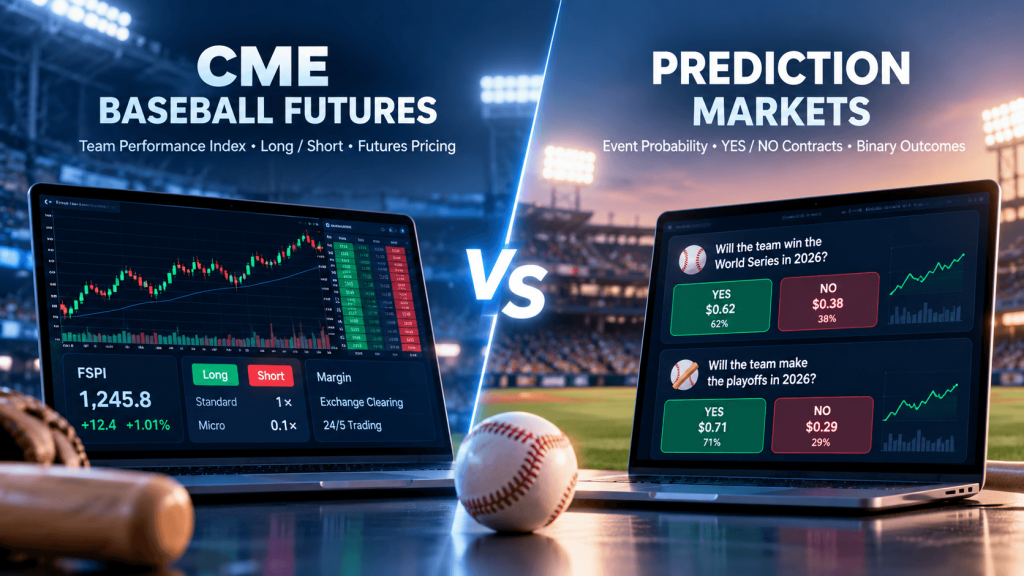
Sports markets are moving deeper into financial-market infrastructure, and one of the most unusual developments of 2026 is the arrival of actual exchange-traded baseball futures.
CME Group announced on October 8, 2026 that it plans to launch the world’s first baseball futures on October 12, 2026, pending regulatory review. The contracts will be based on CME FutureSports Performance Indexes, or CME FSPI, which convert official professional baseball statistics into continuously changing financial benchmarks. The initial launch begins with teams participating in the 2026 League Championship Series before expanding across the league’s 30 clubs.
At first glance, that sounds similar to a prediction market where traders buy contracts on questions such as:
“Will this team win the World Series?”
But CME Baseball futures are structurally very different.
A prediction-market contract normally settles according to whether a specific event happens. A YES contract might trade at $0.60 and eventually settle at either $1 or $0 depending on the outcome. Baseball futures instead track a continuous team-performance index that rises and falls as officially recorded baseball events add or subtract index points.
The simplest distinction is:
Prediction markets trade the probability of an outcome.
CME Baseball futures trade the changing value of a performance index.
That difference affects pricing, risk, settlement, hedging, margin, trading strategy, and even what it means to be “right” about a baseball team.
What Are CME Baseball Futures?
CME’s baseball contracts belong to its new FutureSports Performance Index ecosystem developed with FutureSports. Instead of asking one binary question about whether a team wins or loses, FSPI converts official league statistics into a rules-based benchmark.
Every team’s sports-performance index begins from a standardized base value of 7,500 points at the start of a season. Official game activity then moves that index up or down according to a predefined methodology. Positive actions contribute points while negative actions subtract them. CME describes these indexes as continuous benchmarks derived from official league data rather than simple win/loss contracts.
This creates something closer to a stock index tied to team performance.
Imagine a hypothetical baseball index starting at 7,500. Strong hitting, pitching, defensive performance, wins, postseason progress, or other qualifying statistical events could increase the benchmark according to the published methodology, while negative performance could reduce it.
The exact value is therefore not simply:
Team won = 1
or
Team lost = 0.
Instead, team performance accumulates into a numerical benchmark.
The futures market then trades expectations about where that benchmark may be by the contract’s expiration.
CME describes the conceptual futures pricing relationship as:
Current index level + expected future accumulation of index points = estimated futures value
although actual market prices can also reflect liquidity, uncertainty, risk premiums, new information, injuries, roster changes, and trader expectations.
That makes baseball futures a genuine continuous-value derivative, rather than a binary outcome contract.
How Prediction Markets Work Instead
Prediction markets generally organize trading around questions with clearly defined outcomes.
Examples might include:
Will a team win tonight?
Will a team reach the playoffs?
Will Los Angeles win the World Series?
Will a particular team win its league championship?
A typical binary prediction market has YES and NO contracts whose combined economic value is approximately $1. If the event occurs, the winning side settles at $1 and the losing side settles at $0. Kalshi describes its prediction-market contracts this way: prices represent the market’s view of the likelihood of an event and a correct contract settles for $1.
Polymarket baseball markets use a similar probability-style presentation. Baseball outcomes can trade between $0 and $1, with a market price such as $0.62 commonly interpreted as an approximately 62% market-implied probability, subject to the usual limitations of liquidity and market pricing.
Suppose a hypothetical World Series market says:
Chicago wins championship — YES: $0.30
A trader buying 100 YES shares spends approximately $30 before fees.
If Chicago wins and the contract resolves YES:
100 × $1 = $100 settlement value.
If Chicago does not win:
Settlement value = $0.
CME Baseball futures do not have that payoff shape.
If a team’s FSPI futures contract is trading at 8,100, the trader is not necessarily saying there is an “81% chance” of anything.
The number represents an expected index level.
That is the key conceptual difference.
CME Baseball Futures vs Prediction Markets at a Glance
| Feature | CME Baseball Futures | Prediction Markets |
|---|---|---|
| Underlying | Team performance index | Defined real-world event |
| Price meaning | Expected index value | Often interpreted as implied probability |
| Settlement | Financial settlement to index | Usually $1 or $0 for binary outcome |
| Value range | Continuous; not limited to $0–$1 | Usually $0–$1 |
| Position | Long or short futures | YES / NO |
| Exposure | Broader team performance | Specific outcome |
| Margin | Futures margin system | Often position cost/collateral model |
| Trading style | Index/futures trading | Event probability trading |
| Main data | Official statistical performance | Resolution of defined question |
| Use case | Trading/hedging performance | Trading probability of an event |
| Clearing | CME clearing framework | Depends on prediction-market venue |
| Contract size | Standard and Micro | Usually small binary contracts |
The difference is particularly important because the word “futures” has traditionally been used in sports betting to describe long-term wagers such as “Who will win the World Series?”
Those sportsbook-style “futures bets” are not the same thing as an actual futures contract traded on a derivatives exchange.
CME Baseball futures are futures in the financial-market sense.
How CME Baseball Futures Are Sized and Traded
CME plans to offer both standard and Micro baseball futures.
The standard Sports Index futures structure uses a multiplier of:
$10 × index value
while the Micro version uses:
$0.10 × index value.
At an index level of 7,500, that corresponds to approximately:
Standard contract notional: $75,000
Micro contract notional: $750.
The minimum price movement is one index point, making the corresponding tick value $10 for the standard contract and $0.10 for the Micro. CME’s broader FSPI specifications use this structure across Sports Index futures.
A trader who believes a team’s future performance will exceed the market’s expectations can go long.
A trader expecting deterioration can go short.
For example, suppose a Micro baseball futures contract trades at an illustrative index price of:
8,000
and later moves to:
8,150.
That is a gain of:
150 index points.
At $0.10 per index point:
150 × $0.10 = $15 gain per Micro contract
before commissions and fees.
A standard contract would have a $10 value per index point, so the same 150-point move would represent:
150 × $10 = $1,500.
This payoff is fundamentally different from buying a binary YES contract.
The trader does not need the team to win a championship for a long futures position to gain value. The relevant question is whether the underlying team-performance index and market expectations move favorably relative to the futures entry price.
A Team Can Perform Well Without Winning the Championship
This may be the biggest strategic difference between baseball futures and championship prediction markets.
Suppose a team performs extremely well throughout the season but eventually loses in the postseason.
A binary contract asking:
“Will this team win the World Series?”
ultimately settles at zero if the team does not become champion.
Its strong regular season does not change the final outcome.
An FSPI-style futures contract can behave differently because the underlying index reflects accumulated statistical performance.
The team could generate substantial positive index movement during the season before being eliminated.
Therefore:
Prediction market: final answer matters most.
Performance futures: the path of performance matters.
This creates potential strategies that do not exist in simple binary prediction markets.
A trader could potentially take positions based on expectations involving:
- roster improvements,
- pitching performance,
- offensive production,
- injuries,
- scheduling,
- postseason advancement,
- managerial changes,
- player trades,
- or broader seasonal momentum.
Because the futures market remains tradable, participants do not necessarily need to hold positions until final settlement.
They can enter and exit as expectations change.
Why CME Built an Index Instead of Another YES/NO Sports Contract
The regulatory environment surrounding prediction markets has become increasingly important.
CME itself has experience with sports-related event contracts. Earlier in 2026, the exchange listed event-contract swaps tied to professional baseball outcomes, including a Pro Baseball Season Champion product. However, effective September 11, CME amended the listing schedule for its sports and cultural event-contract swaps so that no additional expirations would be added on CME Globex.
Only weeks later, the exchange announced the new FSPI baseball futures.
The structures are notably different.
The older sports event contracts revolved around discrete outcomes.
The new product tracks a continuous performance benchmark.
The CFTC, meanwhile, has been actively examining prediction markets and sports event contracts. In March 2026, the agency issued an advisory reminding designated contract markets of their obligations when listing event contracts, particularly sports-related contracts, and separately opened a broader rulemaking process concerning prediction markets.
That regulatory backdrop makes the distinction between sports-performance index futures and binary sports event contracts more than a technical curiosity.
They are different product designs.
CME’s FSPI contracts resemble traditional index derivatives more closely because their settlement value comes from a transparent numerical benchmark rather than simply asking whether a game, championship, or other discrete event occurred.
Are CME Baseball Futures Still a Form of Sports Speculation?
Yes.
A trader can clearly use CME Baseball futures to speculate on team performance.
Someone expecting a team’s index to rise can buy the futures contract, while someone expecting weakening performance can sell.
But speculation is not the only proposed use.
CME has positioned Sports Index futures as potential risk-management instruments for organizations whose economics may be affected by team performance.
Consider businesses such as:
- sponsors,
- hospitality operators,
- sports-related vendors,
- media businesses,
- companies with team-linked promotions,
- or other organizations whose revenue may change depending on fan engagement and competitive performance.
A business whose revenue tends to increase when a team performs strongly could theoretically use a sports derivative as part of a broader risk-management strategy.
Whether such hedges become economically practical will depend heavily on liquidity, basis risk, margin, transaction costs, and how closely the FSPI benchmark correlates with the business exposure being hedged.
That is another major difference from many prediction markets.
Prediction markets are primarily structured around answering an outcome question.
Traditional futures markets are designed around price discovery and risk transfer, even though speculators play an essential role in providing liquidity.
24/7 Trading Makes Baseball Futures Different From Traditional Sports Markets
CME says its FSPI futures will trade around the clock, subject to scheduled maintenance, allowing traders to react to information outside ordinary U.S. market hours.
That can matter because baseball information does not arrive on a stock-market schedule.
Important developments can happen:
- during games,
- immediately after games,
- overnight,
- during trade negotiations,
- after injury announcements,
- during roster changes,
- or over weekends.
The ability to maintain a continuous order book means the futures price can respond as new information changes expected future index performance.
Prediction markets can also trade nearly continuously depending on the venue, so 24/7 access alone is not what separates the two.
The difference is what is being continuously priced.
A prediction market may continuously answer:
“What probability does the market assign to this team winning the World Series?”
The futures market instead asks something closer to:
“What should this team’s performance index be worth at this contract’s settlement date?”
Frequently Asked Questions About CME Baseball Futures
Not in the usual binary prediction-market sense. They are futures based on continuous FutureSports Performance Indexes rather than YES/NO contracts tied to one specific outcome.
They are rules-based sports-performance benchmarks developed with FutureSports using official league statistics. Teams begin from a standardized index level and gain or lose points according to defined statistical events.
Yes. Like conventional futures, market participants can take long or short positions based on their expectations about future index performance.
CME plans standard and Micro versions. The wider FSPI framework uses $10 per index point for standard contracts and $0.10 per index point for Micro contracts.
It depends on the venue and jurisdiction. Some U.S. prediction-market operators function through CFTC-regulated designated contract markets, while other platforms operate under different legal and regulatory structures. Traders should evaluate the specific venue rather than treating every prediction market as legally identical.
Potentially. Prediction-market prices can provide information about expected competitive outcomes, while FSPI futures provide a market price for broader continuous team performance.
Final Thoughts: Baseball Futures Trade Performance, Prediction Markets Trade Outcomes
CME Baseball futures and baseball prediction markets may react to many of the same events.
A star player’s injury could move both.
A major trade could move both.
A postseason victory could move both.
But the contracts represent very different financial questions.
A prediction market asks:
“Will this particular event happen?”
CME Baseball futures ask something closer to:
“What will this team’s rules-based performance index be worth?”
That creates different payoff structures.
Prediction markets generally provide an intuitive binary framework where market prices can be interpreted as probabilities and contracts settle according to a defined outcome.
CME Baseball futures provide continuous long and short exposure to changing team performance through a standardized index, margin-based futures structure, central clearing, official statistical inputs, and exchange-based price discovery.
Neither structure automatically replaces the other.
They can serve different traders.
Prediction markets may remain more intuitive for someone whose primary view is:
“I think this team will win the championship.”
Baseball futures may be more interesting for someone whose view is:
“I think this team’s overall performance will exceed current market expectations over the next several weeks or months.”
And sophisticated traders may eventually monitor both.
Prediction markets can provide information about event probabilities.
FSPI futures can provide information about continuous team-performance expectations.
Together, they represent a broader development in financial markets: professional sports are increasingly becoming not just something people watch or bet on, but something whose performance can be represented by standardized financial benchmarks and traded using increasingly sophisticated market infrastructure.
The launch of CME Baseball futures therefore matters for more than baseball.
It is another step toward treating sports performance as a new class of measurable, tradeable financial exposure.
This article is provided for general educational and technical purposes only and does not constitute financial, investment, tax, legal, gambling, or trading advice. Futures trading involves substantial risk and leverage. Sports event and prediction-market regulation can vary by jurisdiction and platform. CME Baseball futures are scheduled to launch October 12, 2026 pending regulatory review, and contract specifications, broker availability, margins, liquidity, and trading access should be verified before trading.