
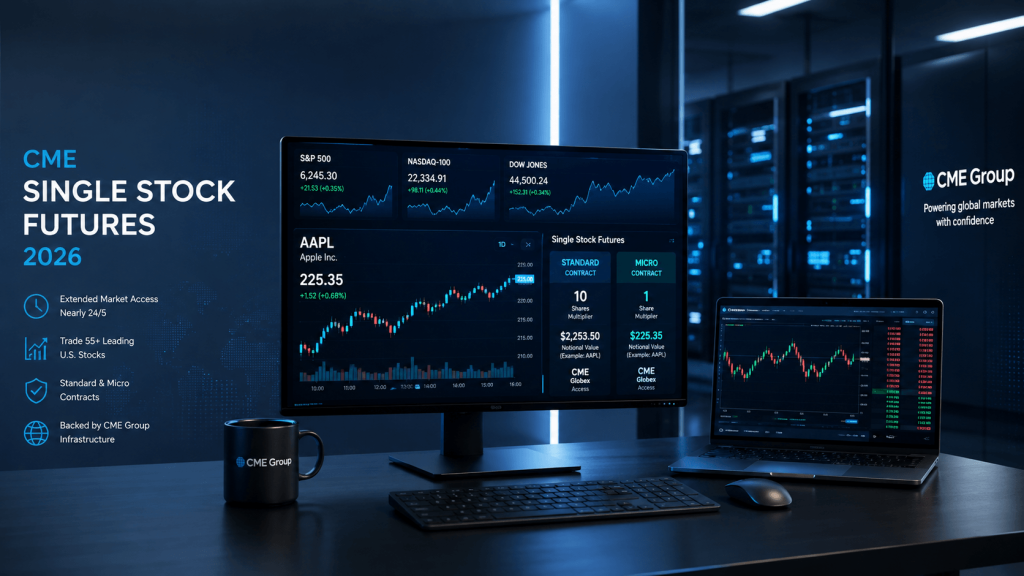
CME Group has introduced a major new way to access individual U.S. companies through the futures market. On July 27, 2026, the exchange launched single stock futures covering more than 50 leading stocks, including many of the largest companies represented in the S&P 500, Nasdaq-100 and Russell 1000.
The initial launch includes 55 standard-sized contracts and 22 Micro-sized contracts. Together, they give traders a choice between exposure equivalent to 100 shares or a smaller position equivalent to 10 shares of the underlying stock.
Unlike buying shares, these contracts do not provide ownership in a company. They are futures agreements whose value follows the price of one specific stock and settles financially in U.S. dollars. They also trade for nearly 24 hours per day from Sunday through Friday, extending access well beyond regular U.S. stock-market hours.
The launch creates new opportunities for traders who want individual-company exposure within a futures account. It also introduces important differences involving leverage, margin, dividends, expiration, liquidity and platform availability.
What Are Single Stock Futures?
Single stock futures are standardized futures contracts based on the price of one company’s stock.
A contract on NVIDIA, for example, tracks NVIDIA’s stock price rather than a broad equity index. A trader can take a long position when expecting the futures price to rise or a short position when expecting it to fall.
The contract has an expiration date, a defined multiplier and an exchange-established settlement process. Gains and losses are calculated from changes in the futures price multiplied by the contract size.
Although the futures contract follows an individual stock, holding it is not the same as owning the underlying shares. The trader does not become a shareholder, does not receive voting rights and does not receive shares when the contract expires.
CME’s contracts are financially settled. At expiration, the final value is determined using the official closing price of the underlying stock on its primary listing exchange. Any remaining gain or loss is settled in cash.
Why Did CME Launch Single Stock Futures?
CME already provides an extensive range of equity-index futures based on benchmarks such as the S&P 500 and Nasdaq-100. Those products allow traders to take a view on a large group of companies through one contract.
Single stock futures add another level of precision. Instead of trading the broader technology sector through Nasdaq futures, a trader can gain exposure to one specific technology company. Instead of using an index to manage general market exposure, an institution can isolate the risk associated with an individual holding.
The products also bring familiar futures-market features to individual stocks. These include extended trading hours, centralized clearing, margin-based exposure and a relatively direct process for taking long or short positions.
What Launched on July 27, 2026?
CME’s first phase introduced 77 contracts across 55 individual stocks.
Every one of the 55 stocks has a standard-sized futures contract. A selected group of 22 stocks also has a Micro contract. The Micro lineup concentrates on widely followed names such as Apple, Amazon, Alphabet, Microsoft, Meta, NVIDIA, Tesla, AMD, Netflix and Walmart.
The broader standard-sized lineup includes companies from technology, financial services, consumer goods, healthcare, energy, communications and industrial sectors.
The two contract sizes are designed for different exposure requirements.
| Contract type | Number launched | Contract multiplier | Value of a one-cent price move |
|---|---|---|---|
| Standard Single Stock futures | 55 | 100 shares | $1.00 |
| Micro Single Stock futures | 22 | 10 shares | $0.10 |
The Micro contract is one-tenth the size of the corresponding standard contract. This gives traders more control over position sizing without changing the stock being tracked.
Which Companies Are Included?
The initial standard-sized lineup covers many heavily traded U.S. companies. Examples include Apple, Microsoft, Amazon, Alphabet, Meta, NVIDIA, Tesla, AMD, Broadcom, JPMorgan Chase, Bank of America, Visa, Mastercard, Exxon Mobil, Chevron, Walmart and Boeing.
Not every standard contract has a Micro version. CME selected 22 stocks for the initial Micro lineup, while the remaining stocks are available only through the 100-share contract.
The exchange may add more companies or Micro contracts as the market develops. Traders should therefore check the current product lineup rather than assuming the original July launch list will remain unchanged.
How Large Is a Single Stock Futures Contract?
The standard contract represents 100 shares of the underlying stock. The Micro contract represents 10 shares.
The notional value is calculated by multiplying the futures price by the contract multiplier.
Suppose a contract is trading at $200. The standard contract would have a notional value of $20,000 because it represents 100 shares. The Micro contract would have a notional value of $2,000 because it represents 10 shares.
This notional value is the market exposure controlled by the contract. It is not necessarily the amount of cash required to open the position.
Futures are traded using margin, so the required deposit may be smaller than the contract’s full notional value. That capital efficiency can be useful, but it also increases risk because profits and losses are based on the full exposure rather than only the margin deposited.
How Much Is Each Price Movement Worth?
The contracts are quoted in U.S. dollars and cents per share.
A one-cent movement is worth $1 for a standard contract because $0.01 multiplied by 100 shares equals $1. For a Micro contract, a one-cent movement is worth $0.10 because the multiplier is 10 shares.
A $1 move in the underlying futures price would therefore change the value of a standard position by $100 per contract. The same $1 move would change the value of a Micro position by $10 per contract.
The smaller Micro multiplier can make it easier to adjust exposure in smaller increments. It does not make the underlying market movement less risky. A sharp move in the stock can still create a meaningful gain or loss, especially when multiple contracts are used.
What Are the CME Single Stock Futures Trading Hours?
CME single stock futures trade from Sunday evening through Friday afternoon.
The regular CME Globex session opens at 6:00 p.m. Eastern Time on Sunday and continues until 5:00 p.m. Eastern Time on Friday. There is a daily maintenance break from 5:00 p.m. to 6:00 p.m. Eastern Time.
That produces approximately 23 hours of trading access per day during the futures trading week.
These extended hours are significantly longer than the regular U.S. cash equity session, which runs from 9:30 a.m. to 4:00 p.m. Eastern Time on weekdays.
Why Extended Trading Hours Matter
Company-specific news does not always arrive during the regular stock-market session. Earnings announcements, regulatory developments, overseas market movements and major economic events can occur before the opening bell or after the cash market closes.
Single stock futures allow market participants to respond during much of that extended period.
However, availability does not guarantee consistent liquidity. Trading volume, bid-and-ask spreads and available market depth may differ substantially between the regular cash session and overnight hours.
A contract may be open while still having limited activity. Traders should distinguish between market availability and the ability to execute efficiently at a particular time.
How Do Single Stock Futures Expire and Settle?
CME single stock futures are listed in quarterly contract months: March, June, September and December.
Two consecutive quarterly expirations are initially available. For example, depending on the current date, traders may see the next two applicable quarterly contracts listed on their platform.
Trading ends at 4:00 p.m. Eastern Time on the third Friday of the expiration month. The final settlement price is based on the official closing price of the underlying stock on its primary listing exchange.
Because the contracts are financially settled, traders do not receive or deliver shares. Any open position that reaches final settlement is converted into a cash gain or loss based on the difference between the futures position and the final settlement price.
Do Traders Need to Hold Until Expiration?
No. A futures position can normally be closed before expiration by placing an offsetting trade in the same contract month.
A trader who is long one contract can close the position by selling one contract. A trader who is short can close by buying one contract.
Positions can also be moved into a later expiration through a rollover. This generally involves closing the approaching contract and opening a position in the next listed quarter.
Because prices can differ between contract months, the rollover should not be treated as a neutral administrative action. The price difference, spread, liquidity and transaction costs all matter.
How Are Dividends Reflected in Single Stock Futures?
A futures holder does not own the underlying shares and does not directly receive company dividends.
Expected ordinary dividends are instead reflected in the relationship between the futures price and the cash stock price. That relationship is often described as the futures basis or fair value.
The theoretical futures price considers the stock price, expected dividends, financing costs and the amount of time remaining until expiration.
This means a futures contract may trade above or below the current stock price. The difference does not automatically indicate that the market expects the stock to rise or fall. Financing and expected dividend payments can explain part of the gap.
Unexpected dividend changes can also affect futures pricing. A dividend increase, reduction or cancellation may change the fair-value calculation and cause the contract’s basis to adjust.
Single Stock Futures vs Buying Shares
Both products provide exposure to the movement of one company, but the legal and operational structures are different.
A shareholder owns part of the company and may receive dividends and voting rights. A futures trader holds a time-limited financial contract and receives no ownership rights.
Stocks do not expire, while futures contracts have defined quarterly expiration dates. A long-term futures position must therefore be closed, settled or rolled into a later contract.
Futures also use daily mark-to-market accounting. Gains and losses are credited or debited as the position changes in value. A trader may need to provide additional funds when the account falls below the broker’s required margin level.
Another difference appears when taking a bearish position. Short selling stock may require locating and borrowing shares, and borrowing costs can vary. A futures trader can generally establish a short position by selling the contract without borrowing the underlying stock.
That does not make short futures positions safer. Losses on a short position can grow as the price rises, and leverage can amplify those losses.
Single Stock Futures vs Stock Options
A stock option gives its buyer the right, but not the obligation, to buy or sell shares at a specified strike price before or at expiration.
A futures contract creates a direct obligation whose value moves more linearly with the underlying stock. There is no strike price to select, and the contract does not have the same time-value structure as an option.
Options are affected by several variables, including implied volatility, time decay, strike selection and the relationship between the stock price and strike price. Single stock futures provide a more direct form of directional exposure.
That simplicity does not mean the products are interchangeable.
An option buyer’s maximum loss is generally limited to the premium paid. A futures position can experience losses beyond its initial margin deposit. Options can also be used to create defined-risk structures that cannot be duplicated by simply buying or selling one futures contract.
The appropriate instrument depends on the intended exposure, risk limit, time horizon and account structure.
How Does Margin Work?
Single stock futures are cleared and margined through CME’s SPAN framework.
For outright long or short positions, regulatory requirements establish a minimum initial and maintenance margin equal to 15% of the contract’s current notional value. Brokers and clearing firms can require more than that minimum.
Margin levels may change as market conditions, volatility and risk assessments change. A position that met requirements when it was opened may require additional capital later.
Because futures are marked to market, losses reduce the available account balance. When the balance falls below the required level, the broker may issue a margin call or liquidate positions according to its policies.
The lower upfront requirement should not be confused with a lower-risk position. A standard contract still produces economic exposure equivalent to 100 shares, while a Micro contract produces exposure equivalent to 10 shares.
How Are Stock Splits and Corporate Actions Handled?
Individual companies can complete stock splits, mergers, spin-offs, special dividends and other corporate actions. These events may require an adjustment to the corresponding futures contract.
CME applies adjustment procedures intended to preserve the economic position of contract holders. Depending on the event, the contract multiplier, settlement terms, futures price or underlying reference may be adjusted.
An ordinary cash dividend is generally incorporated into futures pricing and does not require the same type of contract adjustment as an unexpected corporate event. A stock split or major restructuring may require more direct changes.
Traders holding a contract through a corporate action should review the relevant exchange notice and their broker’s communication. The treatment can depend on the details of the event and should not be assumed from previous examples involving another company.
What Happens When the Underlying Stock Is Halted?
When the primary exchange halts trading in an underlying stock, CME can halt the corresponding single stock futures contract.
The futures market does not provide a way to bypass a regulatory halt in the company’s shares. Trading generally resumes when the underlying stock resumes trading in its primary market.
Market-wide circuit breakers can also affect the entire single stock futures suite. These controls are designed to coordinate futures activity with protections applied across U.S. equity markets during unusually severe market declines.
A platform may continue showing the contract during a halt even though new transactions cannot be completed. Traders should monitor exchange status and platform messages rather than assuming a lack of price movement is caused by a technical problem.
Will Every Broker Offer the New Contracts?
Exchange listing does not guarantee immediate availability through every broker.
A broker must have the correct registration, clearing relationships, platform support, risk controls and market-data arrangements before offering single stock futures to customers.
Some brokers may support the standard contracts but not the Micro lineup. Others may introduce the products gradually or require customers to request additional trading permissions.
Contract symbols on CME Globex are also different from ordinary stock tickers. Searching only for the underlying stock symbol may not display the futures contract on a trading platform.
Before relying on a particular contract, traders should confirm broker support, live market-data access, margin requirements, order types and the correct futures symbol.
What Should Traders Know About Early Liquidity?
Single stock futures are new CME products, so liquidity may take time to develop.
The underlying companies may be among the most actively traded stocks in the world, but liquidity in the cash stock does not automatically transfer to the futures contract. Futures volume depends on participation from market makers, institutions, proprietary firms and individual traders.
Volume can also become concentrated in particular names and expiration months. The most recognizable technology stocks may attract activity faster than less frequently traded contracts.
Before entering a position, traders should examine the current bid and ask, available depth, recent volume and open interest. A displayed market with little depth may move quickly when a larger order is entered.
Limit orders can help control the maximum purchase price or minimum sale price, but they do not guarantee execution.
Why Trading Infrastructure Matters for Single Stock Futures
The new contracts trade for 23 hours per day, which places additional demands on the technology used to access them.
A trader following overnight company news may need charts, market data and alerts to remain active long after a personal computer would normally be turned off. Automated monitoring systems may also need to reconnect after CME’s daily maintenance break.
Running the platform entirely from a home computer introduces dependencies on residential power, local Internet service, router stability and device settings. Sleep mode, automatic restarts or a temporary connection failure can interrupt the session.
A remote environment from TradingVPS can keep supported platforms, charts and monitoring tools running independently of a trader’s personal device. This does not prevent exchange halts, broker outages or periods of low liquidity, but it can reduce avoidable interruptions caused by local hardware and connectivity.
Uptime Must Include Platform Monitoring
A server can remain online while the trading application has stopped receiving data.
Reliable infrastructure therefore requires more than checking whether a VPS responds to a remote login. Traders should also confirm that the platform process is running, the broker connection is active and market data is updating normally.
CME’s daily maintenance period is another important consideration. A platform may disconnect at 5:00 p.m. Eastern Time and need to reconnect when the next session starts at 6:00 p.m.
A properly monitored setup should identify when that reconnection does not happen as expected. Alerts can help distinguish a normal exchange break from an application-level failure that requires attention.
Who May Find Single Stock Futures Useful?
The contracts may appeal to market participants who already understand futures but want more precise exposure to an individual company.
A trader may use them to express a directional view without selecting an option strike. An institution may use a contract to adjust exposure to one portfolio holding. A trader with broader index exposure may use a single-company future to isolate part of that risk.
Micro contracts can make the exposure more adjustable because they represent 10 shares rather than 100. They may also make it easier to scale into or out of a position in smaller increments.
However, the products are not suitable for every account or objective. Leverage, daily settlement, quarterly expiration and developing liquidity create risks that differ from simply purchasing shares.
What Are the Main Risks?
The most important risk is leverage.
A trader controls the full notional exposure while depositing only part of that amount as margin. Even a relatively small percentage move in the stock can produce a substantial gain or loss compared with the initial deposit.
Overnight trading creates another risk. The market may be open, but thinner liquidity can produce wider spreads and faster price changes. A stop order may execute at a different price from its trigger when the market moves rapidly or available depth is limited.
Basis risk also matters. The futures price may not exactly match the cash stock price before expiration because dividends, interest rates and time to maturity influence fair value.
Expiration and rollover add operational demands that stockholders do not face. Traders must track the correct contract month and decide whether to close, settle or roll a position.
Finally, a new product may have uneven adoption. Liquidity should be evaluated contract by contract rather than assumed from the popularity of the underlying stock.
Final Thoughts on CME Single Stock Futures
The July 27 launch gives traders a new way to access individual U.S. companies through CME’s futures market.
The standard contracts represent 100 shares, while Micro contracts represent 10 shares. Both are financially settled, use quarterly expirations and trade for approximately 23 hours per day from Sunday through Friday.
Their extended hours, direct long-or-short structure and margin-based exposure may make them useful for certain strategies. At the same time, traders must understand that they are not substitutes for share ownership and do not eliminate the risks associated with leverage, overnight liquidity, expiration or corporate events.
The most practical approach is to evaluate each contract individually. Broker availability, spreads, volume, margin and platform support may vary considerably across the 55 stocks.
As these markets develop, dependable platform access and monitoring will also become more important. A stable remote environment can support the longer trading session, but sound infrastructure must be combined with careful position sizing, current contract information and a clear understanding of futures risk.
FAQs
The initial offering contains 77 contracts across 55 stocks. All 55 stocks have a standard-sized contract, while 22 also have a Micro contract.
No. The contracts provide price exposure but do not give the holder company ownership, shareholder voting rights or direct dividend payments.
They trade on CME Globex from 6:00 p.m. Eastern Time on Sunday through 5:00 p.m. Eastern Time on Friday. A daily maintenance break takes place from 5:00 p.m. to 6:00 p.m. Eastern Time.
Yes. A trader can establish a short futures position by selling a contract without borrowing the underlying shares. The position can still produce significant or potentially unlimited losses if the price rises.