Now imagine that you’ve spent weeks developing and tuning an automated algorithmic trading strategy. You have tested it across several market cycles, set up the risk parameters, and have implemented it on your chosen futures trading Platform. At the end of 3 months, your account has a 60% loss.
You are not alone. Almost 73% of new automated traders lose money in the first 6 months. If you switch from manual trading to automated trading, then the technology you use is as crucial as your entry signals. It can take just a few seconds for a lag spike, an oversold server CPU, or a static bot in a changing market regime to erase weeks of profit. Here are the top five hidden mistakes that can destroy the best trading bots, and how top-notch infrastructure can help you avoid them.
Mistake 1: Ignoring Where Your Platform for Futures Trading Actually Runs
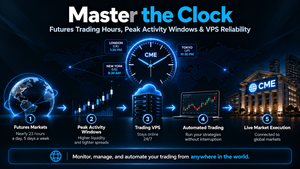
The execution of futures contracts for CME-related products is focused in the Chicago/Aurora region where CME’s data center and co-location services are physically located. Every order, and every quote, gains a bit of unnecessary inconsistency when your platform for futures trading is on a server hundreds of miles away from that execution path, or on a home connection going through several consumer ISPs. Not all traders require sub-millisecond executions, as the majority of retail and prop futures trading strategies are not based on a fraction of a millisecond. However, the distance introduces an element of uncertainty that is not a part of your strategy.
Fix: Make sure that you select a hosting site that is fairly close to the infrastructure that your broker actually uses. Additionally, test your connection; don’t just trust the numbers on a sales page.
This is where a high-quality service like TradingVPS is crucial for dedicated algorithmic traders. TradingVPS offers super-low latency to key brokers, meaning your orders reach the market first. Their powerful infrastructure is built specifically for execution, featuring AMD Ryzen 9950 CPUs, DDR5 RAM, and Gen4 NVMe SSDs to ensure absolute reliability for automated and high-frequency trading.
Mistake 2: Running “Set and Forget” Default Configurations
The idea behind automation is that a bot trades for you when you’re sleeping. However, markets don’t just stand still, and a “set and forget” bot soon becomes a “fight and forget” bot. A grid bot with a huge, fixed price range locks up a lot of its capital in orders that may never get executed. When the market starts to trend, a tight grid that’s been built for sideways chop is left behind. Static RSI levels that performed well in a backtest begin spitting false signals as soon as volatility moves under the levels.
Fix: Do not consider the configuration of your bot as something you set once and forget. Use accumulation logic or short logic when there is a clear downtrend and widen when there is a sustained uptrend. Use volatility-based indicators such as Bollinger or Keltner Channels instead of static RSI levels so that the bot will respond to the market that it is trading in, rather than the market that it was optimized for last month.
Mistake 3: Relying on Oversold, “Noisy Neighbor” Infrastructure
One mistake is buying a generic (non-trading) VPS using only the advertised RAM. It is common for generic cloud providers to oversubscribe their hardware. They may host 50 users on one physical server, hoping that not all of the users are using their maximum CPU allocation at the same time.
When there is big economic news, all the trading algorithms respond at the same time. When you are on an oversold server, you become a victim of the “noisy neighbor” effect. Your CPU gets throttled, your platform’s event loop freezes, and your bot fails to send its cancel-and-replace orders.
Fix: Your platform for futures trading must operate on infrastructure that has dedicated resource allocation. A server equipped with an AMD Ryzen 9 9950X or AMD Epyc processor, which includes dedicated threads, guarantees that your single-core processors’ performance does not slow down during periods of high market volume.
Mistake 4: Misunderstanding Uptime Design and Recovery Speed
Reliable is written on all hosting pages. It is what lies beneath this word that is important. With a 99.9% uptime, a server can be down for about 8.7 hours per year. When that unforeseen downtime happens during the New York open while your bot is fully loaded, the risk and slippage may undo months of work.
This is particularly harsh in the prop firm world. Apex Trader Funding’s rules state that a position must be flat by 4:59 PM ET, and Topstep has enforced a 3:10 PM CT flatten requirement for years. If your platform for futures trading crashes or your VPS slows down during one of those critical times, your account is simply breached.
Fix: Select infrastructure that prioritizes enterprise-grade redundancies. Your server needs to use NVMe SSDs (such as those used on top trading machines) so that log writes, database queries, and system reboots can be done in microseconds. Moreover, make sure that your provider offers always-on DDoS protection. This will ensure that your WebSocket connections are not lost during critical trading times due to malicious volumetric attacks.
Mistake 5: Assuming Every Platform for Futures Trading Behaves the Same with Every Broker
Today, more and more futures traders are operating multiple accounts, including multiple brokerages. The firms are linked through various rails, ranging from Rithmic to their own systems, to broker-specific bridges. A platform for futures trading that runs smoothly on one connection method can behave differently on another, especially under load. The problem for traders is that they ask “which platform should I use?” as a one-time thing, and they don’t consider revisiting it when a broker or firm changes their platform setups.
Fix: Ensure that the connection method supported by the platform is proven and stable for the particular firm before taking it live on a new account. Assuming compatibility carries over is not a good idea; a quick test session under normal load is the best.
Conclusion
None of these five mistakes are about picking the wrong software. They’re about under-investing in what sits underneath it. No matter how profitable a backtest is, if your server cannot place orders in real-time or your trading platform starts to freeze during the hottest periods in the market, the backtest is useless. By correctly setting risk limits, adapting your bot to the changing conditions of the market, and considering your execution environment as an integral part, you can avoid unnecessary capital losses due to technical issues.
TradingVPS gives you the perfect base for your trading systems, without infrastructure friction. It provides ultra-low-latency routing, 100% dedicated resources, and enterprise-class hardware, ensuring your bots work exactly how you want, around the clock, in any market.
Frequently Asked Questions
If your bot is fully hosted on a third-party cloud service (such as alerts from TradingView sent to the exchange), then you might not require a traditional Windows VPS for your execution. If you are using desktop applications such as NinjaTrader, MetaTrader 5, Sierra Chart, or custom Python scripts that need to keep you connected to the broker’s APIs at all times, then a VPS is essential. In this way, you can avoid leaving your trades unsupervised due to local power or internet outages.
Yes, if there is adequate dedicated headroom on the server. If too many platforms are loaded into a server, order execution will be delayed. When you have high volatility phases, always keep an eye on CPU and RAM usage, and leave 30% overhead.
That depends on your game plan. While most retail and prop futures traders do not require sub-millisecond execution, it helps to reduce avoidable inconsistency in order routing and market data delivery by hosting reasonably near the CME-related infrastructure in the Chicago/Aurora area.
REST is where your bot is continually pulling updates from the exchange, and it is slower and rate-limited. A WebSocket is a connection that remains open and delivers updates to you as they occur. WebSocket is the superior default for live data for any intraday bot on a futures trading platform.
While there is no real way to prevent a market crash, you can program protective measures into your bot. Use “circuit breakers” to halt trading when volatility reaches a level or after a series of losses reaches a limit. Also, make sure that your bot places hard stop loss orders on the exchange’s servers, and not stop loss orders that are sent by the bot once the price has already dropped.