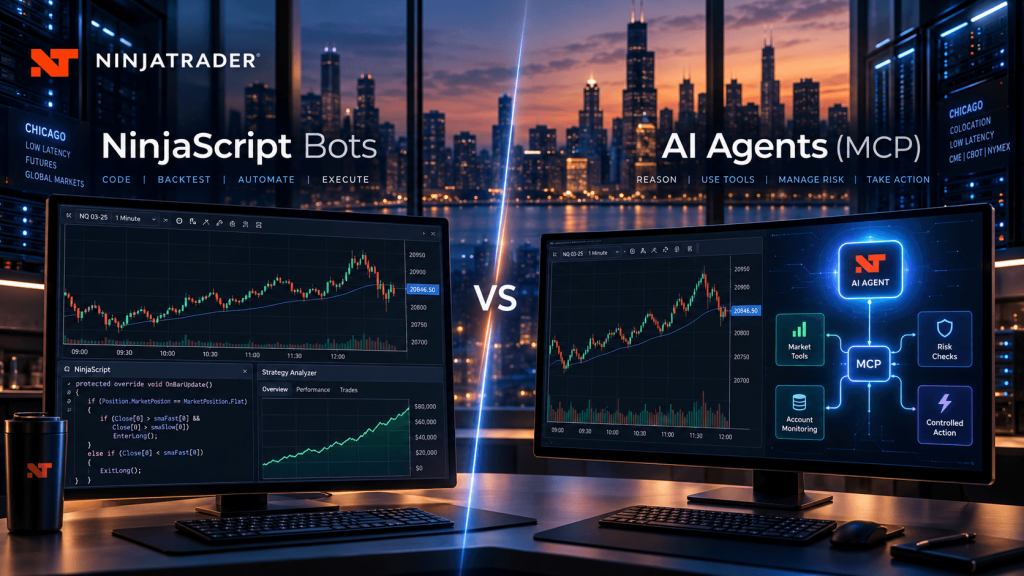
Automated trading in NinjaTrader has traditionally meant building a rules-based strategy with NinjaScript, testing it in Strategy Analyzer, running it in simulation, and eventually deploying it for live execution. The strategy follows deterministic logic: when specific market conditions occur, the code reacts according to predefined rules.
In 2026, NinjaTrader added another automation model: AI agents connected through Model Context Protocol, or MCP. Instead of relying only on fixed C# strategy logic, compatible AI systems can interact with NinjaTrader account and market tools through natural-language instructions. That creates a new layer of automation for account analysis, market research, risk review, order preparation, and potentially trade execution.
This does not mean AI agents replace NinjaScript. The two approaches are designed for different types of work. NinjaScript is strongest when speed, repeatability, backtesting, and deterministic execution matter. AI agents are strongest when the task involves interpretation, natural-language requests, multi-step analysis, or coordinating several account and market tools.
For futures traders, the important question is therefore not whether AI agents are “better” than traditional bots. It is where each technology belongs in the trading architecture and how VPS infrastructure fits into that system.
NinjaTrader AI Agents vs NinjaScript Bots
A NinjaScript strategy is compiled C# code running inside NinjaTrader Desktop. It can respond to ticks, bars, trade events, account changes, and other platform events while managing entries, exits, stops, targets, position sizing, and custom strategy logic.
A typical NinjaScript strategy may follow a rule such as:
If the 20 EMA crosses above the 50 EMA, price is above VWAP, the time is between 8:30 a.m. and 11:00 a.m. CT, and no position is open, buy one contract with a predefined stop and target.
The strategy does not need to interpret what the trader “means.” Every condition is defined in code.
An AI agent takes a different approach. Instead of executing one predefined algorithm, it receives a higher-level instruction and determines which NinjaTrader tools it needs to call.
For example:
“Show my current ES and NQ positions, summarize today’s P&L, check available buying power, and tell me whether adding another index-futures position would exceed my risk settings.”
That request requires several actions: retrieving account information, identifying positions, examining P&L, checking risk limits, and summarizing the result.
This is where MCP becomes useful.
| NinjaScript Bot | NinjaTrader AI Agent |
|---|---|
| Deterministic code | Natural-language reasoning |
| Runs in NinjaTrader Desktop | Connects through MCP |
| Designed for repeated execution | Designed for multi-step workflows |
| Backtestable | Not equivalent to a traditional backtest |
| Fast local reaction | Additional AI/tool-call latency |
| Highly predictable | More context-dependent |
| Ideal for entry/exit logic | Ideal for analysis and orchestration |
The two technologies can therefore complement each other rather than compete.
What NinjaTrader MCP Does
NinjaTrader’s 2026 AI initiative introduced an official MCP server alongside other AI-focused tools such as its AI trading companion and AI Strategy Builder.
MCP acts as a controlled bridge between an AI client and NinjaTrader account functionality. Compatible AI systems can use available tools to retrieve information and, when appropriate permissions are enabled, perform account actions.
The current MCP architecture can expose functions involving:
- account balances,
- positions,
- working orders,
- fills and history,
- futures contract searches,
- quotes and market information,
- Depth of Market snapshots,
- risk settings,
- order estimates,
- order placement,
- cancellations,
- order modifications,
- position closing,
- and alerts.
Without MCP, an AI assistant might explain how to perform a NinjaTrader task. With MCP, the AI can interact with supported NinjaTrader tools directly.
Conceptually, the flow becomes:
Trader → AI Agent → NinjaTrader MCP → Account / Market Tools
That creates more automation, but also more risk. A chatbot that misunderstands a question may produce a bad explanation. An agent with order permissions could potentially turn a misunderstanding into an actual order.
For that reason, the safest way to begin using NinjaTrader AI is usually with read-only access and a demo environment, then expand permissions only when the workflow has been thoroughly tested.
Why MCP Does Not Replace NinjaScript
AI agents are powerful, but they are not the ideal execution engine for every trading strategy.
Consider a futures scalping system that reacts immediately when price breaks a specific level. A traditional NinjaScript execution path might look like:
market event → strategy condition → order
An AI-driven path could look more like:
market event → AI request → model reasoning → tool selection → MCP call → order
That adds additional latency and variability to a decision that may not require any reasoning at all.
For deterministic trading rules, NinjaScript remains the cleaner architecture.
The advantage of AI becomes clearer when a task involves higher-level interpretation, such as:
“Compare today’s ES, NQ, CL, and GC exposure, identify whether my account is becoming concentrated, and review whether my risk settings should be adjusted.”
A NinjaScript strategy could be programmed to calculate this, but building custom code for every possible question would be inefficient.
An AI agent can interpret the request and combine several available tools dynamically.
A strong hybrid architecture may therefore look like:
AI Agent → analysis, research, portfolio review, account intelligence
NinjaScript → entries, exits, order handling, strategy execution
This gives each system the type of responsibility it handles best.
AI Strategy Builder Connects AI With Traditional Automation
One of the more interesting NinjaTrader developments is the AI Strategy Builder.
Instead of allowing the AI to make every live trading decision itself, a trader can describe a strategy in natural language and have the platform help translate those rules into a compiled and testable strategy.
For example:
“Create an ES strategy that trades only between 8:45 a.m. and 11:00 a.m. CT, enters after a pullback above VWAP, uses an eight-tick stop, targets 1.5 times the stop distance, and stops opening new trades after two consecutive losses.”
The AI can help transform those rules into a strategy that can then be evaluated through the normal NinjaTrader process.
That creates a useful middle ground:
natural-language strategy idea → AI-assisted strategy creation → compiled strategy → backtesting → simulation → deterministic execution
For many traders, this may be a better use of AI than placing an LLM directly inside the real-time execution loop.
AI speeds up development.
NinjaScript preserves repeatability.
Strategy Analyzer provides historical testing.
The trader still needs to verify that the generated strategy actually implements the intended rules.
Traditional Bots Still Have Important Advantages
Traditional NinjaScript strategies retain several advantages that AI agents cannot easily replicate.
The first is repeatability. Given the same market input and internal state, deterministic code should make the same decision. That makes debugging and strategy analysis much easier.
The second is backtesting. NinjaTrader strategies can be tested against historical data, optimized, and evaluated using Strategy Analyzer. A free-form AI agent is much harder to backtest because its decisions can depend on the model version, prompt wording, available tools, account state, and external context.
The third advantage is execution speed. Compiled strategy logic running directly inside NinjaTrader Desktop avoids the additional network and inference delays introduced by a remote AI model.
These advantages matter most for:
- scalping,
- breakout systems,
- order-flow strategies,
- fast stop management,
- high-volume market periods,
- and strategies requiring exact repeatability.
AI agents become more attractive where the task is less about reacting to a tick and more about understanding context.
Where AI Agents Have the Advantage
AI agents can be useful for tasks that are difficult to express as one fixed strategy.
A trader might ask:
“Analyze my last 50 futures trades and tell me whether my largest losses happened after adding to losing positions.”
Or:
“Find the current crude oil contract, check my available buying power, estimate the impact of trading one contract, and tell me whether the order would pass my current risk controls without placing it.”
These are multi-step tasks.
The agent can gather the required information, interpret it, and produce a useful answer without the trader needing a custom NinjaScript module for each question.
This is also why NinjaTrader separates read and write permissions. An agent can be used purely as an account analyst without giving it authority to place or modify trades.
A cautious progression could be:
Stage 1: read-only market and account analysis.
Stage 2: order estimates and trade preparation.
Stage 3: limited execution with strict risk controls.
That is much safer than granting unrestricted order access immediately.
Risk Controls Are Essential for Agentic Trading
AI agents introduce a different kind of automation risk.
Traditional bots can fail through programming errors. An EA-style loop bug can submit duplicate orders, calculate the wrong position size, or lose track of account state.
AI agents add semantic risk: the system might misunderstand a natural-language instruction or operate with incomplete context.
That is why server-side limits are important.
NinjaTrader’s MCP architecture supports risk checks around factors such as:
- order quantity,
- margin,
- account exposure,
- product restrictions,
- volume limits,
- and connection-level permissions.
A particularly useful concept is order estimation before execution.
Instead of immediately submitting a trade, the workflow can evaluate whether the order would pass risk and margin requirements first.
A safer agentic sequence therefore looks like:
interpret request → retrieve account state → identify contract → estimate order → check risk → confirm → execute
The risk engine should remain deterministic even when the higher-level instruction comes from AI.
This is the same design principle used in other secure automated-trading systems: AI can propose; deterministic risk logic decides what is allowed.
How VPS Infrastructure Fits Into NinjaTrader AI
The VPS requirement differs significantly between NinjaScript automation and MCP-based AI agents.
A traditional NinjaScript strategy runs inside NinjaTrader Desktop on Windows. If the strategy needs to run continuously without depending on a home PC, a Windows VPS is highly useful.
The execution environment is:
Windows VPS → NinjaTrader Desktop → NinjaScript Strategy → Broker / Connectivity → Futures Market
If the trader closes their personal computer, NinjaTrader continues running on the VPS.
The official NinjaTrader MCP server works differently. It is hosted remotely and accessed over the Internet by compatible AI clients. A trader does not necessarily need to install the MCP server on the same Windows VPS that runs NinjaTrader Desktop.
That means an MCP-only workflow can look like:
AI Client → NinjaTrader MCP → Account Tools
while a traditional strategy uses:
Chicago VPS → NinjaTrader Desktop → NinjaScript → Futures Execution
This is an important distinction because adding AI does not automatically mean the VPS needs more resources.
If the AI model itself runs remotely, the VPS is not performing the LLM inference.
Why Chicago Still Matters for NinjaScript Futures Trading
For CME futures traders, Chicago remains a logical VPS region to evaluate because CME’s execution infrastructure is centered around the Chicago/Aurora ecosystem.
The actual route may involve:
NinjaTrader → broker or connectivity provider → CME infrastructure
depending on the account and data connection.
A Chicago VPS can reduce reliance on residential Internet and position the desktop trading environment closer to the futures infrastructure that matters.
This is particularly useful for strategies that depend on:
- continuous market-data delivery,
- responsive order submission,
- multiple charts,
- DOM activity,
- NinjaScript automation,
- ATM strategies,
- local order-management behavior,
- or several simultaneous futures strategies.
An AI agent performing occasional account analysis is far less sensitive to a few milliseconds of additional network latency.
This is why infrastructure should be matched to the actual workload rather than treating every form of AI trading as latency-sensitive.
Platform Continuity Still Matters
Traders also need to understand where their orders and order-management logic actually reside.
Some accepted orders may remain at the broker, exchange, or connectivity provider even if NinjaTrader Desktop disconnects. But certain order relationships or strategy behavior can still depend on the local platform.
For example, some Rithmic OCO behavior in NinjaTrader can be simulated locally, meaning the platform needs to remain online to manage the relationship correctly.
This makes questions like these important:
Where is the working order stored?
Where is the stop managed?
Is the OCO relationship server-side or local?
What happens if NinjaTrader disconnects?
What happens if Windows restarts?
A VPS helps maintain platform continuity, but the strategy still needs appropriate restart and position-reconciliation logic.
NinjaScript, AI Agents and ATM Strategies Can Work Together
Modern NinjaTrader automation does not have to be built around one technology.
A trader could use:
| Component | Main role |
|---|---|
| AI Agent | Analysis, account review, research |
| MCP | Controlled AI access to NinjaTrader tools |
| NinjaScript | Deterministic strategy execution |
| ATM / order logic | Position and protective-order management |
| VPS | Keep Desktop and strategies online |
| Broker/connectivity | Route orders to the market |
The key is defining responsibilities clearly.
If both an AI agent and a NinjaScript strategy can independently close the same position, the two systems may eventually disagree about account state.
For example, a NinjaScript strategy may believe it owns a long ES position while an AI agent closes that position because the trader issued a manual natural-language instruction.
The strategy may then attempt to modify or exit a position that no longer exists.
For hybrid systems, account reconciliation and strategy ownership rules become essential.
Recommended VPS Resources for NinjaTrader Automation
NinjaTrader workloads vary significantly, so VPS resources should be sized according to the number of charts, strategies, indicators, order-flow tools, and testing workloads.
A practical starting point is:
| Workload | VPS Starting Point |
|---|---|
| One lightweight NinjaScript strategy | 2 fast cores, 8 GB RAM |
| Several strategies and charts | 4 fast cores, 16 GB RAM |
| Order flow + multiple strategies | 4–6 cores, 16–24 GB RAM |
| Multiple heavy workspaces | 6–8 cores, 24–32 GB RAM |
| Heavy Strategy Analyzer use | 8+ cores, 32 GB+ RAM |
High CPU clock speed is important for responsive live-trading workloads.
More CPU cores become increasingly useful when running optimization or several strategies simultaneously.
NVMe storage helps with historical data, logs, platform startup, local databases, strategy files, and cached market data.
TradingVPS‘s Chicago configurations use Ryzen 9 9950X CPU resources, DDR5 memory, NVMe storage, dedicated IPv4 connectivity, and Windows Server options suitable for NinjaTrader Desktop environments.
A simple futures strategy may only need 8 GB RAM.
A larger multi-strategy environment may justify 16–32 GB or more.
The correct plan should be based on measured workload rather than simply buying the largest machine available.
Frequently Asked Questions About NinjaTrader AI Agents
Yes. NinjaTrader introduced an official MCP environment in 2026 for connecting compatible AI assistants to NinjaTrader account and market tools. The environment remains beta/pre-release and may continue changing.
Yes, when the MCP connection has the required permissions. Traders can also use read-only access where order execution is unnecessary.
No. NinjaScript remains the main framework for deterministic automated trading inside NinjaTrader Desktop.
Chicago is a logical region to test because of the Chicago/Aurora futures infrastructure ecosystem. Actual latency depends on the broker and connectivity provider.
Yes, but the systems need careful position reconciliation because both interact with the same account state and risk limits.
Final Thoughts: AI Agents Add a New Layer to NinjaTrader Automation
NinjaTrader’s 2026 AI tools do not make traditional trading bots obsolete.
Instead, they introduce a new automation layer.
NinjaScript remains better suited to deterministic execution.
It can react directly to market events, enforce exact strategy rules, run continuously inside NinjaTrader Desktop, and be evaluated using historical backtesting and optimization.
AI agents are better suited to higher-level reasoning.
They can interpret natural-language requests, review account state, combine several tools, analyze positions, evaluate risk, and assist with workflows that would otherwise require custom software.
MCP is the bridge between those AI agents and NinjaTrader’s account tools.
A VPS is the infrastructure layer that keeps local Desktop-based automation running continuously.
For many futures traders, the strongest setup may therefore be hybrid:
AI Agent → research, analysis, account intelligence
MCP → controlled access to NinjaTrader tools
NinjaScript → deterministic trading logic
VPS → continuous NinjaTrader Desktop operation
Broker / Connectivity → market execution
The trader should decide which responsibilities belong to each layer.
If a decision needs exact, repeatable, low-latency execution, NinjaScript is usually the cleaner tool.
If a task requires interpretation across several pieces of account or market information, an AI agent may provide significant value.
And if the strategy depends on NinjaTrader Desktop remaining online, a properly sized Windows VPS—often in Chicago for CME-focused workflows—remains highly relevant.
The future of NinjaTrader automation therefore may not be AI agents versus traditional bots.
It may be AI agents working around carefully engineered traditional bots, with each system handling the work it performs best.
This article is provided for general technical and educational purposes only and does not constitute financial, investment, legal, or trading advice. Futures trading involves substantial risk. AI agents can misunderstand instructions or perform unintended actions. NinjaTrader’s MCP functionality is evolving, so users should verify current platform documentation, test agent workflows in a demo environment, and thoroughly evaluate automated strategies before live deployment.