
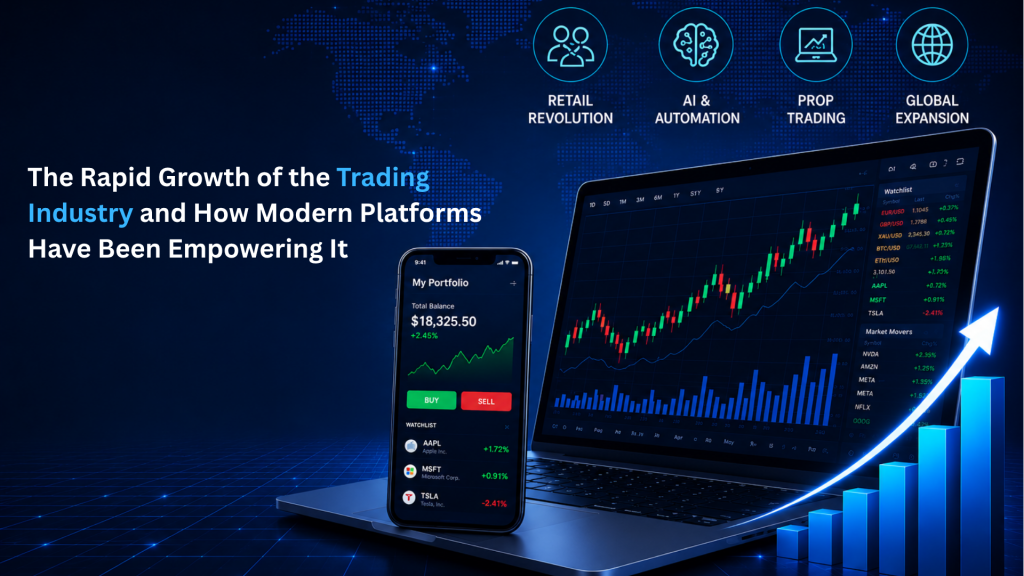
The trading industry is absolutely not limited to institutional investors who sit behind multiple screens. Over the last few decades, it has changed into a global and tech-driven ecosystem where anyone with a good smartphone can participate.
Despite global trade slowing down due to geopolitical tensions, the financial trading sector has seen impressive growth in recent years. However, this growth is not at all random. It has been highly influenced by technology, accessibility, and a new generation of traders.
A Market That Has Never Rested
The growth of the trading industry has been going out of the league. As per the recent statistics, the global online trading platform has reached USD 11.45 billion in the previous year.
- It is expected to grow steadily at a CAGR of 7% and reach USD 19.8 billion by 2034. You can also explore the real acceleration that is happening in specific segments.
- Algorithmic trading is one of the fastest-growing segments that has been effectively showcasing its potential due to automation and AI. The global algorithmic trading is expected to reach USD 4.33 billion by 2034.
- Stock trading apps are also witnessing an unmatched growth as mobile-first investments have become critical. Its market size is going to touch USD 140.07 billion by 2030. It has been growing at a CAGR of 18.3%.
Elements that Have Been Boosting this Growth
Here are the major factors that have been influencing the trading industry to grow on a large scale.
The Retail Revolution
Retail traders are no longer a small portion of the market. In fact, they are conveniently driving it. Retail investors now seriously dominate platform usage, accounting for nearly 70% of the market share in trading platforms. Today, individual inventors contribute a significant portion of daily trading volume across global markets. This shift is majorly fueled by fractional shares that allow users to invest with minimal capital. Mobile-first platforms make trading available anytime and anywhere. Gamified features grab the attention of younger traders and increase engagement.
AI and Automation
Trading is no longer about human decision-making. It has become machine-driven. Modern platforms are not capable of offering AI-powered trading insights, automated strategy execution, and high-frequency capabilities. Such technologies enable faster execution and better precision. However, they also demand ultra-fast and stable infrastructure. Even a small delay in execution might influence your profitability, mainly in algorithmic trading.
Gen AI is further transforming the landscape by making trading accessible for beginners. The advanced platforms are now serving AI trading assistants to suggest strategies, automate trades, and adapt to changing market conditions. This evolution has significantly enhanced speed, efficiency, and accuracy.
At the same time, HFT has become the cornerstone of algorithmic trading. Using advanced algorithms & ultra-fast computing systems, it allows traders to execute thousands of trades in milliseconds. It will not only drive market liquidity but also drive overall market efficiency.
Proprietary Trading
Proprietary trading has frequently moved from a niche segment to a mainstream opportunity within the global trading ecosystem. In this model, traders use the firm’s capital rather than their own funds. This revolution has grabbed the attention of new generations, who may have skills but lack capital.
The prop industry has witnessed impressive expansion, with the market now worth around $20 billion. The statistics showcase how accessible funding models and structured evaluation programs are reshaping individuals in trading. The advanced prop firms are leveraging modern platforms, real-time analytics, and structured risk management to support traders. These firms often provide training, performance tracking, and scalable allocation.
Emerging challenges to consider
- Regulatory scrutiny- Government & financial regulators are increasingly strengthening rules around high-frequency trading. The aim is to safeguard the retail investors from excessive risks, misleading interfaces, and algorithmic-driven volatility. The strict compliance demands may slow down innovation and aim to create a transparent and safe trading environment.
- Market volatility- The current geopolitical tension in areas such as the Middle East has vast worldwide market uncertainty. The fluctuating oil cost and supply chain disruption are hampering the investors’ emotions. Institutions such as the IMF have warned of the prolonged instability that could lead to significant market dislocation if the risks are not managed accurately.
- Overvaluation concerns- Most of the financial experts believe that the equity markets are overvalued because of liquidity inflows and unnecessary trends. There are growing concerns that markets may face a correction by late 2026 that could hamper both retail and institutional investors.
The trading industry has evolved into a tech-driven, accessible ecosystem driven by various growth factors such as AI, retail involvement, and advanced platforms. The frequent growth in mobile and algorithmic trading is reshaping the market, whereas prop trading broadens the opportunities. To succeed in this market, it is suggested to stay prepared for the risks and adopt modern practices.
Need lightning-fast execution for modern trading strategies? Explore reliable low-latency VPS solutions at TradingVPS and stay ahead in today’s competitive trading market.