Prediction markets are evolving rapidly.
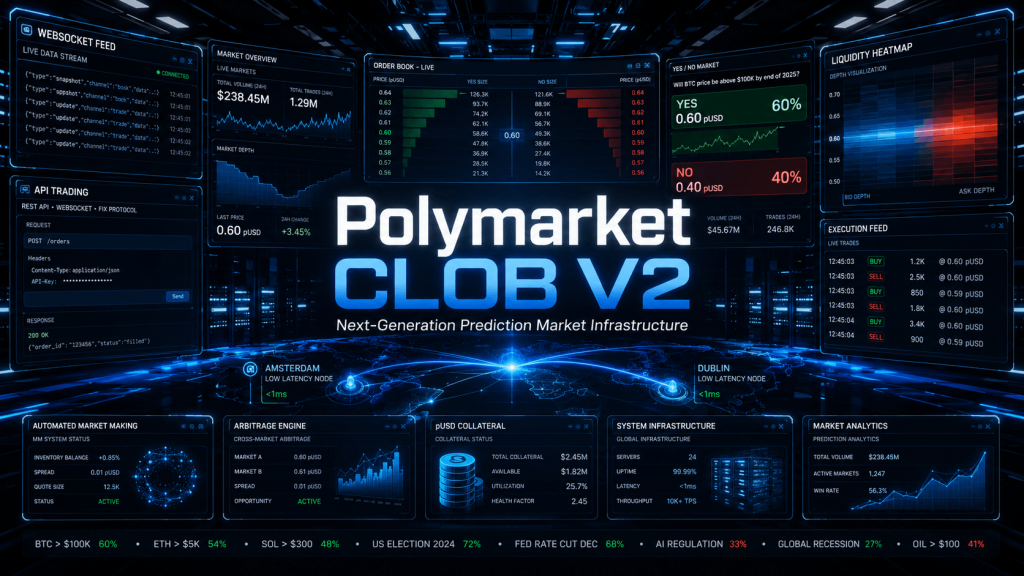
As trading volume grows and more algorithmic traders enter the market, infrastructure speed and execution reliability are becoming increasingly important. One of the biggest recent upgrades in the prediction market ecosystem is the Polymarket CLOB V2 update.
For active traders, market makers, API traders, and bot developers, this upgrade changes how orders are routed, managed, and executed.
It also increases the importance of using a low-latency trading environment.
In this guide, we will explain what the Polymarket CLOB V2 upgrade means, how it impacts trading performance, and why many serious traders are moving their trading bots and execution systems to TradingVPS infrastructure.
What Is the Polymarket CLOB?
CLOB stands for Central Limit Order Book.
Instead of relying purely on automated market makers, Polymarket uses a professional order book model that is much closer to traditional financial exchanges.
This allows traders to:
- Place limit orders
- Provide liquidity
- Execute tighter spreads
- Run market making strategies
- Build automated trading systems
- Use advanced execution logic
- Capture arbitrage opportunities
- Manage risk more efficiently
The CLOB architecture is one of the reasons why Polymarket has attracted sophisticated traders, quantitative firms, crypto-native market makers, and automation developers.
Unlike simplified prediction market systems, Polymarket’s exchange-style structure creates opportunities for:
- High-frequency execution
- Order book analytics
- Liquidity provision
- Statistical trading
- Cross-market arbitrage
- Event-driven trading
- Automated hedging
As trading competition grows, execution quality becomes increasingly important.
That is where the CLOB V2 upgrade becomes significant.
What Changed in Polymarket CLOB V2?
Polymarket’s CLOB V2 upgrade is much more than a simple backend update.
The migration introduced a completely rewritten exchange infrastructure, new exchange contracts, updated SDKs, a redesigned order structure, a new collateral token system, and major changes to how API-based trading works.
For traders running automated systems, market-making bots, arbitrage engines, or custom API integrations, these changes are extremely important.
Completely Rewritten Exchange Infrastructure
According to the official migration documentation, Polymarket rebuilt large parts of its trading stack for V2.
This includes new:
- Exchange contracts
- Order management systems
- Execution services
- Ledger systems
- Balance-checking services
- Tracking infrastructure
The exchange contracts themselves were rewritten with updated Solidity architecture and optimized gas efficiency.
This creates a more scalable foundation for future growth as prediction market volume continues increasing.
Nonce System Removed
One of the biggest architectural changes in CLOB V2 is the removal of the old nonce system.
In CLOB V1, traders and bots relied on order nonces for uniqueness and order management.
In V2:
- Nonces are removed
- Order uniqueness now uses millisecond timestamps
- Order structures are simplified
- Certain legacy order fields no longer exist
This significantly changes how custom bots and manual API integrations must handle order creation.
Many developers had to update their execution logic during migration because older V1-signed orders are no longer compatible with production.
New Order Structure
Polymarket also changed the raw order format used by the exchange.
Several older fields were removed, including:
noncefeeRateBpstaker
New fields were added, including:
timestampmetadatabuilder
This impacts:
- Custom API integrations
- Market-making systems
- Arbitrage bots
- Order management engines
- Manual EIP-712 signing systems
Any trader using direct API execution had to update their signing logic and exchange interaction methods for V2 compatibility.
Dynamic Fee System
CLOB V2 also changes how fees are handled.
Previously, fees were embedded directly into signed orders.
In V2:
- Fees are determined dynamically
- Fees are handled at match time
- Market information endpoints provide fee data
- Manual fee calculation logic is no longer recommended
This creates a more flexible trading environment but also changes how many algorithmic systems estimate profitability and execution costs.
Some traders reported that strategies optimized for the old execution environment required major recalibration after the migration.
New pUSD Collateral System
Another major change is the migration from USDC.e to pUSD (Polymarket USD).
For standard website users, this process is mostly automatic.
However, API traders and bot operators must now handle:
- pUSD wrapping
- Collateral conversion
- Updated settlement flows
- Modified redemption behavior
This especially impacts high-frequency automated systems that continuously recycle collateral between trades.
Some developers noted that the migration temporarily complicated redemption and collateral workflows for custom bot infrastructure.
New SDKs and API Migration
Polymarket also released entirely new SDK packages for CLOB V2.
The old SDKs:
@polymarket/clob-clientpy-clob-client
are no longer compatible with production V2 infrastructure.
Traders now need:
@polymarket/clob-client-v2py-clob-client-v2
This forced many trading bot operators to update:
- Signing logic
- Order handling
- Websocket systems
- Market data processing
- Builder integrations
- Execution workflows
Bots that were not updated stopped functioning after the April 2026 migration cutover.
Builder System Simplification
Polymarket also simplified the builder attribution system.
The older HMAC-based builder authentication flow was replaced with a simpler builderCode model attached directly to orders.
For developers building:
- Trading platforms
- Automated bots
- Analytics systems
- Market-making infrastructure
this creates a cleaner integration workflow with less overhead.
Why This Matters for Traders
CLOB V2 effectively moves Polymarket closer to a more professional trading infrastructure model.
The upgrade improves:
- Scalability
- Execution architecture
- API consistency
- Order management
- Infrastructure flexibility
- High-volume trading support
At the same time, it raises the technical standard for serious traders.
Many older trading systems required substantial updates after migration, especially market-making and API-intensive strategies.
As the ecosystem matures, infrastructure quality, latency optimization, and reliable VPS hosting become increasingly important for traders running automated strategies.
How TradingVPS Helps Polymarket Traders
TradingVPS infrastructure is designed specifically for latency-sensitive trading applications.
Whether you are running a simple API bot or a complex automated market-making system, infrastructure reliability matters.
Low Latency Network Routing
Execution speed can directly impact trading outcomes.
TradingVPS provides optimized network routes designed for fast API communication.
This helps traders:
- Reduce API delay
- Improve execution responsiveness
- Receive websocket updates faster
- Minimize slippage
- React more quickly to volatility
For active traders, even milliseconds can matter.
High-Performance Ryzen 9 9950X Infrastructure
Modern trading bots increasingly require strong CPU performance.
This is especially true for strategies involving:
- Real-time probability calculations
- Statistical models
- Multi-market scanning
- Arbitrage detection
- Order book analysis
- High-frequency execution loops
TradingVPS offers powerful Ryzen 9 9950X plans that are highly suitable for advanced trading workloads.
Strong single-core performance is especially important for:
- Python trading bots
- Node.js execution systems
- Market-making engines
- Real-time websocket processing
- API-intensive automation
24/7 Bot Uptime
Prediction markets never truly stop.
Major events can happen at any time.
A VPS allows traders to keep their systems online continuously without relying on a personal computer.
This is important for:
- Market-making bots
- Arbitrage systems
- Monitoring systems
- Alert engines
- Automated execution strategies
- Risk management systems
Instead of worrying about:
- Power outages
- Internet interruptions
- PC crashes
- Forced updates
- Local hardware instability
Traders can operate from a professional server environment.
Better Remote Trading Experience
Many traders monitor their systems manually alongside automation.
A professional VPS environment provides:
- Smooth remote desktop access
- Stable monitoring performance
- Faster application responsiveness
- Improved multitasking
This is especially helpful during high-volatility events when traders need to manage positions quickly.
Best Trading Strategies Benefiting From CLOB V2
The improved infrastructure opens more opportunities for advanced trading systems.
Market Making
Market makers continuously place buy and sell orders to capture spread opportunities.
This strategy benefits heavily from:
- Fast order updates
- Stable websocket data
- Low cancellation latency
- Reliable API execution
A low-latency VPS environment can improve quote responsiveness significantly.
Arbitrage Trading
Arbitrage traders attempt to capture pricing inefficiencies between:
- Related markets
- External sportsbooks
- Crypto markets
- Other prediction platforms
These opportunities may only last seconds.
Execution speed becomes extremely important.
News-Based Trading Bots
Some traders build systems that react to:
- Headlines
- Social sentiment
- Breaking political developments
- Sports updates
- Economic announcements
In these systems, infrastructure speed affects how quickly a strategy can react.
Order Flow Analysis
Advanced traders increasingly analyze:
- Liquidity shifts
- Spread changes
- Large order activity
- Market depth behavior
- Aggressive order flow
These strategies often require continuous websocket monitoring and fast data processing.
Best VPS Solutions for Polymarket Trading
After the Polymarket CLOB V2 upgrade, infrastructure speed and latency became more important for serious traders running bots and automated strategies.
A low-latency VPS can help improve:
- Order execution speed
- Websocket stability
- API responsiveness
- Arbitrage execution
- Market-making performance
For active Polymarket traders, Amsterdam and Dublin are two of the most popular VPS locations.
Dublin VPS
Dublin is becoming increasingly popular among algorithmic traders because of its modern datacenter infrastructure and reliable international routing.
It is ideal for:
- Automated trading bots
- High-frequency API execution
- Quantitative trading systems
- Continuous 24/7 trading automation
Amsterdam VPS
Amsterdam is widely used for trading infrastructure because of its strong European connectivity and stable network routing.
It is suitable for:
- Market-making bots
- API trading systems
- Arbitrage strategies
- Real-time websocket monitoring
Why Use TradingVPS?
TradingVPS is built specifically for latency-sensitive trading workloads.
Our infrastructure offers:
- Low-latency network routing
- Ryzen 9 9950X performance
- Stable 24/7 uptime
- Fast VPS deployment
- Optimized trading environments
For serious Polymarket traders, a professional VPS environment can provide a more stable and reliable setup for automated trading and execution systems.
Conclusion
The Polymarket CLOB V2 migration represents a major evolution in prediction market infrastructure.
With redesigned exchange architecture, updated SDKs, new order systems, dynamic fees, and improved scalability, Polymarket is becoming increasingly attractive to professional traders and automated trading firms.
But as the ecosystem matures, competition also increases.
Execution quality, infrastructure stability, and latency optimization are becoming more important for traders running:
- Market-making bots
- Arbitrage systems
- Quantitative models
- API trading automation
- High-frequency execution strategies
For serious traders, a professional VPS environment is no longer just a convenience.
It can become part of the trading edge itself.
TradingVPS provides infrastructure specifically optimized for low-latency trading workloads, with powerful Ryzen 9 9950X servers, fast deployment, stable uptime, and trading-focused VPS locations such as Amsterdam and Dublin.
As prediction markets continue growing in 2026 and beyond, professional infrastructure will likely play an increasingly important role in trading performance and automation reliability.
FAQs
Polymarket CLOB V2 is the latest version of Polymarket’s central limit order book infrastructure. It introduces updated exchange contracts, new SDKs, improved order handling, dynamic fee systems, and a redesigned trading architecture for better scalability and performance.
The migration changes how orders are created, signed, and executed. Traders using bots, APIs, or automated strategies must update their systems to remain compatible with the new infrastructure.
Amsterdam and Dublin are two popular VPS locations for Polymarket traders because they offer strong European connectivity, reliable routing, and stable performance for API-based trading systems.
Strategies that benefit the most include:
– Market making
– Arbitrage trading
– News-based trading bots
– High-frequency execution
– Real-time order book analysis
Yes. TradingVPS infrastructure is designed for latency-sensitive trading systems including market-making bots, arbitrage engines, websocket monitoring tools, and API-intensive trading automation.