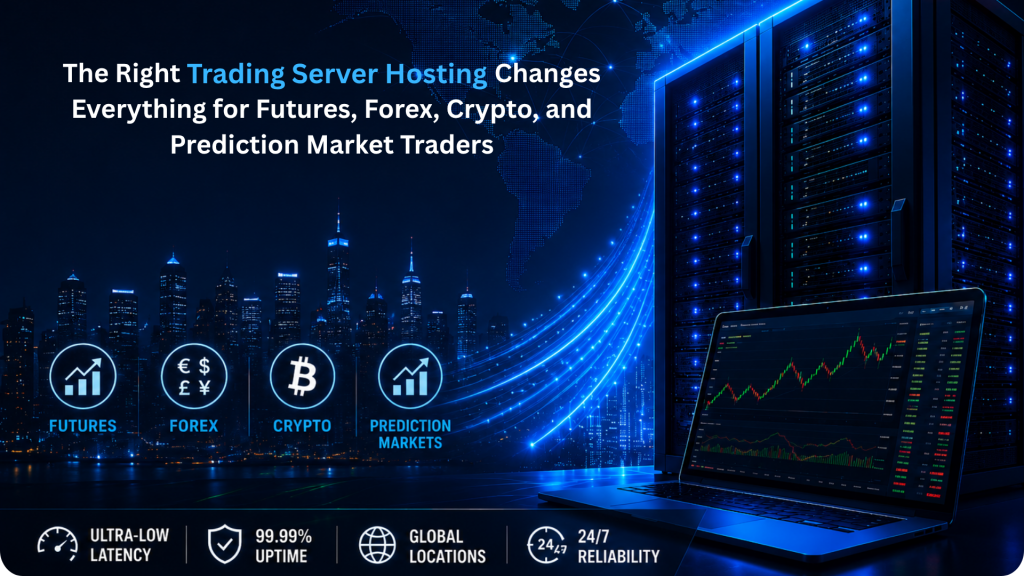
The volume of markets is hitting quarterly highs in 2025 and 2026 on both futures and forex, cryptocurrency, and prediction platforms. The number of traders taking part in the arena is rising. Institutional money is pouring in. Automated systems are executing thousands of orders per second.
In that environment, your strategy is only as good as the infrastructure behind it. And in the center of that infrastructure is your trading server hosting. This blog provides insights into why trading server hosting is important, how every major market has evolved, and what traders in these respective markets should seek for their setup.
Forex: The World’s Biggest Market Gets Even Bigger
The worldwide forex market is very huge, and as of April 2025, the daily forex trading volume is $9.6 trillion, which is 28% more than $7.5 trillion in 2022. The aggressive and divergent central bank policies have led to sharp currency swings, which have increased speculation from both institutions and retail traders. This growth was also likely due to increased hedging activity.
This is a genuine opportunity for Forex traders, but it also raises the level of competition. If everybody is responding to the same central bank news at the same time, then being 50 milliseconds late is akin to being completely absent from the trade. That is where trading server hosting turns into a must.
What forex traders should do: Place your VPS in a server location close to your broker. London and Frankfurt are the important centers for EUR/USD traders. Tokyo is more important for Asian pairs. Before deciding on a location, check the latency of the site using tools such as the Glassnode Latency Monitor.
Futures: Record Volumes and Rising Stakes
Trading volumes on CME increased by 139% in 2025 compared to the prior year, led by Micro Ether and Bitcoin futures. December 2025 marked a peak, reaching an all-time high of 339,000 contracts.
In 2025, Kraken made a $1.5 billion acquisition of NinjaTrader, a regulated American retail futures broker, to acquire not only regulation, but a large pool of traditional derivatives traders as well. This type of transition is significant because it reveals that there is a convergence between futures and crypto and that the infrastructure requirements are converging.
Charles Schwab has just introduced 24/7 Bitcoin futures trading, allowing select crypto futures to be traded around the clock until June 2, 2026. The eligible products include Bitcoin, Ether, Solana, and Ripple futures contracts. The 24/7 trading markets require that your trading system be online around the clock.
What futures traders should do: If you trade CME products like E-mini S&P 500 or Nasdaq futures, your server should be close to Chicago. Co-location is a significant factor for trading crypto futures at CME, either in New York or Chicago. For prop firm traders, uptime is critical: any downtime while trading could result in a drawdown violation and potentially losing your funded account.
Cryptocurrency: Institutional Adoption Changes the Game
In 2025, the trading volume of all cryptocurrency exchanges (spot and derivatives) reached a total of more than $79 trillion, with futures and perpetuals accounting for approximately $62 trillion. In 2025, there was a record volume of $862 trillion in centralized perpetual volume, representing a 47.4% increase from the previous year. By early 2026, the CME’s average daily crypto futures volume increased to nearly 404,000 contracts, representing a 47% increase from the previous year.
In 2026, one such critical data detail for crypto traders is the location of the servers on platforms like Hyperliquid. According to Glassnode, traders around Tokyo can connect to Hyperliquid’s validator nodes with a latency of 2–3 milliseconds. In Europe, traders can expect delays of more than 200 milliseconds. On a venue that processes billions of dollars each day, that deficit adds up each day.
As of June 1, 2026, CME Group began 24/7 trading of cryptocurrency futures and options. More than 7,200 cryptocurrency futures and options contracts were traded during the first weekend, with an estimated notional value of $50 million.
What crypto traders should do: Match the server location with the platform. Hyperliquid has a measurable advantage with a Tokyo VPS. If you are using Binance or Coinbase, use the Glassnode Latency Monitor CEX section to see which region has the lowest latency from your preferred exchange. Proximity to Solana-based DeFi strategies is important and dynamic for Solana-based DeFi strategies.
Prediction Markets: Speed Decides Who Gets Filled
Like traditional exchanges, prediction markets such as Polymarket operate by means of order books. When there is a news event, prices can move in milliseconds. The first one to arrive at the engine match gets a better price. The Polymarket Infrastructure is mainly deployed in London, on AWS eu-west-2. All the trade goes through that area.
For prediction market traders, Dublin (AWS eu-west-1) offers the best combination of ultra-low latency and platform access. For API based and bot-based strategies, Amsterdam (AWS eu-west-3) is a great alternative. Glassnode Latency Monitor is designed to measure real-time latency to Polymarket from various locations globally, without relying on latency estimates.
What prediction market traders should do: Use your trading bot on a VPS in Dublin or Amsterdam. Never use bots from home internet (ISP routing is not consistent and has unpredictable delays). Your competition is already on a professional infrastructure.
Latency Is the One Variable You Can Control
It takes time to learn strategy, risk management, and market selection. Latency is something that you can improve today. The Glassnode Latency Monitor provides real-time and continually refreshed latency data from probes in Asia, Europe, and the Americas, and publishes it to:
- Major centralized exchanges (Binance, Coinbase, Kraken, OKX, Bybit, Bitmex, Deribit)
- Hyperliquid API and Tokyo validator nodes
- Prediction markets (Polymarket and Kalshi)
- Solana validators with real-time leader rotation
- HFT oracle gateways, including Pyth Lazer and Chainlink Data Streams
This type of information was previously available exclusively to institutional firms. Now any serious trader can use it to make an informed decision about server placement. The key insight across all these markets: physical distance is still the dominant variable. Routing optimizations and premium networks help. However, nothing quite makes up for being in the wrong city.
What Does Professional Trading Server Hosting Require?
Now that you know the market background, let’s know what your trading server hosting service should provide in all four markets.
- Low latency to your target venues
This is non-negotiable. Always use the data from your measurement to check your connection speed to the exchanges and platforms you trade on, not marketing data.
- 24/7 uptime with redundant systems
Forex is operated on Asian, European, and US sessions. Crypto never closes, and prediction markets respond to information at 3 am. A good VPS provider will have redundant backup systems and uninterrupted connectivity on the servers.
- Remote access from anywhere
VPS is a way of monitoring and managing your trades on a virtual private network from home, on the road, or even on sea! You can take action on time-sensitive opportunities on the move from your mobile, and your automated strategies continue to operate 24/7.
- Hardware that keeps up with modern trading software
Today’s trading environment, particularly algorithmic trading bots, multi-feed data processing, and low-latency storage, relies heavily on the single-core CPU, memory speed, and storage latency. With old server hardware, there will be a bottleneck regardless of network tuning.
- DDoS protection
Trading servers are high-value targets. A DDoS attack at a critical moment in the volatile market can be the difference between hours or days of profit. Protection needs to be at the network level, not just the application level.
TradingVPS Is Built for Every Market on This List
We have the best infrastructure, AMD Ryzen 9 9950X processors, coupled with next-generation DDR5 RAM and NVMe SSD storage. This hardware configuration ensures that your robots have the latest market data in real time, so you can make orders efficiently.
- The NVMe drives communicate directly to each other via the PCIe, which reduces storage latency from milliseconds to microseconds. DDR5 RAM offers twice the bandwidth as previous generations.
- We have servers in Dublin, Amsterdam, London, Frankfurt, New York, and Chicago, the very hubs that are important for each of the four markets in this blog.
- From EUR/USD on London liquidity, to E-mini futures from Chicago, crypto on Hyperliquid’s Tokyo-adjacent infrastructure, or prediction markets on Polymarket’s London servers, we can find the perfect trading server hosting location for you.
Conclusion
Trading in 2025 and 2026 is more competitive, quicker, and technically demanding than ever before. Volumes in the Forex market have reached an all-time high. Futures markets have gone 24/7. Crypto derivatives are attracting institutional capital at scale. Prediction markets reward whoever reaches the order book first.
In each of these markets, the performance of your trading strategy depends on your trading server’s hosting infrastructure layer. Today, the right server location, the right hardware, and the right network connectivity are basic requirements to compete at a professional level. When analyzing all the trading needs, TradingVPS appears to be the best option for traders of futures, forex, cryptocurrency, and prediction markets.
FAQs
Though the Polymarket system core engine runs from AWS servers in London, Dublin offers the best combination of ultra-low latency and full-platform access to traders. For those using an API or bots, Amsterdam is an excellent choice for lightning-fast trades.
Now that Charles Schwab and the CME Group offer 24/7 trading for cryptocurrencies, your trading bot can’t afford any downtime. Our professional server offers round-the-clock uptime and redundant systems to avoid losing profits by violating drawdown limits at odd hours.
Being located close to the trading platform is necessary, but not enough. Outdated computing devices have limitations that slow down your order processing. Modern algorithms and bots require high-speed single-core processors, fast DDR5 RAM, and NVMe SSDs for quick execution of trades.