
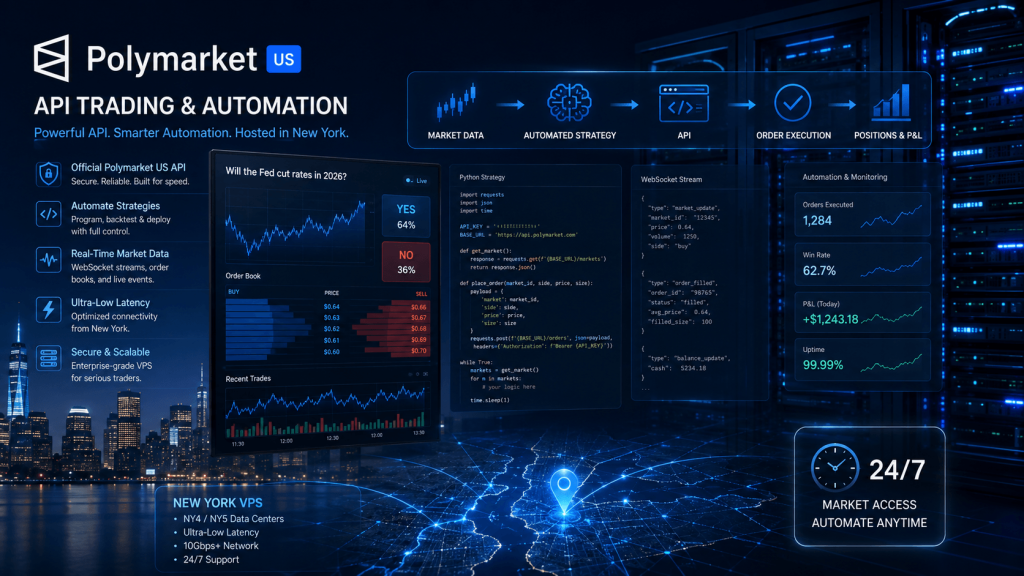
Polymarket US is becoming more than a platform for manually buying and selling event contracts. With an official API, Python and TypeScript SDKs, real-time WebSocket feeds, automated order support, portfolio endpoints, and programmatic market data, developers can build software that continuously monitors markets and interacts with the exchange without depending on a browser session.
The first distinction traders need to understand is that this guide is specifically about Polymarket US.
Polymarket US is not the international crypto-based version of Polymarket. It is a separate U.S. platform operating as a CFTC-regulated designated contract market, uses U.S. dollars, and provides its own API infrastructure, authentication system, developer portal, market data feeds, and trading endpoints. The CFTC lists QCX LLC doing business as Polymarket US as a designated contract market, while Polymarket US documentation describes the platform as a fiat-based U.S.-regulated exchange built for U.S. residents.
That distinction is especially important for developers. Code written for the international Polymarket blockchain ecosystem should not automatically be assumed to work with Polymarket US. The U.S. platform has its own REST API, WebSocket connections, API-key authentication, official SDKs, order model, compliance requirements, and exchange rules.
For traders interested in automation, this creates a more traditional exchange-style development environment. A program can retrieve markets, monitor order books, follow trades, check positions, submit orders, cancel or modify working orders, and receive real-time execution updates. Polymarket US even requires API orders to identify whether they were entered manually or by an automated trading system, confirming that programmatic order execution is a supported part of its API design.
Running such an application introduces a second question: where should the software operate?
A bot running from a trader’s laptop depends on that laptop remaining powered, connected to the Internet, correctly synchronized, and available whenever the strategy needs to respond. An always-on VPS moves the application into a persistent server environment. For Polymarket US specifically, TradingVPS New York is the relevant TradingVPS location, providing a U.S.-based environment for API bots, WebSocket listeners, monitoring tools, and other permitted Polymarket US workloads.
This guide explains how the Polymarket US API works, what can be automated, how real-time market data and order execution fit together, what developers need to know about API keys and rate limits, and how to build a reliable New York VPS setup for continuous Polymarket US trading applications.
What Is the Polymarket US API?
The Polymarket US API is the programmatic interface developers can use to interact with markets and trading accounts without manually performing every action through the consumer interface.
For retail app users, Polymarket US separates public information from authenticated account functionality. Public API resources can be used to retrieve events, markets, series, sports information, prices, order books, and search results without an authenticated trading session. Trading functions such as placing orders, viewing private portfolio information, and receiving private WebSocket updates require authenticated API credentials.
That creates a logical architecture for an automated application. The system can first discover markets through public endpoints, subscribe to real-time market information, evaluate that information according to whatever logic the developer has created, and then use authenticated endpoints only when an account-level action is required.
Polymarket US currently provides official Python and TypeScript SDKs. The Python package supports Python 3.10 and later, while the TypeScript library requires Node.js 18 or later. The SDKs handle request authentication and expose typed methods for markets, events, orders, portfolios, accounts, series, sports, search, and WebSocket connections.
For a developer, the difference between manual and API trading can be summarized like this:
| Function | Manual Polymarket US | API-based Polymarket US |
|---|---|---|
| Find markets | Browse interface | Query API |
| Monitor probability changes | Watch screen | Process data automatically |
| Order-book monitoring | Manual observation | WebSocket stream |
| Submit orders | Click manually | API request |
| Modify/cancel orders | Manual action | API request |
| Monitor fills | Watch account | Private WebSocket |
| Track positions | Account interface | Portfolio endpoints |
| Run continuously | Depends on user/device | Can run on VPS |
| Automate decisions | No | Yes, within platform rules |
The API should not be confused with an automatic trading strategy by itself. Polymarket US supplies the connection to the exchange. The trader or developer still decides what software should monitor, how signals are generated, what position limits apply, what prices are acceptable, and when orders should be submitted or removed.
Retail API vs Institutional API
Polymarket US actually documents more than one level of API access.
The retail API is intended for individual app users and provides REST and WebSocket access for personal accounts. Separately, Polymarket US has an institutional Exchange API intended for direct-market-access participants, independent software vendors, introducing brokers, futures commission merchants, and other professional integrations. That institutional environment adds protocols such as gRPC and FIX alongside broader clearing and account-management capabilities.
Most individuals searching for “Polymarket US API trading” will be interested in the retail developer environment, so that is the primary focus of this guide.
The retail API uses the api.polymarket.us infrastructure and official Python or TypeScript SDKs. Institutional documentation should not be mixed into a retail bot without understanding the separate onboarding, authentication, permissions, and connectivity requirements.
How Polymarket US API Trading Works
Before an individual can use authenticated trading endpoints, Polymarket US requires an account and identity verification. Current documentation instructs users to create their Polymarket US account through the app, complete identity verification, then access the Polymarket US developer portal to generate an API key. The credentials consist of a Key ID and Secret Key, and the secret is displayed only once when created.
The official SDK can then handle authentication automatically. Developers making raw requests instead must sign requests using the required Polymarket US authentication headers. The system uses a timestamp, access-key identifier, and cryptographic signature, and Polymarket US states that request timestamps must remain within 30 seconds of server time.
That last requirement makes correct server clock synchronization important for a VPS. A trading server with a badly drifting system clock can create authentication failures even when the API key itself is valid.
Once authenticated, the application can submit orders through the Orders API. Polymarket US supports both limit orders and market orders, along with functionality to modify existing orders, cancel individual orders, cancel all open orders, close positions, preview orders before submission, and perform certain batched operations. Current documentation permits batches of up to 20 orders for supported batch requests.
The exchange also supports several time-in-force instructions, including DAY, Good Till Cancel, Good Till Date, Immediate or Cancel, and Fill or Kill. That gives automated systems control over how long an order should remain active rather than forcing every strategy into one execution model.
One particularly important Polymarket US-specific requirement is the Manual Order Indicator.
Every API order is required to indicate whether it was generated manually or automatically. Polymarket US documents MANUAL_ORDER_INDICATOR_MANUAL for human-entered orders and MANUAL_ORDER_INDICATOR_AUTOMATIC for orders generated by an automated trading system. An API trading bot should therefore identify its orders correctly instead of marking automated execution as manual.
This is exactly why developers should build specifically against Polymarket US documentation rather than reusing assumptions from international Polymarket tools.
What Can Be Automated With the Polymarket US API?
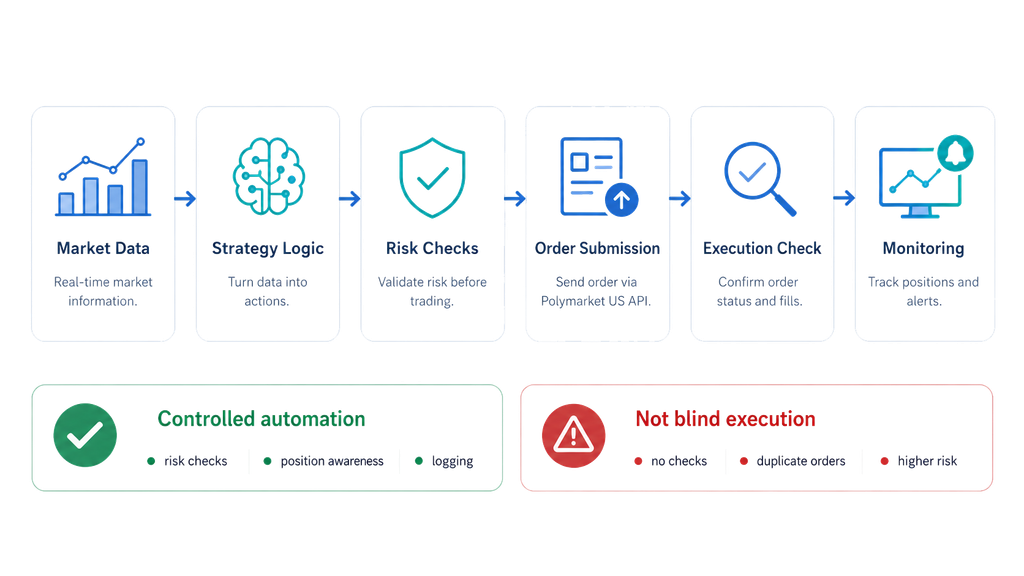
Automation does not have to mean a fully autonomous bot that decides when to trade and manages an entire account without supervision.
Some of the most useful Polymarket US applications may never submit an order automatically.
A developer could build a market scanner that watches hundreds of available contracts and sends an alert only when a probability crosses a defined threshold. Another program might track bid-ask spreads and notify the trader when liquidity improves. A research system could collect order-book and trade data for later analysis. A portfolio monitor could track positions and balances without placing new trades.
More advanced applications can combine those data functions with authenticated order execution.
For example, a strategy could monitor a particular event market using a WebSocket connection. If the best bid or offer moves beyond a predefined threshold, the application can verify its current account balance and existing exposure, check that the market remains active, confirm that the proposed price conforms to the contract’s minimum tick, and then send a limit order.
After submitting the order, the system should not simply assume execution occurred.
Polymarket US provides a private WebSocket stream that can deliver order, position, and account-balance updates in real time. The application can use those updates to determine whether an order was accepted, partially filled, completely filled, canceled, replaced, rejected, or expired.
A practical automated architecture therefore looks more like:
Market data → strategy logic → risk checks → order submission → execution confirmation → position update → monitoring
rather than:
Signal → blindly send trade
That difference is crucial for reliable automation.
A robust system should know its existing position before placing another order, understand whether an earlier order is still working, recognize partial fills, handle rejected orders, and prevent duplicate execution after a restart.
Market Making, Alerts and Event-Driven Automation
Polymarket US’s API can technically support several types of legitimate automated workflows.
A market-monitoring system can continuously evaluate probability changes. A liquidity-monitoring tool can analyze spreads and order-book depth. A market-making application can place and update resting limit orders subject to applicable exchange rules. An event-driven strategy can combine permitted external data with Polymarket US pricing and use predefined rules to determine when an order should be considered.
The API itself does not make these strategies profitable.
Automation simply allows a program to process information and interact with the exchange consistently. A poorly designed automated strategy can lose money faster than a manual trader because the computer will execute bad logic very efficiently.
Risk controls therefore matter just as much as signal logic.
Position limits, maximum order size, maximum daily exposure, duplicate-order protection, stale-data checks, order-price boundaries, connection health, and an emergency cancel mechanism are all useful parts of a production system.
Polymarket US also explicitly prohibits manipulative behavior including spoofing, wash trading, fictitious transactions, self-dealing, front-running, attempted manipulation, and other disruptive practices. Automation does not exempt a participant from those requirements.
Why WebSockets Matter for Polymarket US Bots
An inexperienced API developer may begin by repeatedly asking the REST API for the latest market price every fraction of a second.
That approach is usually inefficient.
Polymarket US provides dedicated WebSocket streams for real-time data. The markets WebSocket can deliver order-book information, lighter market data, and trade notifications. The private WebSocket provides account-specific updates such as order changes, positions, and balances.
For an automated system, WebSockets have several advantages.
The connection stays open instead of repeatedly creating new HTTP requests. Updates can arrive as events occur, reducing unnecessary polling. A bot can react to order-book changes immediately rather than waiting for the next scheduled REST request. Private execution events can also provide a much cleaner view of order status than repeatedly asking whether an order has filled.
Polymarket US documentation recommends handling reconnections automatically, monitoring heartbeat messages, processing messages in sequence, and limiting subscriptions to markets the application actually needs.
These are exactly the kinds of processes that benefit from running on an always-on server.
A laptop moving between Wi-Fi networks may lose its WebSocket connection. Closing the lid may suspend the process completely. A residential router reboot can terminate long-running connections. On a properly configured VPS, the bot and its WebSocket sessions can continue operating independently of the device the trader uses to view them.
REST still has an important role. It is appropriate for actions such as fetching reference information, making authenticated account requests, previewing or submitting orders, and performing specific queries. The strongest architecture normally uses streaming for rapidly changing information and REST for actions that do not require a permanently open data stream.
Polymarket US API Rate Limits and Order Handling
Automated trading does not mean sending unlimited requests.
Polymarket US enforces API rate limits, and developers should design their software around those restrictions instead of sending traffic until the server rejects it.
Current retail Orders API documentation lists a global limit of 20 requests per second per API key and instructs developers to implement throttling and exponential backoff when receiving 429 Too Many Requests responses. Polymarket US also recommends using WebSockets rather than repeatedly polling for updates.
Institutional API environments have their own separate firm-level and protocol-specific limits, which is another reason not to combine retail and institutional API documentation when designing an individual trading bot.
A production bot should therefore maintain its own request budget.
If a strategy is monitoring 100 markets, that does not mean it should make 100 REST requests every second. WebSocket subscriptions can carry many real-time updates through persistent connections, while relatively static market metadata can be cached locally.
Error handling is equally important.
An order request can fail because the market is closed, the quantity is incorrect, the price does not match the permitted increment, the price is outside valid bounds, liquidity is unavailable for the requested market order, account risk limits are reached, authentication fails, or network conditions interrupt the request.
Polymarket US also supports slippage-tolerance settings for certain market and close-position orders. Without explicit slippage protection, current documentation indicates that market orders can have unlimited slippage tolerance by default. Automated systems should therefore understand exactly how their chosen order type behaves before using it in live markets.
For many automated workflows, limit orders can provide more explicit price control. Whether that makes sense depends on the strategy because a limit order also introduces the possibility that the market moves away and the order never fills.
There is no API setting that eliminates the trade-off between price certainty and execution certainty.
Polymarket US VPS Setup: Why Use a New York VPS?
A Polymarket US API bot is fundamentally a server application.
It needs CPU resources to execute strategy logic, memory to maintain market state, storage for logs and databases, a stable network connection for REST and WebSocket communication, correct system time for authentication, and enough reliability to continue running when the developer’s personal computer is unavailable.
For this specific workload, TradingVPS New York is the TradingVPS location we recommend for Polymarket US.
This should be distinguished from VPS recommendations for the international Polymarket platform. TradingVPS uses different infrastructure locations for different trading venues and network routes. The New York service is the relevant U.S. option for Polymarket US API trading, while global Polymarket infrastructure should be evaluated separately. TradingVPS’s current Polymarket US offering specifically recommends its New York VPS for U.S.-based Polymarket US trading systems.
A New York VPS can be used to run Python bots, Node.js/TypeScript applications, WebSocket listeners, databases, monitoring dashboards, scheduled tasks, log collectors, and risk-management services in one persistent environment.
TradingVPS’s New York infrastructure is available with high-frequency AMD Ryzen processors, DDR5 memory, NVMe storage, dedicated IPv4 connectivity, Windows Server or Ubuntu options, and high-speed network connectivity. For an API-driven strategy, Ubuntu may be attractive for lightweight Python or Node.js deployments, while Windows can be more convenient for users who also want graphical tools or Windows-specific software.
The reason to use a VPS is not that New York magically guarantees a winning trade or a particular fill.
Network routing changes. Exchange infrastructure changes. Different API requests can take different paths. A VPS cannot eliminate Internet latency or guarantee execution ahead of another participant.
The practical benefit is having a persistent U.S.-based computing environment that can remain online and connected while the user’s desktop or laptop is turned off.
A Practical New York VPS Architecture
A clean Polymarket US VPS setup does not need to be excessively complicated.
At the center is the trading application, usually written in Python or TypeScript. API credentials should be loaded from environment variables or a dedicated secrets-management mechanism rather than written directly into the source code. Polymarket US itself recommends keeping keys out of code and version-control systems and revoking compromised credentials immediately.
The application can then establish a markets WebSocket to receive the information needed by the strategy and a private WebSocket to receive account and execution events.
The bot maintains local state containing the latest relevant market prices, working orders, fills, current positions, and available balance. Strategy logic evaluates that state and passes potential orders through risk checks before any authenticated request is made.
Orders are submitted using the API with the automated order indicator correctly set. Execution events then update the application’s state.
Logs should be written to persistent storage so that a restart does not erase the information needed to understand what happened.
A separate monitoring process can verify that the main application remains alive. More advanced setups can also monitor whether WebSocket heartbeats are arriving, whether API authentication is still succeeding, whether market data has become stale, and whether disk or memory usage is approaching unsafe levels.
This creates a much more resilient architecture than simply leaving a Python terminal open on a home laptop.
How to Configure a VPS for Polymarket US Automation
The first decision is the operating system.
For developers running a pure Python, Node.js, Docker, or database workload, Ubuntu is often efficient because it has low overhead and mature tooling for server applications. Windows Server can still be a good choice for developers who prefer Remote Desktop, graphical applications, or Windows-based management.
After deployment, the system clock should be synchronized correctly. This matters because Polymarket US authenticated requests include timestamps and can reject requests whose timestamps fall too far outside server time.
The application runtime comes next. Python users can install Python 3.10 or later and the official polymarket-us SDK. TypeScript developers can install Node.js 18 or later and the corresponding official package.
API credentials should then be stored securely. They should never be pasted permanently into a publicly accessible source file, uploaded to GitHub, printed into logs, or exposed through an unsecured web dashboard.
Once the application can authenticate successfully, test market-data access before enabling live execution. Confirm that the WebSocket reconnects after a temporary network interruption. Confirm that the software recognizes heartbeat failure. Confirm that duplicate orders are not generated after restarting the bot. Confirm that the program handles partial fills rather than assuming every order is either fully filled or completely empty.
Only after the monitoring and risk layers behave correctly should automated execution be treated as production-ready.
For users choosing TradingVPS New York, the ideal server size depends much more on the software workload than on Polymarket US itself. A single lightweight Python bot processing a small number of markets can use modest resources, while multiple strategies, databases, large WebSocket feeds, machine-learning inference, backtesting, and several simultaneous applications will require more CPU and RAM.
The goal is to maintain sufficient headroom so the machine does not become resource constrained during the exact moment market activity increases.
Security, Reliability and Compliance for Automated Trading
API keys effectively provide programmatic access to a trading account. They should be treated with the same care as other sensitive financial credentials.
The Polymarket US secret key is shown once during creation. If it becomes exposed, the correct action is to revoke it and issue a replacement rather than hoping no one uses it.
The VPS itself should also be secured. Use a strong administrator or SSH credential, keep the operating system updated, restrict unnecessary network ports, enable a firewall, and avoid running unrelated public services on the same trading server unless they are properly secured.
Reliability requires more than leaving the bot process open.
A well-designed deployment should have an automatic restart mechanism. On Linux, that might use a service manager such as systemd. On Windows, a service or scheduled recovery mechanism can perform the equivalent role. The objective is that a process crash does not leave the strategy offline indefinitely.
The application should also know the difference between restarting safely and immediately sending new orders.
On startup, it should first restore or reconstruct its state, query existing positions and open orders, reconnect to real-time streams, and verify that data is current. Only after synchronization should it resume automated decision-making.
That avoids one of the most dangerous automation errors: a restarted bot assuming it has no position because its in-memory state was erased.
Compliance should be designed into the software too.
Automated orders must be identified appropriately. Strategies must comply with Polymarket US rules against manipulation, spoofing, wash trades, fictitious activity, and other prohibited conduct. API rate limits need to be respected. The trader remains responsible for the activity generated by the software running under the account.
A New York VPS changes where the program runs. It does not change who is authorized to use the account, remove identity-verification requirements, or override exchange rules.
Common Polymarket US API Trading Mistakes
The first major mistake is using documentation or code written for global Polymarket and assuming it applies directly to Polymarket US.
It does not.
Polymarket US has separate API endpoints, official SDKs, authentication, USD-based accounts, order requirements, regulatory rules, and infrastructure. A tutorial discussing Polygon wallets, the international CLOB, USDC collateral, or global Polymarket API endpoints is not automatically a Polymarket US automation tutorial.
Another mistake is polling every data point through REST. WebSocket feeds exist specifically for real-time market and account updates and can create a cleaner, more efficient architecture.
Developers also need to avoid treating an order submission response as proof of a fill. Orders can be accepted and remain resting, fill partially, be canceled, or be rejected. Real-time private WebSocket events should be incorporated into the bot’s state.
Authentication failures caused by server-time drift are another preventable problem. Because signed requests contain timestamps, keeping the VPS time synchronized is part of API reliability.
Hardcoding API secrets is equally risky.
And perhaps the most important mistake is deploying automated order execution before creating risk controls and monitoring. A bot that can place orders but cannot recognize stale market data, duplicated orders, partial fills, broken WebSockets, or unexpectedly large positions is not a production trading system.
Frequently Asked Questions About Polymarket US API Trading
Yes. Polymarket US provides APIs for market data, orders, portfolios, account information, WebSocket streaming, and other exchange functionality. Official Python and TypeScript SDKs are also available.
No. Polymarket US is a separate U.S.-regulated platform with its own API, authentication, developer portal, USD trading environment, and exchange infrastructure.
Yes. The Orders API explicitly includes a required manual-order indicator with a value specifically for orders placed by an automated trading system. Automated activity still has to follow Polymarket US exchange rules and applicable regulations.
Identity verification is required before an app user can generate trading API credentials. Current documentation instructs users to create an account, complete verification, and then generate credentials through the developer portal.
For Polymarket US, TradingVPS recommends its New York VPS rather than the locations used for international Polymarket workloads. It provides a U.S.-based server environment suitable for Python bots, TypeScript applications, WebSocket monitoring, databases, and other permitted automated trading tools.
Final Thoughts: Building a Reliable Polymarket US API Trading Setup
Polymarket US API trading creates a substantially different workflow from simply opening the Polymarket US app and manually selecting an event contract.
The U.S. platform provides developers with public market-data APIs, authenticated trading endpoints, official Python and TypeScript SDKs, real-time WebSocket connections, order-management functions, portfolio information, and support for explicitly identified automated orders.
That makes it possible to build everything from simple market alerts to sophisticated always-on trading applications.
The strongest architecture does not begin with the order button. It begins with reliable data.
A production system should maintain live market state through WebSockets, verify account positions, apply its own risk controls, submit properly identified automated orders, monitor execution events, handle partial fills and rejects, stay inside current API limits, and recover safely from server or network interruptions.
Infrastructure then becomes the foundation underneath that application.
For Polymarket US specifically, TradingVPS New York is our recommended location. A New York VPS can provide a persistent U.S.-based environment for Python bots, TypeScript services, WebSocket listeners, market scanners, databases, alerts, and permitted automated Polymarket US trading systems without requiring a trader’s personal computer to remain switched on continuously.
That recommendation is specifically for Polymarket US. It should not be confused with infrastructure guidance for the global Polymarket platform, which uses a different technical environment.
A VPS cannot create a profitable strategy, guarantee execution, eliminate slippage, or protect a trader from market risk. What it can do is remove several avoidable infrastructure dependencies and provide a consistent environment in which a properly designed application can run.
For developers approaching Polymarket US automation in 2026, the practical sequence is clear:
Understand the U.S. API. Complete the required account verification. Secure the API credentials. Build around WebSockets rather than excessive polling. Mark automated orders correctly. Add position and execution controls. Test reconnect and restart behavior. Then deploy the application to a persistent environment such as a TradingVPS New York server.
The trading logic remains the developer’s responsibility.
The VPS simply keeps that logic where it belongs: online, monitored, and ready to communicate with Polymarket US.
This article is provided for general informational and technical-education purposes only and does not constitute financial, investment, legal, or trading advice. Event-contract trading involves risk. Polymarket US API specifications, rate limits, eligibility requirements, exchange rules, and available markets can change. Developers should verify current Polymarket US documentation before deploying production trading systems.