Prediction markets have quickly become one of the most interesting trading sectors for quantitative traders, data-driven speculators, and automation-focused investors. Unlike traditional markets, prediction exchanges allow traders to speculate on the probability of future outcomes such as elections, inflation data, crypto prices, sports results, and macroeconomic events.
Two of the most recognized platforms in this space are Polymarket and Kalshi. Because these platforms often list similar or overlapping events, pricing differences can appear regularly. Those temporary inefficiencies create an opportunity known as cross-exchange arbitrage.
This is where a Polymarket-Kalshi arbitrage trading bot becomes valuable. Instead of manually checking prices and trying to react quickly, an automated bot can monitor both exchanges in real time, calculate spreads after fees, and execute trades instantly when profitable opportunities appear.
For serious traders, strategy alone is not enough. Speed, stability, and uptime matter. That is why many advanced users run their bots on a dedicated TradingVPS, allowing them to trade 24/7 with lower latency and better reliability.
In this guide, we will explain how Polymarket-Kalshi arbitrage works, how bots are built, risks to understand, ideal VPS locations, and why TradingVPS is an excellent solution for this strategy.
What Is Polymarket-Kalshi Arbitrage?
Arbitrage is the process of taking advantage of price differences between two markets that reference the same or highly similar asset.
In prediction markets, both Polymarket and Kalshi may offer contracts tied to:
- Election winners
- Interest rate decisions
- Inflation numbers
- Bitcoin or Ethereum price targets
- Sports championship outcomes
- Government policy events
- Economic recession odds
Although both exchanges may reference the same real-world outcome, prices are often different due to separate liquidity pools, different user bases, platform rules, and market sentiment.
Example:
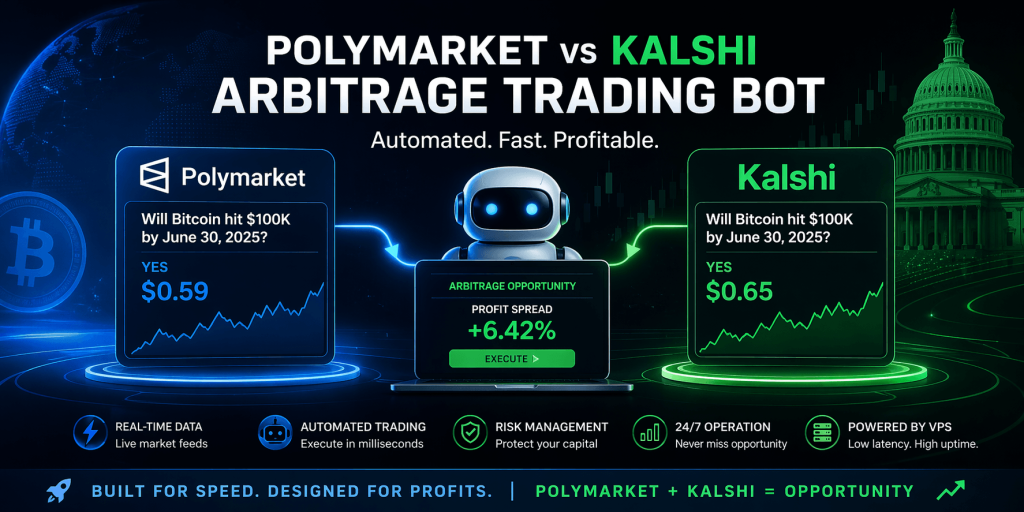
- Polymarket YES price = $0.59
- Kalshi YES price = $0.65
A trader may buy the cheaper side and hedge on the more expensive side. If the spread narrows or both contracts settle consistently, profit can be realized.
This concept sounds simple, but opportunities can disappear in seconds. That is why automated execution is so important.
Why Pricing Differences Exist Between Polymarket and Kalshi
Many new traders assume two markets tracking the same event should always have the same price. In reality, that rarely happens.
Different User Bases
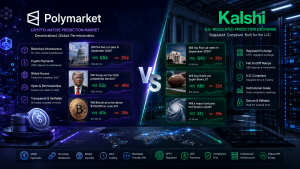
Polymarket often attracts crypto-native traders, globally active speculators, and users comfortable with on-chain systems.
Kalshi tends to attract users focused on regulated U.S. event contracts and macroeconomic speculation.
Because each crowd behaves differently, market sentiment can diverge.
Different Liquidity Levels
Some markets may have deep order books on one platform and thinner liquidity on the other. A large order can move price significantly in a shallow market.
Faster Reaction to News
One platform may react first to breaking headlines, political updates, CPI releases, or crypto market moves.
Fee Structures
Fees and spreads impact displayed pricing. Some traders price aggressively based on fee advantages.
Market Design Differences
Even when events seem identical, wording, settlement terms, expiration time, and resolution source may differ slightly.
All these factors create repeated short-term arbitrage opportunities.
Why Manual Trading Usually Fails
Many traders try to monitor both exchanges manually using browser tabs. This usually becomes frustrating because opportunities move too fast.
By the time a human:
- Checks Polymarket price
- Checks Kalshi price
- Calculates fee-adjusted spread
- Logs in
- Places both orders
…the pricing gap may already be gone.
Manual trading also struggles during high-volatility moments such as:
- Election night
- FOMC announcements
- CPI releases
- ETF approvals
- Major sports finals
- Sudden crypto rallies or crashes
This is why successful arbitrage traders often automate their strategy.
How a Polymarket-Kalshi Arbitrage Bot Works
A professional arbitrage bot is more than a simple price checker. It is a complete automated trading system.
1. Contract Matching Engine
The bot maps similar markets between both exchanges.
Examples:
- “Will Bitcoin hit $100k before July?”
- “Will BTC exceed $100,000 by June 30?”
Even though naming differs, they may reference nearly identical outcomes.
Good bots use custom symbol mapping, keyword logic, and manual overrides.
2. Real-Time Data Collection
The bot continuously pulls:
- Bid price
- Ask price
- Last trade price
- Order book depth
- Volume
- Spread
- Expiration time
WebSocket feeds are often preferred because they deliver faster updates than slow polling.
3. Spread Calculation
The bot then checks:
- Gross spread
- Fees
- Slippage estimate
- Position limits
- Settlement compatibility
Only real net-positive opportunities should trigger execution.
4. Smart Execution Engine
A high-quality bot can:
- Place both legs nearly simultaneously
- Cancel stale orders
- Reprice missed fills
- Scale into opportunities
- Split large orders across levels
5. Risk Management Layer
Essential controls include:
- Max loss per day
- Max exposure per market
- Max open positions
- API disconnect shutdown
- Balance checks
- Position reconciliation alerts
Without risk controls, arbitrage can become dangerous.
Example Arbitrage Scenario
Suppose both platforms offer the same election outcome.
Prices:
- Polymarket YES = 57¢
- Kalshi YES = 63¢
Potential strategy:
- Buy YES on Polymarket
- Sell YES equivalent / hedge on Kalshi
Spread = 6¢ before fees.
At $20,000 notional, that spread becomes meaningful if execution is efficient.
Now imagine dozens of such small opportunities appearing weekly. This is why firms and advanced retail traders automate these systems.
Why VPS Hosting Is Essential for Arbitrage Bots
Running a bot on your home PC creates multiple problems:
- Power outages
- ISP interruptions
- Windows updates
- Laptop sleep mode
- Higher latency
- Unstable Wi-Fi
- Missed overnight opportunities
A dedicated VPS solves these issues.
Benefits of Using TradingVPS
24/7 Continuous Uptime: Your bot stays online even while you sleep or travel.
Lower Latency Execution: Closer network routes can reduce delays to APIs and exchanges.
Dedicated Performance: Bots run smoother with dedicated CPU and RAM resources.
Stable Linux Environment: Many professional bots run best on Ubuntu.
Better Security Separation: Keep trading systems separate from your personal computer.
Easy Multi-Bot Deployment: Run arbitrage, hedging, scanners, and logging systems simultaneously.
Best VPS Locations for Polymarket Arbitrage
Location matters because network routing affects speed and accessibility.
For this strategy, New York and London are generally not ideal choices for Polymarket-focused setups due to regional access limitations and routing constraints.
Instead, traders often prefer:
Dublin VPS
Dublin has become one of the strongest options for Polymarket traders due to excellent European connectivity and strong routing performance. Many users report very competitive latency to relevant APIs.
Dublin is an excellent choice for traders who want balance between speed, reliability, and accessibility.
Amsterdam VPS
Amsterdam remains another popular option, especially for API-focused users who need excellent European infrastructure and premium data center connectivity.
It is often selected by automation traders seeking stable execution environments.
Which Is Better?
For many Polymarket-Kalshi arbitrage traders:
- Dublin VPS = Best overall balance
- Amsterdam VPS = Strong alternative with premium connectivity
Testing both can help determine the best route for your specific bot.
Why TradingVPS Is Great for This Bot
TradingVPS is designed specifically for traders who need fast, stable infrastructure rather than generic low-quality hosting.
High Performance Ryzen Plans: Powerful CPUs help bots process market feeds, calculations, and order execution faster.
Low Latency Network: Strong routing for trading applications where milliseconds matter.
Fast Deployment: Many users receive VPS details quickly after purchase so they can deploy bots fast.
Ubuntu Support: Perfect for Python and Linux-based trading bots.
Reliable 24/7 Infrastructure: Ideal for markets that never stop generating opportunities.
Multiple Global Locations: Useful for testing best routing paths.
Good for Automation Traders: Whether you run one bot or several strategies, TradingVPS is built for serious trading workloads.
Risks to Understand Before Trading
Arbitrage sounds safe, but execution risk is real.
Partial Fills: One side fills while the hedge side fails.
Slippage: Prices move while orders are executing.
Settlement Mismatch: Contracts may look similar but resolve differently.
Exchange Downtime: API issues can leave positions exposed.
Balance Fragmentation: Capital must often remain on multiple platforms.
Regulatory Compliance: Always follow each platform’s terms and local laws.
Final Thoughts
Polymarket-Kalshi arbitrage trading bots represent one of the most advanced opportunities in prediction markets today. Because the two platforms frequently price similar events differently, traders with strong infrastructure and automated execution can potentially capture recurring spreads.
But success rarely comes from strategy alone.
Winning traders usually combine:
- Fast execution
- Low latency hosting
- Stable uptime
- Smart risk management
- Efficient code
- Reliable VPS infrastructure
For traders serious about this niche, TradingVPS Dublin VPS or Amsterdam VPS can provide an excellent foundation for running a profitable arbitrage bot in 2026
FAQs
A Polymarket Kalshi arbitrage trading bot is an automated system that monitors both platforms for pricing differences on similar prediction markets. When profitable spreads appear, the bot can place trades quickly to capture the gap before prices adjust.
Arbitrage works when the same or similar event is priced differently on both exchanges. For example, if one market shows a lower probability price than the other, traders may buy the cheaper side and hedge on the higher-priced side.
Many traders prefer Dublin VPS or Amsterdam VPS because these locations can offer strong routing and stable connectivity for Polymarket-focused trading setups.
Yes, many traders choose TradingVPS for prediction market automation because of reliable uptime, strong performance, and suitable European VPS locations such as Dublin and Amsterdam.
Yes, depending on the VPS resources. Many traders run multiple scanners, arbitrage bots, dashboards, or logging tools on one high-performance server