When it comes to a trading bot, every millisecond counts. The signal is picked, an order is fired, and the broker executes, in fractions of a second. However, when the infrastructure that supports that bot is slow, inefficient, or lacks location, those fractions cost real money. And that is why it is crucial to select the proper VPS for trading bot.
Role of Latency on Your Bot’s Performance
Latency is the time that your bot takes to dispatch an order, and the broker has to execute it. It is a technicality amongst most traders. As a matter of fact, it is a profit variable.
The following is a basic example. A scalping bot pursues a 5-pip on EUR/USD. When your PC is 100ms away from the broker, and the market alternates or moves in that 100ms, your entry price changes. Those slippages accumulate into a quantifiable performance loss over hundreds of trades each month.
The part of the latency that is controllable reduces to a single choice of data center location. Placing a VPS near the matching engine of your broker can cut latency by 100ms to under 5ms in a great number of applications. That will be 95 percent of the difference that you can personally manage.
Bots Can’t Run Reliably from a Home Computer
The execution of a trading robot with a local computer poses some substantial risks:
- Power failures cancel dynamic positions without notice.
- ISP interruptions interrupt the bot when the market is volatile.
- The use of a system restart interrupts strategy execution at the worst moments.
- Sleep mode and updates break continuous operation overnight.
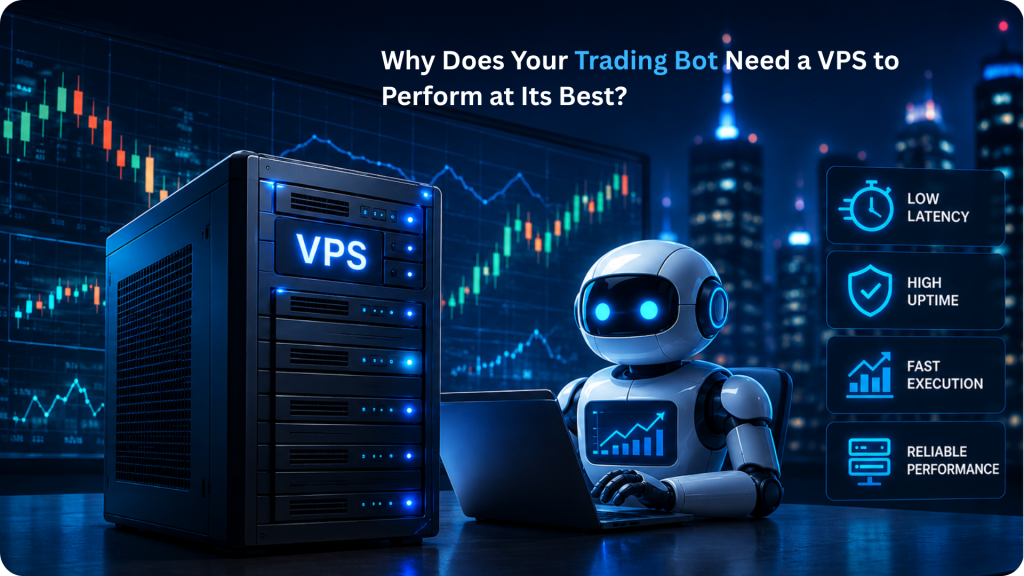
All of these are solved with a VPS for trading bot. It is hosted in a professional data facility that is online 24/7, has redundant power, high-end connectivity, and is monitored 24/7. The bot runs whether or not the local machine is on.
Hardware That Actually Moves the Needle
Trading does not work as well on all VPS hardware. Most trading platforms are not multi-threaded, which is why a single-processor clock speed is more important than core count.
The AMD Ryzen 9 9950X CPU, with a base frequency of 4.3 GHz and a turbo boost up to 5.7 GHz, offers the type of single-core performance that trading software requires. Combined with DDR5 RAM and NVMe SSD storage, this configuration supports speedy tick data processing, real-time market analysis, and expedited order execution with no bottlenecks.
Why NVMe Storage Matters for Trading Bots
NVMe storage is worth mentioning in particular. Bots that record tick data or execute data-intensive backtests on a live session make bursts of disk read/write access. In this case, standard SATA SSDs are at a disadvantage. NVMe eliminates that lag entirely.
How To Select the Right Datacenter Location?
The distance between where your VPS is and the server of your broker has a direct influence on your baseline latency. Most major forex brokers host their matching engines in a small number of well-known financial datacenter hubs:
- New York (NY4/NY5 Equinix)
- London (LD4/LD5 Equinix)
- Frankfurt (FR5 Equinix)
The most effective configuration choice that can be made is to match your location VPS to the server hub of your broker. In the case of scalping tactics, that figure must be maintained to be regularly under 10ms when using the VPS and the broker in the same datacenter.
What to Look for When Choosing a Trading VPS?
A VPS for a trading bot is not a standard hosting service. The following are the specifications that are relevant:
- CPU clock speed 3.5 GHz and above: Focus on single-thread performance.
- NVMe SSD storage: Required to run tick data and achieve a high-speed performance.
- Less than 1ms network latency to key broker servers.
- 99.9% uptime: Uncontrolled positions come with downtime during the active sessions.
- DDoS protection: Trading servers are targeted; free in-built protection is important.
- Windows OS compatibility: Many MT4/MT5 configurations cannot be run on Linux.
- 24/7 tech support: Problems do not keep regular operating hours.
Security and Stability for Automated Trading
The issue of security extends beyond DDoS defense. A dedicated VPS keeps your trading environment away from shared hosting risks, malware exposures, and unauthorized access.
Conclusion
A well-configured VPS for trading bot not only keeps your bot running but also proactively defends your advantage. The correct hardware, the correct place, and the correct infrastructure will make your algorithm slip less, eliminate the risk of downtime, and provide it with the stable environment it requires to work over time. TradingVPS is designed specifically with traders in mind and is powered by the AMD Ryzen 9 9950X CPU, with latency to major brokers under 1ms, and can be set up in less than five minutes.
FAQs
Regular web hosting is not designed for trading. A dedicated VPS for a trading bot needs an optimal single-core clock speed and often runs on Windows OS. Web hosting, on the other hand, tends to be Linux-based and favors multi-threading. Similarly, a dedicated trading VPS is physically installed in financial datacenter clusters, hence the near-zero latency for high-speed trades.
If you run your bot from home, then a local Internet Service Provider (ISP) failure will leave your positions open and at risk of unexpected moves. That’s why it’s important to use a VPS for your trading bot. With your bot running on a remote professional server, which has redundant power sources and 24/7 uptime, local ISP outages and computer reboots will not disrupt it.
Your VPS should be in the same location as your broker’s trading server. The first thing to do is locate where your broker’s matching engine is located; major financial hubs are New York (NY4), London (LD4), and Frankfurt (FR5). By selecting a VPS for a trading bot hosted in the same datacenter hub as your broker, you can reduce your network lag by as little as 5ms.
Low latency helps trading bots execute orders faster and respond quickly to market changes, reducing delays and slippage.
Yes, a VPS provides stable uptime, faster processing, and reliable connectivity for better trading bot performance.
A VPS allows trading bots to run continuously with stable performance, even when your local computer is turned off.
Run your trading bot with low latency and uninterrupted performance using TradingVPS.