Prediction markets have moved from a relatively niche corner of online trading into a much more visible financial-market category. Political elections, economic releases, interest-rate decisions, sports, technology developments, weather, entertainment, and other measurable events can now be expressed through contracts whose prices change as traders reassess the probability of an outcome.
Two names dominate many conversations about this market: Polymarket and Kalshi.
At first glance, the platforms appear very similar. A market might ask whether an event will occur, a YES contract could trade at $0.60, and that price can be interpreted as roughly a 60% market-implied probability. If the qualifying event ultimately occurs, a winning contract generally settles at $1. If it does not, the losing side settles at zero.
That similarity hides major differences.
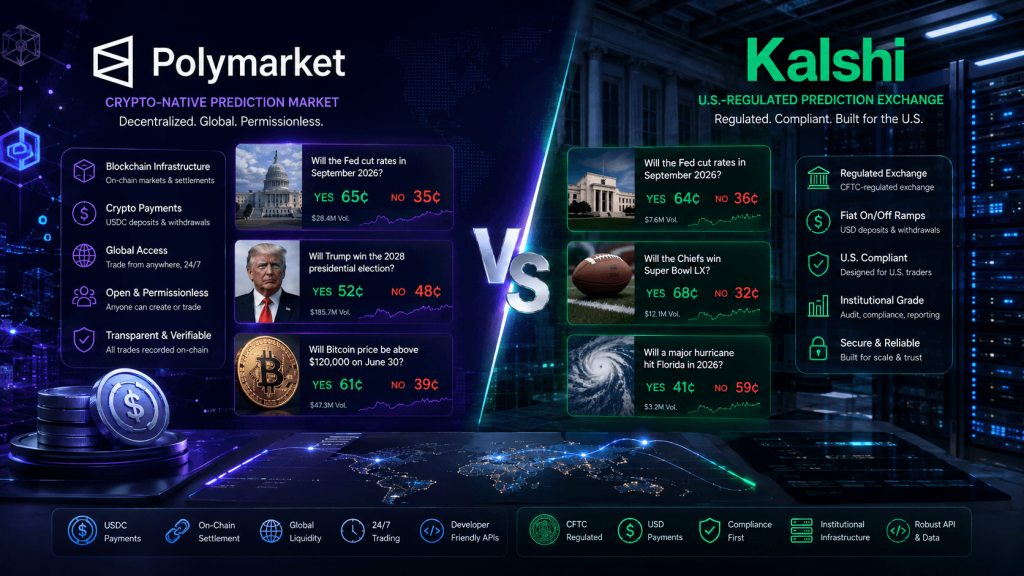
Polymarket developed primarily as a crypto-native, onchain prediction market with an international user base, while Kalshi was built as a federally regulated U.S. derivatives exchange.
The comparison became more complicated in 2025 and 2026 because Polymarket returned to the regulated U.S. market through Polymarket US, operated by QCX LLC, which is now a Commodity Futures Trading Commission-designated contract market. The global Polymarket platform and Polymarket US are separate environments and should not be treated as the same product. U.S. users visiting the international Polymarket site are currently blocked from trading there and directed toward Polymarket US instead.
Kalshi has also expanded significantly. It remains a CFTC-designated contract market and now clears through its affiliated Kalshi Klear derivatives clearing organization. The platform supports event contracts across a growing range of categories, operates nearly continuously, provides retail and API access, and has expanded funding options well beyond traditional bank transfers.
So the useful question in 2026 is not simply, “Is Polymarket better than Kalshi?”
The better question is: Which platform structure, regulation model, market selection, fee system, funding method, settlement process, and technical environment better matches what a particular trader actually needs?
Polymarket vs Kalshi: Quick Comparison
| Feature | Polymarket | Kalshi |
|---|---|---|
| Core product | Prediction/event markets | Regulated event contracts |
| U.S. structure | Polymarket US is a separate CFTC-regulated DCM | CFTC-regulated DCM |
| Global structure | Polymarket.com operates separately as crypto-native international platform | Available in the U.S. and many international jurisdictions, subject to eligibility |
| Trading model | Peer-to-peer order book | Exchange order book |
| Contract pricing | Usually $0–$1 probability-style pricing | $0–$1 probability-style pricing |
| Global Polymarket collateral | Crypto-native, with pUSD/USDC infrastructure | Primarily cash account with bank, card, wire and crypto funding options |
| Market resolution | Global platform uses UMA Optimistic Oracle; Polymarket US uses exchange rules and official sources | Exchange rules and defined official resolution sources |
| Fees | Vary by Polymarket entity and market category | Formula-based transaction fees; some markets can also have maker fees |
| Trading availability | Global markets generally trade continuously until resolution, subject to system availability | 24/7 except scheduled maintenance |
| API access | Available on global and U.S. platforms | REST and WebSocket APIs |
| Best fit | Crypto-native/global prediction-market users or Polymarket US users | Users prioritizing conventional regulated exchange structure and flexible funding |
The table provides a useful starting point, but several rows require more explanation. In particular, the term “Polymarket” can refer to two different regulatory and technical environments in 2026. Any comparison that ignores that split risks giving U.S. traders outdated information.
How Polymarket and Kalshi Actually Work
Both platforms use market prices to represent the market’s current assessment of an event, but neither platform simply publishes an arbitrary probability.
Traders create the prices.
On Polymarket, prices are determined through its order book. On the global platform, the displayed probability normally reflects the midpoint between the best bid and ask when the spread is sufficiently narrow; when the spread is unusually wide, the last traded price can be used instead. If YES shares are trading around $0.65, the market is effectively pricing the event near a 65% probability.
Kalshi uses a similar probability-style structure. A contract priced at 40 cents can be interpreted as a market-implied probability of approximately 40%. If the qualifying outcome occurs and the contract resolves YES, the winning contract is worth $1 at settlement. If the outcome does not occur, it becomes worth zero.
Importantly, the platforms are markets rather than traditional fixed-odds bookmakers setting one permanent line for the customer. Orders interact with other market participants, prices can move continuously as information changes, and traders can normally close a position before the final event resolves if sufficient liquidity is available.
That makes prediction-market trading closer in some respects to trading an exchange-listed instrument than placing a conventional one-time wager. A trader can buy at one probability, later sell at another probability, provide liquidity with limit orders, or simply hold a contract until settlement.
It also means liquidity matters.
Seeing a displayed probability does not guarantee that a large order can execute entirely at that price. A thin order book may have only a small quantity available at the best bid or ask, and larger orders can move through several price levels. Polymarket explicitly notes that its order book does not impose a general size limit but that available liquidity can limit how much can actually be executed without materially affecting price.
The same market principle applies to Kalshi. Traders should distinguish the probability displayed on the interface from the real execution price available for the quantity they intend to trade.
The Biggest Difference in 2026: Regulation and U.S. Access
The regulatory comparison has changed dramatically.
Historically, one of the easiest distinctions was that Kalshi operated as a CFTC-regulated U.S. event-contract exchange while Polymarket’s main platform operated through crypto infrastructure outside that framework and restricted U.S. participation.
That description is no longer complete.
Polymarket US, operated by QCX LLC, is now listed by the CFTC as a designated contract market. Its affiliated clearing structure, QC Clearing LLC doing business as Polymarket Clearing, is also registered with the CFTC as a derivatives clearing organization.
The international Polymarket website remains separate. Its current terms explicitly state that trading on Polymarket.com is blocked in the United States and directs eligible U.S. users to Polymarket US. The international site also states that it is not itself regulated by the CFTC.
This distinction is essential when comparing Polymarket vs Kalshi in 2026.
A U.S. trader is not simply choosing between the global crypto-native Polymarket interface and Kalshi. The more accurate U.S. comparison is usually Polymarket US vs Kalshi.
Polymarket US uses a central limit order book and regulated event-contract structure. Its current documentation describes sports markets as a major part of the available product set, with additional categories developing over time.
Kalshi, meanwhile, has been a CFTC-designated contract market since 2020 and now clears through Kalshi Klear. It operates under an established exchange-and-clearing framework and supports users in the United States as well as eligible users from many other countries. International eligibility remains dependent on Kalshi’s Member Agreement and geographic restrictions.
This does not mean every market offered by either platform is automatically available everywhere. Event-contract regulation remains a rapidly developing area, particularly around sports and certain politically sensitive event categories. Users should verify the current platform eligibility, local restrictions, and exact contract rules rather than assuming availability based on an older article.
Polymarket vs Kalshi Fees
Fees are one of the hardest parts of the comparison because there is no single universal “Polymarket fee.”
The global Polymarket platform currently charges taker fees on selected market categories, while makers are not charged trading fees. Fee rates vary by category, and Polymarket’s current schedule gives certain geopolitical and world-event markets zero trading fees. Its formula depends partly on the contract price, so the dollar cost is generally highest around uncertain 50/50 markets and lower as prices move closer to zero or one.
Polymarket US has its own fee framework. Its current exchange-wide fee schedule uses a probability-sensitive formula based on the number of contracts and the contract price. Takers pay a transaction fee, while qualifying makers can receive rebates for supplying liquidity. Because the formula contains the term p × (1 − p), costs are again greatest around the midpoint and decline toward the probability extremes.
Kalshi also uses a probability-sensitive transaction-fee formula. Its general fee schedule has historically used the number of contracts and price uncertainty to calculate the fee, and some markets can include separate maker-fee treatment. Kalshi earns revenue from transaction fees rather than taking a financial position on which event outcome wins.
The important takeaway is that traders should not compare the platforms using statements such as “Polymarket has no fees” or “Kalshi always costs more.”
Those descriptions are too simplistic for 2026.
Fees can depend on whether the user means global Polymarket or Polymarket US, the market category, whether the order adds or removes liquidity, the probability price, and the current incentive or rebate structure.
For active traders, spreads can also matter as much as posted fees. Paying a small explicit transaction fee on a tight order book may ultimately cost less than entering a supposedly low-fee market with a much wider bid-ask spread.
Market Selection: Which Platform Has More to Trade?
Market selection is one of Polymarket’s strongest historical advantages, particularly on the international platform.
Global Polymarket has developed a broad culture around rapidly created markets covering politics, crypto, technology, macroeconomics, geopolitics, sports, entertainment, weather, and highly specific news-driven questions. The platform’s current fee categories themselves reflect the breadth of its coverage, including crypto, sports, finance, politics, economics, culture, weather, technology, geopolitics, and other general events.
Kalshi has also broadened considerably and is no longer primarily an economics-focused prediction platform. Its event contracts span numerous categories, and the platform can list markets around macroeconomic releases, politics, weather, sports, technology, cultural events, financial conditions, and other objectively resolvable outcomes.
The practical difference is less about whether both platforms cover major topics and more about how quickly and how deeply each ecosystem develops specific markets.
Global Polymarket often attracts highly granular markets around developing news stories, internet culture, crypto, elections, and international events. Its crypto-native audience can create substantial activity around subjects that traditional financial exchanges historically would not have listed.
Kalshi generally feels more like a regulated derivatives marketplace. Markets are built around predefined contract rules and identified resolution sources, and the platform has invested heavily in formal exchange infrastructure and market-integrity processes.
Polymarket US should again be separated from global Polymarket. Its product catalog has been developing under the U.S. exchange framework, and current documentation shows a strong sports presence while other areas continue expanding.
For traders, the “better” market catalog is therefore whichever platform actually offers liquid contracts around the events they follow. A platform can have thousands of listed questions and still be less useful if the particular markets a trader wants have little depth.
How Market Resolution Differs
Prediction markets ultimately depend on one thing that is easy to overlook while prices are moving: the wording of the resolution rules.
A trader can be directionally correct about what happened in the real world and still misunderstand how a contract will settle if the market’s formal wording uses a different definition, deadline, measurement source, or qualifying condition.
Global Polymarket uses the UMA Optimistic Oracle for market resolution. Once an outcome is proposed, there is a challenge period. If the proposal is disputed, UMA’s dispute process can be used to determine the final outcome. Polymarket’s current process requires a resolution proposer to post a bond and allows challenges during the defined dispute window.
Polymarket US operates differently because it is a regulated exchange rather than simply the international onchain protocol. Markets settle under exchange contract rules and identified official sources. For example, its sports documentation establishes a hierarchy beginning with official governing bodies and then specifies secondary sources where necessary.
Kalshi also defines the settlement method in the contract rules for each individual market. Those rules identify the data or source that determines whether the event satisfies the contract criteria. After expiration, Kalshi determines the outcome according to those rules and the designated source. Settlement often occurs within several hours, but delays can occur when official information has not yet been published or finalized.
Neither approach removes ambiguity completely.
A political announcement may appear obvious in news headlines while the contract requires an official government publication. A sporting event may appear complete while official scoring remains under review. An economic release may later be revised while the contract specifically references the initially published number.
The best habit on either platform is therefore to read the full market rules before taking a position rather than relying only on the question displayed in the headline.
Funding and Withdrawals: Crypto-Native vs Conventional Payments
Funding is another area where the two platforms historically felt very different.
Global Polymarket was built around cryptocurrency rails. Following its 2026 exchange-stack upgrade, the platform uses Polymarket USD, or pUSD, as a technical collateral layer on Polygon, backed 1:1 by USDC. Users interact with a dollar-denominated trading balance, while the underlying infrastructure remains blockchain-based.
The international platform currently states that it does not charge its own deposit or withdrawal fee for USDC, although outside providers and blockchain networks may impose their own costs.
Polymarket US is a different environment. Its documentation includes traditional USD account funding and ACH infrastructure through Aeropay, along with card-based payment functionality for supported users.
Kalshi now supports one of the broadest funding menus in this space. Depending on region and account eligibility, users can fund through bank transfer, debit card, wire, cryptocurrency, PayPal, Venmo, Cash App, and real-time payment methods. International users have a different subset of available options, with bank transfers and some U.S.-specific payment apps unavailable outside the United States.
That difference can materially affect the user experience.
Someone already operating primarily through crypto wallets may find global Polymarket’s structure familiar. Someone who wants to fund directly from a U.S. checking account may prefer a traditional regulated-exchange workflow such as Kalshi or Polymarket US.
Neither is automatically better. The friction depends on what financial infrastructure the user already uses.
Trading Hours, Liquidity and Execution
Prediction markets are highly sensitive to breaking information. A political resignation, court decision, injury announcement, economic release, technology launch, or unexpected geopolitical event can change the probability of a market within seconds.
That makes trading availability important.
Kalshi currently operates 24 hours per day, seven days per week, except for scheduled maintenance. Its regular maintenance period is currently Thursday from approximately 3:00 a.m. to 5:00 a.m. Eastern Time.
Global Polymarket is also designed around continuously accessible markets that can generally be traded until they resolve or close, although maintenance and individual market-state restrictions can temporarily affect availability. The platform underwent a major exchange-stack upgrade in 2026 that temporarily paused trading and cleared resting orders during the migration, demonstrating that “always available” should never be interpreted as technically incapable of maintenance.
The more important execution issue is liquidity.
A 70% probability displayed on a market does not mean an unlimited number of shares are available at 70 cents. Traders need to examine the order book. A large order may fill partly at 70 cents, then at 71, 72, or higher if available liquidity becomes thinner.
This means comparing Polymarket and Kalshi using headline volume alone can be misleading. One platform may have more total activity while the other has a tighter spread in the exact contract being traded.
Liquidity is ultimately market-specific.
Polymarket vs Kalshi for API and Technical Traders
Both platforms are becoming increasingly relevant to traders who do more than use the standard browser interface.
Kalshi provides REST and WebSocket interfaces for market data, orders, trades, account information, and real-time order-book updates. Its 2026 API environment includes dedicated production and demo endpoints, making it possible to develop and test applications without relying exclusively on the consumer trading interface.
Polymarket also has a substantial developer ecosystem. The global platform’s crypto architecture has long encouraged analytics tools, bots, dashboards, and market-data applications. Polymarket US now offers retail and institutional APIs as well, with REST and WebSocket access for app users and more extensive connectivity options for professional participants.
This matters because prediction markets increasingly function as real-time information sources even for people who never place a trade.
A market’s price can be monitored as a continuously updating estimate of how participants interpret new information. Developers can incorporate order-book data into research dashboards, compare prediction-market probabilities with traditional market prices, monitor abrupt changes, or build alerting systems around large movements.
The same caution that applies to other automated financial tools applies here: technical access does not override platform rules, geographic restrictions, API limits, or regulatory requirements.
Do You Need a VPS for Polymarket or Kalshi?
For most ordinary retail users, no.
A person manually checking a few Polymarket or Kalshi markets through a browser or mobile application does not need a dedicated VPS simply to use a prediction market.
A remote server becomes more relevant when the workflow involves permitted API clients, market-data collectors, monitoring dashboards, alerts, research applications, or other software that needs to remain online independently of a home computer.
For example, a trader or researcher might run a program that monitors selected event-contract order books continuously and sends an alert when spreads widen or probabilities move rapidly. That type of always-on monitoring application can benefit from a persistent server environment.
This is where TradingVPS can fit naturally for users whose wider market workflow includes server-based analytics or monitoring tools. The benefit is infrastructure continuity: the application can remain hosted remotely rather than depending on a laptop, residential Internet connection, or home electricity.
A VPS should never be used to disguise a user’s actual location, bypass a platform’s geographic restrictions, defeat KYC controls, or access a market that is not legally available to that user. Polymarket.com explicitly blocks U.S. trading and directs U.S. users toward Polymarket US, and server location does not change those eligibility requirements.
That distinction is important for TradingVPS content. A VPS can host legitimate market-monitoring infrastructure. It is not a compliance workaround.
Which Is Better: Polymarket or Kalshi?
There is no single winner across every category.
Global Polymarket is particularly compelling for users who value crypto-native infrastructure, onchain market mechanics, a broad international prediction-market culture, and highly specific event markets. Its ecosystem often feels closer to crypto trading than to a traditional regulated derivatives account.
Polymarket US is substantially different. It brings the Polymarket brand into the regulated U.S. event-contract market through a CFTC-designated exchange and clearing structure. U.S. traders should evaluate it as its own product rather than assuming every feature, market, funding method, or resolution mechanism from global Polymarket is identical.
Kalshi is especially strong for users who prioritize an established regulated exchange framework, conventional USD funding, broad payment options, clearly defined settlement sources, and a rapidly expanding set of event contracts. Its APIs and near-continuous trading schedule also make it relevant to more technical market participants.
For someone focused entirely on U.S. regulatory structure and straightforward bank-funded access, Kalshi may feel more familiar. For a crypto-native international participant interested in highly varied event markets, global Polymarket may feel more natural. For a U.S. user specifically attracted to the Polymarket interface or ecosystem, Polymarket US is now the relevant regulated alternative.
But platform choice should not be made from branding alone.
A better comparison asks: Which platform lists the specific market? Which one has the tighter spread? Which has more order-book depth? Which resolution rules are clearer? What fees apply to the exact trade? Is the user eligible to trade the market? And which funding system is more convenient?
Those questions are more useful than simply asking which platform is “better.”
Frequently Asked Questions About Polymarket vs Kalshi
The international Polymarket.com platform blocks U.S. trading. Polymarket US is a separate platform operated by QCX LLC doing business as Polymarket US, which is designated by the CFTC as a contract market. U.S. users should use the appropriate regulated U.S. platform rather than attempting to access the international service.
Yes. Kalshi is a CFTC-designated contract market, and Kalshi Klear is a registered derivatives clearing organization.
The global Polymarket platform is crypto-native and currently uses blockchain-based collateral infrastructure on Polygon, including pUSD backed 1:1 by USDC. Polymarket US operates separately with regulated U.S. exchange and funding infrastructure.
Yes. Eligible U.S. users can fund Kalshi through ACH bank transfers, and the platform also supports several other methods such as debit cards, wires and cryptocurrency. Availability varies by region.
There is no universal answer. Global Polymarket, Polymarket US and Kalshi use different fee schedules. Fees can vary by category, contract price, maker/taker status and current rebate programs, so the exact market should be compared before trading.
Most manual traders do not. A VPS is more relevant for permitted market monitoring, API applications, alerting tools, or research software that needs to remain online continuously. It should never be used to bypass geographic or regulatory restrictions.
Final Thoughts: Polymarket vs Kalshi in 2026
The Polymarket vs Kalshi comparison is more nuanced in 2026 than it has ever been.
Kalshi remains a federally regulated event-contract exchange with its own clearing infrastructure, broad funding options, near-continuous trading, APIs, and an expanding range of markets.
Polymarket now needs to be understood as two environments.
The international Polymarket platform remains crypto-native, globally focused, and technically built around blockchain infrastructure. It offers an unusually broad culture of event markets but does not permit U.S. users to trade through Polymarket.com.
Polymarket US operates separately under CFTC oversight as a designated contract market, bringing the Polymarket brand into the regulated American event-contract industry.
The platforms also differ in how fees are calculated, how accounts are funded, how market outcomes are resolved, how technical infrastructure is structured, and what markets are available at any particular moment.
For a trader, those differences matter more than the logo at the top of the page.
A regulated-exchange user who wants conventional USD funding may lean toward Kalshi. A crypto-native international trader may prefer global Polymarket. A U.S. trader attracted to Polymarket should evaluate Polymarket US specifically rather than relying on information about the international platform.
And for more technical users running permitted market-data collectors, APIs or monitoring software, infrastructure should be considered separately from platform selection. TradingVPS can provide an always-on environment for legitimate analytics and monitoring workloads, but it should never be used to bypass account eligibility or geographic controls.
Ultimately, neither Polymarket nor Kalshi is universally better.
The better platform is the one that offers the market you want, enough liquidity to trade it efficiently, clear resolution rules, acceptable fees, suitable funding methods, and legal availability in your jurisdiction.
This article is provided for general informational purposes only and does not constitute financial, legal, investment, or trading advice. Prediction and event-contract markets involve risk, and platform rules, regulatory status, market availability, fees, and geographic restrictions can change.