Prediction markets have gone from a niche corner of the internet to one of the most interesting ways to trade opinions about real-world events.
And Polymarket is right at the center of that growth.
Instead of trading stocks, forex, or cryptocurrency prices directly, Polymarket lets traders take positions on the outcome of real-world events. Elections, economic announcements, sports, technology developments, geopolitical events, and many other topics can become tradable markets.
So, how do you trade on Polymarket?
At its simplest, you choose an event, decide whether you believe the outcome will happen, and buy YES or NO shares based on the market price.
There’s a little more to it than that, though.
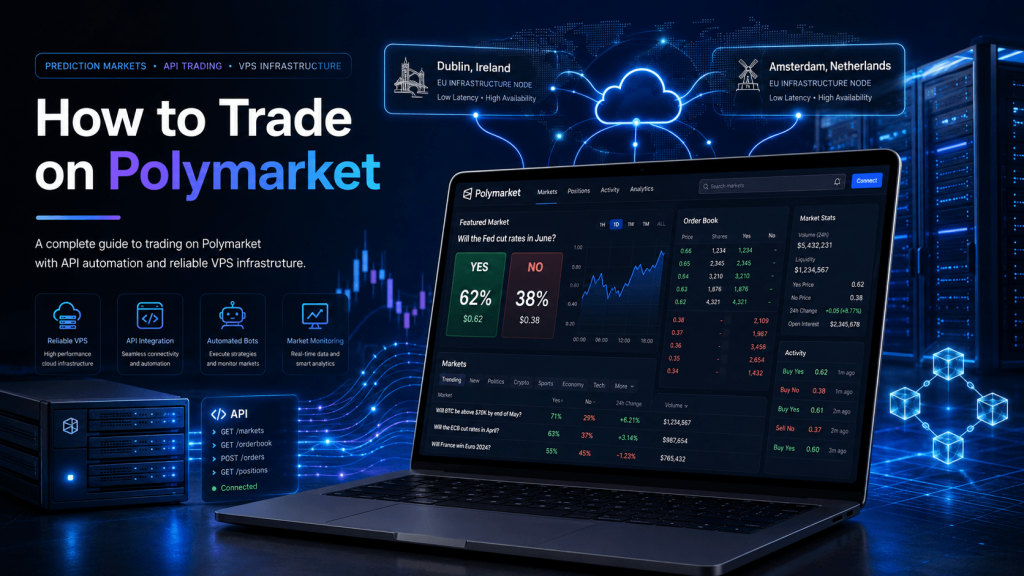
In this guide, we’ll explain how Polymarket trading works, how to place and exit trades, how prices represent probabilities, and how more advanced traders can use APIs, bots, and always-on VPS infrastructure.
We’ll also explain why our Dublin VPS and Amsterdam VPS locations can be useful for API-based Polymarket trading workloads.
Important: Polymarket availability, account eligibility, frontend access, API access, and trading regulations can differ by jurisdiction and can change over time. A VPS shouldn’t be used to bypass geographic, legal, platform, or account restrictions. Always verify Polymarket’s latest terms and your local laws before trading or operating automated trading systems.
What Is Polymarket?
Polymarket is a prediction market platform where users trade contracts based on future events.
A market might ask something like:
Will Event X happen before December 31?
Traders can generally take one of two positions:
- YES — you believe the event will happen.
- NO — you believe the event won’t happen.
Prices move as traders buy and sell.
If YES trades around $0.70, the market is roughly pricing a 70% implied probability that the event will occur.
If NO trades around $0.30, the market is roughly pricing a 30% probability that the event won’t occur.
When the market resolves, the winning side generally settles at $1 per winning share while the losing side settles at $0, subject to the market’s resolution rules.
That’s the basic idea.
How Does Polymarket Trading Work?
Suppose there’s a market asking:
Will Candidate A win an election?
Imagine the current prices are:
- YES: $0.62
- NO: $0.38
Buying a YES share for $0.62 means you’re paying 62 cents for a contract that can settle at $1 if the YES outcome wins.
For example, if you purchase 100 YES shares at $0.62:
Cost:
100 × $0.62 = $62
If the market eventually resolves YES:
Settlement value:
100 × $1 = $100
Your gross difference would therefore be:
$100 − $62 = $38
That’s before considering applicable fees, spread, slippage, or other trading costs.
But you don’t necessarily have to wait until the market resolves.
If other traders become more confident that YES will happen and the price rises from $0.62 to $0.80, you may be able to sell your position before resolution.
That’s one of the key things beginners need to understand about how to trade on Polymarket: you’re trading a market price, not simply placing a traditional fixed-odds bet.
How to Trade on Polymarket Step by Step
Let’s walk through the general process.
1. Check Whether You’re Eligible to Use Polymarket
Before doing anything else, check Polymarket’s current eligibility requirements and geographic restrictions.
Platform rules can change.
Some locations may have restrictions affecting the Polymarket frontend, trading functionality, accounts, APIs, or other parts of the platform.
If you’re legally and contractually eligible to trade, you can continue with the setup.
2. Set Up a Compatible Wallet or Account
Depending on Polymarket’s current onboarding system, you’ll need to complete the required account or wallet setup.
Crypto-based trading platforms commonly involve:
- A compatible cryptocurrency wallet
- Wallet authentication
- Supported assets
- Network fees
- Account verification where required
Never share your private keys or seed phrase with anyone.
For automated trading, avoid placing master wallet credentials directly into scripts whenever safer authentication methods are available.
3. Fund Your Trading Account
You’ll need trading funds before you can open a position.
Polymarket has historically used stablecoin-based settlement infrastructure, but traders should always check the platform’s current documentation for supported assets, networks, deposit processes, and fees.
If you’re transferring crypto from an exchange or external wallet, double-check:
- The blockchain network
- Token type
- Deposit address
- Minimum transfer amounts
- Network fees
Sending assets over an incompatible network can result in lost funds.
4. Find a Market You Understand
This is one of the most important parts of Polymarket trading.
Don’t trade a market simply because it’s trending.
Read the exact question.
Then read the resolution rules.
A headline might sound straightforward while the actual settlement criteria contain important details such as:
- Specific dates
- Official data sources
- Time zones
- Definitions
- Exceptions
- Resolution authorities
If you misunderstand the market’s settlement criteria, you can make the correct real-world prediction and still end up on the wrong side of the contract.
5. Understand the Market Price
Prediction-market prices are generally easy to interpret once you get used to them.
Imagine YES is trading at:
$0.43
That price roughly corresponds to a market-implied probability of:
43%
A $0.75 price roughly corresponds to 75%.
A $0.12 price roughly corresponds to 12%.
However, market prices aren’t guaranteed to represent the true probability of an event.
Prices can be affected by:
- Trader sentiment
- New information
- Liquidity
- Large orders
- Market-making activity
- News
- Uncertainty
- Short-term speculation
This difference between market probability and your estimate of the real probability is where many traders look for opportunities.
6. Decide Whether to Buy YES or NO
Suppose YES trades at $0.40.
After doing your research, you estimate that the actual probability of the event occurring is closer to 60%.
You might decide YES is underpriced.
Another trader could study the same market and conclude there’s only a 25% chance of the event occurring.
That trader might prefer NO.
Prediction markets work because participants have different information, models, assumptions, and risk tolerances.
7. Choose Your Order Type
Depending on the trading interface and current Polymarket functionality, traders may have different ways to submit orders.
A market-style execution prioritizes getting filled quickly at available prices.
A limit order lets you specify the price you’re willing to pay.
For example:
Current YES price: $0.56
You want to buy only if the price falls to $0.50.
You could potentially place a limit order around $0.50 rather than immediately accepting $0.56.
Limit orders can be especially useful for API traders and automated strategies because they give you more control over execution.
8. Monitor Your Position
After entering a trade, the market price will continue changing.
Suppose you buy YES at $0.40.
A major news announcement arrives.
YES jumps to $0.67.
You now have several choices:
- Keep holding
- Sell part of your position
- Exit the entire position
- Adjust exposure through another strategy
Good trading isn’t only about finding an entry.
Position management matters just as much.
9. Sell Before Resolution or Hold Until Settlement
You generally don’t need to hold every prediction-market position until the event ends.
Let’s say you bought 1,000 shares at $0.30.
Your initial position cost:
1,000 × $0.30 = $300
The market later moves to $0.55.
The approximate market value becomes:
1,000 × $0.55 = $550
You may decide to sell and lock in the difference instead of accepting the remaining risk until resolution.
That’s one reason active Polymarket traders closely monitor:
- News
- Order books
- Price movements
- Liquidity
- Related markets
- External data sources
What Does a Polymarket Price Actually Mean?
It’s tempting to say that a price of $0.72 means an event has exactly a 72% probability of happening.
That’s not quite right.
A better interpretation is:
The market is currently pricing the contract at a level roughly consistent with a 72% implied probability.
That distinction matters.
Markets can be wrong.
In fact, if markets were always perfectly accurate, traders would have little reason to trade against the prevailing price.
Successful prediction-market traders typically ask:
What probability is the market implying?
Then:
What probability does my research suggest?
The gap between those numbers may indicate an opportunity.
Example Polymarket Trade
Here’s a simplified example.
A market asks whether a certain economic indicator will exceed a specified level.
YES currently trades at $0.35.
You analyze:
- Recent economic data
- Analyst estimates
- Historical patterns
- Government reports
- Market expectations
Your model estimates the probability at 55%.
You decide the 35-cent contract is attractive.
You buy 500 YES shares.
Your cost is approximately:
500 × $0.35 = $175
Two days later, new economic data is released and the YES contract climbs to $0.60.
Your 500 shares now have an approximate market value of:
500 × $0.60 = $300
You could sell for a gross difference of approximately $125, subject to execution price and applicable costs.
Alternatively, you could continue holding.
If the market ultimately resolves YES, 500 winning shares would settle for $500.
If it resolves NO, those YES shares would lose their settlement value.
This is why position sizing matters.
Can You Make Money Trading on Polymarket?
Yes, profitable trades are possible.
Consistent profitability is another matter.
A trader needs to be right often enough—or identify prices that are sufficiently mispriced—to overcome losing positions, execution costs, and mistakes.
Prediction-market traders commonly look for an edge through:
- Faster information processing
- Statistical models
- Specialized knowledge
- Cross-market comparisons
- News monitoring
- Order-book analysis
- Automated execution
- Better risk management
Simply choosing the outcome you personally believe will happen isn’t a trading strategy.
Price matters.
A highly likely event can still be a bad trade if its contract is overpriced.
Likewise, an unlikely event can sometimes be attractive if the market price is low enough compared with its true probability.
Polymarket Trading Strategies for Beginners
There isn’t one strategy that works for everybody, but several basic ideas are worth understanding.
Trade Markets You Understand
Stick to topics where you can evaluate the underlying information.
A technology specialist may have an advantage in certain AI or product markets.
An economist may understand central-bank or economic-data markets better.
A sports analyst may be more comfortable analyzing sports outcomes.
Domain knowledge matters.
Don’t Confuse Conviction With Value
You can be 90% certain an event will happen and still make a bad trade.
Imagine YES costs $0.98.
Even if you estimate the actual probability at 90%, paying 98 cents for it isn’t attractive based on your estimate.
Trading is about the relationship between probability and price.
Use Position Sizing
Don’t place too much of your capital into a single outcome.
Unexpected events happen.
Even excellent analysis can be wrong.
Spreading risk across multiple independent opportunities can reduce the damage from a single bad prediction.
Avoid Chasing Sudden Moves
News breaks.
Prices jump.
Then traders rush in because they’re afraid of missing out.
By the time you react, the new information may already be fully reflected in the price.
Ask whether there’s still an edge before entering.
Read the Resolution Rules
It’s worth repeating.
Always read them.
A surprising number of prediction-market mistakes come from misunderstanding exactly what determines YES versus NO.
Manual Trading vs API Trading on Polymarket
Beginners will typically start with manual trading.
You find a market, examine the price, and submit an order.
More advanced traders may eventually use Polymarket’s API and programmatic trading tools.
An API can allow software to interact with markets without relying entirely on manual clicks in a browser.
Depending on available endpoints and permissions, API-based workflows may be used for tasks such as:
- Retrieving market data
- Monitoring prices
- Reading order books
- Tracking open orders
- Submitting eligible orders
- Canceling eligible orders
- Monitoring positions
- Running algorithmic strategies
Always use official API documentation and comply with Polymarket’s current terms, eligibility requirements, rate limits, authentication rules, and geographic restrictions.
Why Polymarket API Traders Use a VPS
If you’re trading manually once or twice per day, your laptop might be enough.
Automation changes things.
Imagine you’ve written a script that monitors 50 markets every few seconds.
The script looks for a specific pricing condition and submits an alert or eligible API order when that condition appears.
If you’re running the program from your home PC, it stops when:
- You shut down your computer
- Your internet connection drops
- Your laptop sleeps
- You travel
- Your electricity goes out
- Your operating system unexpectedly restarts
A VPS solves many of these operational problems.
A Virtual Private Server runs continuously in a professional data center.
Your trading scripts can remain active even while your personal computer is offline.
This makes VPS hosting particularly useful for:
- Polymarket API clients
- Trading bots
- Market monitoring systems
- Alerting tools
- Data collection
- Analytics software
- Order-book monitoring
- Automated research pipelines
Dublin VPS for Polymarket API Trading
Our Dublin VPS is one option for traders who need an always-on European environment for legitimate Polymarket API workloads.
Dublin offers strong connectivity to European network infrastructure and can be a practical location for running:
- Python trading scripts
- Node.js applications
- Market-data collectors
- API clients
- Database services
- Telegram or Discord alert bots
- Automated monitoring tools
Importantly, traders should distinguish between frontend availability and API infrastructure.
You mentioned that Polymarket’s frontend has recently become restricted in regions including Dublin/Ireland-related access environments. Because platform policies can change, users should verify the current rule directly with Polymarket.
Our Dublin VPS recommendation is therefore aimed at permitted API and automation workloads, not at bypassing frontend restrictions.
If Polymarket permits your API activity and you’re personally eligible to use the service, a Dublin VPS gives your software an always-on environment without requiring you to keep a home PC running around the clock.
Amsterdam VPS for Polymarket API Trading
Our Amsterdam VPS provides another strong European option for Polymarket API traders.
Amsterdam is one of Europe’s major internet-connectivity hubs and is commonly used for financial, hosting, cloud, data, and application infrastructure.
A Polymarket trader might use an Amsterdam VPS to run:
- API trading applications
- Price-monitoring scripts
- Trading dashboards
- Historical-data collectors
- Custom market scanners
- Risk-management services
- Bot infrastructure
- Database-backed analytics tools
As with Dublin, frontend access rules may differ from API availability or may change independently.
An Amsterdam VPS shouldn’t be used as a way to circumvent a Polymarket restriction that applies to your location or account.
Instead, consider it infrastructure for authorized API-based trading, monitoring, automation, and data processing.
Suggested VPS Setup for a Polymarket Trading Bot
A basic Polymarket VPS environment might look like this:
Operating system: Ubuntu 22.04 or 24.04
Runtime: Python or Node.js
Process manager: systemd, Supervisor, PM2, Docker, or another reliable process manager
Database: PostgreSQL, SQLite, Redis, or another database depending on the application
Monitoring: Server-health monitoring and application logs
Security: SSH keys, firewall rules, limited user permissions, and secure secret management
You might organize the architecture like this:
Polymarket API → Trading Script → Strategy Logic → Risk Controls → Order Manager → Logging & Alerts
Your bot should never blindly send orders.
At minimum, automated trading software should include safeguards for:
- Maximum position size
- Maximum order size
- Maximum daily loss
- Duplicate orders
- API errors
- Failed authentication
- Unexpected price changes
- Rate limits
- Network failures
Automation can execute mistakes much faster than a human can.
Risk controls aren’t optional.
How Much VPS Power Does a Polymarket Bot Need?
You probably don’t need a giant server to start.
A simple market monitoring bot may run on a small VPS.
More demanding systems can require additional resources.
For example:
Basic API Monitoring
Suitable for:
- Price checks
- Notifications
- Simple scripts
- Small data collectors
A lightweight VPS is often sufficient.
Automated Trading
Suitable for:
- Multiple strategies
- Order management
- Frequent API calls
- Persistent databases
Consider additional RAM and CPU headroom.
Advanced Analytics
Suitable for:
- Large market datasets
- Statistical models
- Multiple concurrent services
- Machine-learning workloads
- Complex dashboards
These workloads may benefit from significantly higher CPU, RAM, and storage.
It’s usually better to start with the resources your application actually needs and scale as your system grows.
Can a VPS Make Polymarket Trading Faster?
A VPS can improve the consistency of your trading infrastructure, but it isn’t magic.
Potential advantages include:
- Reliable connectivity
- Continuous uptime
- Lower dependence on home internet
- Stable server environment
- 24/7 automation
- Remote access
- Predictable computing resources
Location can also influence network latency.
However, moving a script to a VPS doesn’t automatically make a strategy profitable.
Execution speed can’t fix a bad trading model.
The real benefit is creating a stable environment where your tools can operate consistently.
Polymarket Trading Bot Security Tips
Trading infrastructure handles sensitive information, so security deserves serious attention.
Use SSH Keys
Avoid password-only SSH access where practical.
Don’t Hard-Code Secrets
Avoid putting API keys, private keys, passwords, or sensitive authentication tokens directly into public source files.
Use environment variables, secure secret stores, or appropriately protected configuration files.
Restrict Network Access
Only expose ports you actually need.
Keep Software Updated
Apply operating-system and dependency security updates.
Run Services With Limited Privileges
Your trading application shouldn’t run as the root user unless there’s a compelling technical reason.
Back Up Important Data
Back up:
- Strategy configuration
- Databases
- Historical data
- Logs where needed
- Application configuration
Never treat the VPS itself as your only copy of important information.
Common Polymarket Trading Mistakes
Even experienced traders make mistakes. Beginners can avoid plenty of trouble by watching for these common ones.
Ignoring Market Resolution Criteria
Always understand exactly how the market settles.
Trading Based on Emotion
Prediction markets move quickly around major news.
Don’t let excitement replace analysis.
Risking Too Much on One Position
Being confident doesn’t make an outcome certain.
Ignoring Liquidity
A market may display an attractive price but have limited liquidity.
Entering or exiting a large position can move the market.
Forgetting About Slippage
The price you see isn’t always the exact average price you’ll receive for a larger order.
Automating Before Testing
Don’t put real money behind a bot you haven’t thoroughly tested.
Start with simulations, paper logic, tiny position sizes, or other appropriate validation methods.
Treating a VPS as a Geo-Restriction Workaround
A VPS is computing infrastructure.
It shouldn’t be used to disguise your actual eligibility or bypass Polymarket’s geographic or regulatory controls.
Our Dublin and Amsterdam servers are recommended here for permitted API trading, market monitoring, automation, and data-processing workloads.
Is Polymarket Trading Risky?
Yes.
Prediction-market trading involves real financial risk.
You can lose some or all of the money allocated to a position.
Risks include:
- Incorrect predictions
- Price volatility
- Liquidity problems
- Resolution uncertainty
- Smart-contract risk
- Wallet security
- Operational errors
- API failures
- Automated trading bugs
- Regulatory changes
Never trade money you can’t afford to lose.
And remember: infrastructure reduces operational problems; it doesn’t eliminate trading risk.
Frequently Asked Questions About Trading on Polymarket
Generally, an eligible trader selects a prediction market, reviews the resolution criteria, evaluates YES and NO prices, chooses a position, and submits an order. The position can potentially be sold before settlement or held until the market resolves.
A YES contract priced around $0.60 roughly represents a 60% market-implied probability of the YES outcome. If a winning contract settles at $1, buying at $0.60 creates a potential gross difference of $0.40 per share if the position ultimately wins and is held to settlement.
In active markets with available liquidity, traders can generally trade positions before final resolution rather than waiting until the event ends.
Polymarket provides developer and API functionality that can support programmatic workflows, subject to its current documentation, permissions, terms, rate limits, and geographic requirements.
A VPS allows trading scripts, monitoring tools, databases, and eligible API applications to run continuously without depending on your personal computer or home internet connection.
Frontend and API policies can differ, but you should never assume API access is permitted solely because an endpoint remains technically reachable. Check Polymarket’s current documentation and terms. Use our Dublin and Amsterdam VPS locations only for activity Polymarket allows for your account and jurisdiction.
Building a Reliable Polymarket Trading Setup
Learning how to trade on Polymarket starts with something surprisingly simple: understand what you’re buying.
A YES or NO contract isn’t merely an opinion.
It’s a market price representing what traders are currently willing to pay for exposure to a particular outcome.
Successful trading therefore involves more than predicting what will happen.
You need to think about:
- Probability
- Price
- Liquidity
- Risk
- Position sizing
- Execution
- Market resolution
As your trading becomes more advanced, technology starts playing a larger role.
API tools can monitor markets faster than you can manually refresh a browser. Automated systems can watch dozens of markets around the clock. Data collectors can build historical datasets for research.
And those tools need somewhere reliable to run.
That’s where an always-on VPS becomes useful.
Our Dublin VPS and Amsterdam VPS options are well suited to traders who need reliable infrastructure for authorized Polymarket API applications, bots, market monitoring, analytics, and other automated workloads.
Even where Polymarket frontend availability differs by region, the purpose of these servers is not to circumvent platform restrictions. They’re designed to give eligible API traders a stable, remotely accessible environment for workloads they’re permitted to operate.
If your Polymarket strategy depends on a laptop staying awake all night, it’s probably time to give your trading stack a more reliable home.