Polymarket trading automation is moving beyond simple scripts that watch a price and place an order when a fixed condition appears. A newer generation of Polymarket AI agents can discover prediction markets, gather information from outside sources, evaluate the probability of an event, compare that estimate with the current market price, apply predefined risk rules, and decide whether an order should be considered.
The important word is agent.
A conventional trading bot normally follows fixed rules written directly into code. For example, it might buy YES whenever a contract falls below 40 cents and sell when it reaches 50 cents. An AI agent can operate at a higher level. Instead of relying exclusively on hard-coded market signals, it can use a large language model or another reasoning system to interpret market descriptions, news, economic data, research, price movements, and portfolio conditions before producing a structured decision.
That does not mean an AI model should be given unrestricted access to a trading wallet and allowed to act without controls.
A well-designed Polymarket AI trading system separates research, reasoning, risk management, and execution. The AI model can produce an estimate or recommendation, while deterministic software checks position limits, available balance, market eligibility, price boundaries, stale data, duplicate orders, and other risk conditions before anything is submitted to Polymarket.
This distinction is increasingly practical because Polymarket provides an API and open-source developer tooling for interacting with its prediction markets. Polymarket’s own GitHub organization includes an open-source Polymarket Agents framework designed to help developers build autonomous AI agents using Polymarket APIs, AI utilities, retrieval-augmented generation, external data sources, and language-model tooling.
Polymarket’s trading infrastructure also changed substantially in 2026. CLOB V2 went live on April 28, 2026, replacing the previous production trading stack. Current integrations use the CLOB V2 SDKs and the production endpoint at clob.polymarket.com, while trade settlement continues through Polygon-based smart contracts.
An AI agent can therefore combine three very different technologies:
real-time prediction-market data, AI reasoning, and automated exchange connectivity.
Running all of that from a personal laptop is possible during development. Running it continuously is another matter.
A VPS gives the AI agent a persistent environment where Python or Node.js processes, WebSocket connections, databases, research services, monitoring tools, and order-management software can remain online without depending on a home computer.
This guide explains how a Polymarket AI agent works, how it can interact with Polymarket trading, how to structure the agent safely, and how to deploy the complete system on a VPS for continuous operation.
What Is a Polymarket AI Agent?
A Polymarket AI agent is software that uses artificial intelligence as part of its prediction-market decision process.
It should not be confused with one specific official trading product. “AI agent” describes an architecture that can be implemented in different ways.
Polymarket itself has published an open-source Agents framework containing utilities for connecting AI agents with Polymarket APIs, RAG systems, web research, external data sources, and language models. Other open-source projects have developed different architectures using LangGraph, multi-agent systems, OpenAI-compatible models, Anthropic models, sentiment analysis, and automated portfolio tools.
What these systems generally have in common is a workflow that looks like this:
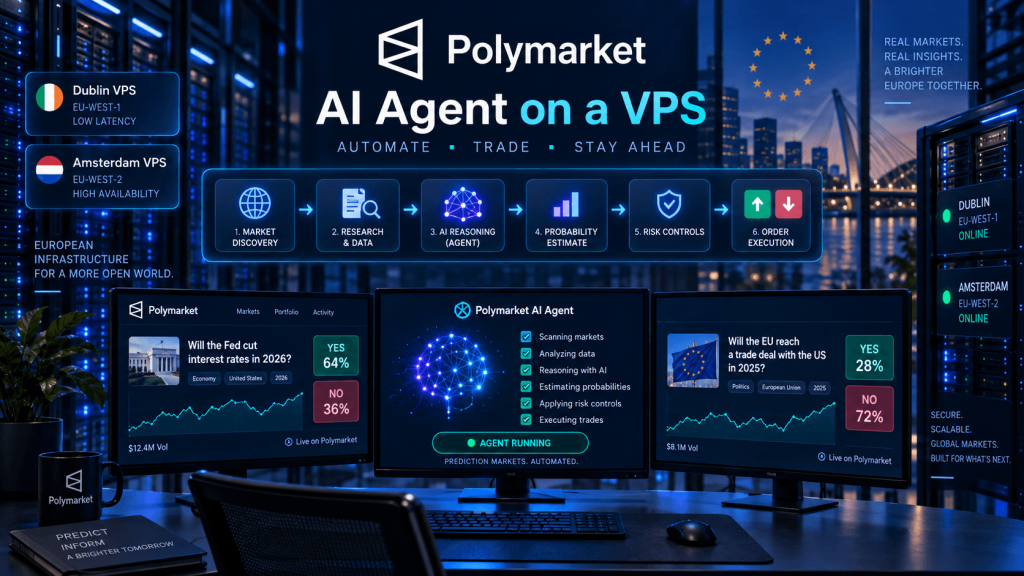
Market discovery → market data → external research → AI probability estimate → strategy logic → risk checks → order execution → portfolio monitoring
Each part solves a different problem.
Market discovery identifies contracts worth evaluating.
Market data tells the agent what traders are currently willing to pay for YES and NO outcomes.
External research gives the AI information beyond the current Polymarket price.
AI reasoning converts that information into a probability estimate or structured trading view.
Strategy logic compares the AI’s estimate with the market.
Risk controls decide whether the proposed trade is allowed.
Execution software sends properly signed orders to Polymarket.
Monitoring confirms whether those orders were accepted, filled, canceled, or remain open.
The architecture matters because the AI model should not be responsible for every technical function.
An LLM is useful for reasoning about ambiguous information. It is much less appropriate for deciding whether an API response means an order is already filled, calculating an exact account limit, or ensuring that the same order is not submitted five times after a network retry.
Those tasks are better handled by deterministic code.
A strong Polymarket AI agent therefore uses AI for the parts where reasoning is useful and traditional software for the parts where precision is essential.
How a Polymarket AI Agent Actually Makes a Trading Decision
Prediction markets are particularly interesting for AI because the price itself already resembles a probability.
If a YES contract is trading near $0.63, the market is roughly expressing a 63% implied probability, ignoring transaction costs, order-book effects, and other market mechanics.
An AI agent can independently ask:
Based on the available evidence, what probability should this event have?
Suppose Polymarket has a market asking whether a particular economic statistic will exceed a defined threshold.
The agent might first retrieve the market title, description, resolution rules, closing time, YES/NO token IDs, current price, bid-ask spread, recent trades, and order-book depth.
It can then gather outside information relevant to that event. Depending on the market, that could include government economic releases, company filings, election data, official sports information, weather forecasts, central-bank announcements, reputable news reports, or other permitted sources.
A retrieval layer can compress that information into a structured evidence package.
The LLM then receives something closer to:
Market question
Exact resolution criteria
Current market price
Relevant evidence
Recent market changes
Current portfolio exposure
Rather than simply asking the model, “Should I buy?”, the system can request a structured output such as:
Estimated probability: 71%
Confidence: Medium
Key evidence: …
Reasons the estimate could be wrong: …
Recommended action: Consider YES only below 64%
Maximum suggested exposure: defined by risk engine
That distinction is important.
If the market is trading at 63 cents and the AI estimates the true probability at 71%, there appears to be an eight-percentage-point difference between the agent’s estimate and the market price.
But that does not automatically mean a trade should occur.
The software still needs to ask whether the estimated advantage is large enough after bid-ask spread, fees, uncertainty, model error, liquidity, and existing portfolio exposure.
An AI probability of 71% is not an objective fact. It is a model output.
The strategy might therefore require a larger buffer before taking action. Instead of trading whenever the AI and market disagree by one percentage point, it could require a materially larger difference plus a minimum confidence level and acceptable order-book conditions.
This produces a more sensible architecture:
AI produces a forecast. The strategy decides whether the forecast is actionable. The risk engine decides whether the trade is permitted.
AI Agent vs Traditional Polymarket Bot
The difference can be summarized simply:
| Function | Traditional bot | AI agent |
|---|---|---|
| Market monitoring | Yes | Yes |
| Fixed quantitative rules | Yes | Yes |
| News interpretation | Usually limited | Strong use case |
| Read complex resolution rules | Limited | Possible |
| Summarize research | Limited | Strong use case |
| Estimate event probability | Model-specific | Core function |
| Explain reasoning | Usually no | Possible |
| Place API orders | Yes | Yes |
| Risk controls | Required | Required |
| Continuous operation | Yes | Yes |
| Human approval option | Possible | Especially useful |
The AI agent is therefore not a replacement for a normal trading engine.
It is an additional intelligence layer inside one.
How the Agent Connects to Polymarket
Current global Polymarket trading uses a hybrid CLOB architecture. Order matching occurs offchain, while matched transactions settle through Polymarket’s exchange contracts on Polygon. Polymarket describes the system as non-custodial, with signed orders submitted through its CLOB infrastructure.
In 2026, new integrations should use CLOB V2. The older V1 SDKs and V1-signed orders are no longer supported in production following the April 28 migration.
Official clients are available for TypeScript, Python, and Rust. The current quickstart uses the CLOB V2 client to create or derive API credentials, initialize the trading client, and create signed orders.
A typical AI-agent stack might therefore look like:
| Layer | Purpose |
|---|---|
| Polymarket market API | Discover available prediction markets |
| CLOB API | Read prices, books and submit orders |
| Market WebSocket | Receive real-time book and price updates |
| User WebSocket | Receive private order/trade updates |
| Research APIs | Retrieve external evidence |
| LLM | Interpret evidence and estimate probability |
| Strategy engine | Compare AI estimate with market price |
| Risk engine | Enforce exposure and loss rules |
| Database | Store research, forecasts, orders and positions |
| VPS | Keep every service running continuously |
Polymarket’s public market WebSocket provides real-time order-book, price, and market-lifecycle information, while the authenticated user WebSocket provides order and trade updates for the account.
WebSockets are particularly useful for an AI trading system because constantly polling REST endpoints wastes requests and can make market state unnecessarily stale.
The AI itself does not necessarily need to run every time the order book changes.
A better design may use lightweight deterministic code to monitor prices continuously and only invoke the more expensive AI reasoning process when something meaningful happens.
For example:
The market moves five percentage points.
A new high-authority news event appears.
Liquidity changes significantly.
The market approaches a predefined trading threshold.
A scheduled economic event is about to occur.
The agent reaches its normal research interval.
This reduces LLM costs while still allowing the agent to react intelligently to important changes.
Market Research, RAG and the AI Reasoning Layer
The quality of a Polymarket AI agent depends heavily on the information given to the model.
An LLM working only from its pretrained knowledge can easily be outdated, particularly when the prediction market concerns an event occurring today.
A production system therefore needs retrieval.
Retrieval-Augmented Generation, or RAG, means the agent collects current information before asking the model to reason.
The official Polymarket Agents repository includes support for local and remote RAG as well as external data sourcing and web-search workflows.
Imagine a political prediction market.
The research pipeline might retrieve official election filings, polling data, candidate announcements, court decisions, and reputable reporting.
For a macroeconomic market, the preferred evidence might include government statistics, central-bank releases, economic calendars, and recent related indicators.
For a sports market, it might include official league information, injury reports, starting lineups, weather, and verified team announcements.
The agent should also read the market’s exact resolution criteria.
This is essential.
A market may look as though it asks one straightforward question while the actual resolution rules specify a particular data provider, time zone, publication, definition, or deadline.
The AI agent should reason against the contract that actually exists, not a simplified interpretation of the headline.
A useful research pipeline can therefore perform four steps:
First, retrieve the market rules.
Second, gather evidence from relevant sources.
Third, score or filter that evidence for freshness and reliability.
Fourth, pass only the most useful evidence to the model.
This helps prevent the LLM context from becoming filled with duplicate, outdated, or low-quality information.
Multiple agents can also be used.
One agent might research evidence.
Another might challenge the bullish case.
Another might challenge the bearish case.
A final decision agent could compare the arguments and produce a probability estimate.
Open-source Polymarket projects already demonstrate multi-agent approaches in which different LLMs or workers perform different parts of the trading workflow.
More agents do not automatically mean better forecasts. They add API costs, latency, complexity, and more places for failure.
The architecture should be as complicated as necessary, not as complicated as possible.
Risk Management Should Sit Between AI and Execution
Giving an LLM direct unrestricted access to a funded wallet is a poor production design.
The AI should make a proposal.
A separate risk engine should decide whether that proposal can become an order.
That engine can be entirely deterministic.
For example, the risk layer can reject a proposed trade when the resulting position would exceed the maximum allowed exposure, when the order book is too thin, when the data is stale, when another conflicting order is already open, when the market is too close to resolution, or when the account has exceeded a defined drawdown threshold.
Open-source Polymarket AI-agent projects increasingly use this architecture. Some default to paper trading and require multiple explicit configuration changes before live execution is enabled. Others include position sizing, portfolio monitoring, human approval, and drawdown controls.
A practical risk system should at minimum understand:
maximum order size, maximum position size, total portfolio exposure, duplicated orders, available balance, stale prices, spread limits, current open orders, failed API requests, daily loss limits, and emergency shutdown conditions.
This is also where position sizing belongs.
The AI might estimate a market at 70% while the contract trades at 60%.
That does not mean the model should decide independently to put 80% of the account into the trade.
Position sizing should follow a defined risk policy.
The same principle applies when the AI changes its mind. If an updated forecast suddenly moves from 70% to 45%, the execution engine needs rules governing whether to reduce, exit, or reverse the position rather than allowing the LLM to improvise account management from scratch every cycle.
Human approval can also be valuable.
A semi-automated system can let the AI research and propose trades while requiring the trader to approve execution. This provides many of the benefits of automated research without immediately giving the agent autonomous control over capital.
For a new AI-agent deployment, that can be a sensible intermediate stage between paper trading and full automation.
Why Run a Polymarket AI Agent on a VPS?
An AI trading agent is naturally an always-on application.
Even when the LLM itself is called only periodically, the surrounding services may need to operate continuously.
The market-data WebSocket should stay connected.
The research scheduler should wake up when required.
The database should remain accessible.
The order manager needs to track live orders.
The portfolio service has to know current positions.
Monitoring should be available even when the trader is asleep.
A personal computer can run all of this, but the agent stops being reliable if the laptop closes, household electricity fails, the router reboots, the Internet connection drops, or the operating system suspends the application.
A VPS moves those services into a remote data center.
A typical VPS architecture could look like:
Polymarket WebSocket → Market Service → AI Research/Forecast Service → Risk Engine → CLOB Execution Service → Database → Monitoring & Alerts
All of those components can run on the same server for a modest system.
Larger deployments can separate them into containers or multiple servers.
For global Polymarket, infrastructure location also deserves careful consideration. Polymarket’s current geographic-restriction documentation says its primary server infrastructure is in AWS eu-west-2, while identifying eu-west-1 as the closest non-georestricted region. The same documentation states that order placement is blocked from several countries and regions, including the United States, United Kingdom, Germany, and France.
For that reason, a VPS should never be selected to circumvent geographic eligibility rules.
A person who is not eligible to trade Polymarket does not become eligible simply because code is running from another country’s server.
For eligible Polymarket users who need European infrastructure, Dublin or Amsterdam is a practical TradingVPS location to evaluate. TradingVPS offers Dublin and Amsterdam infrastructure for API bots, WebSocket applications, Python services, Node.js processes, market-data collection, and other persistent Polymarket workloads.
This recommendation concerns technical hosting for users already permitted to use Polymarket. It is not a method for bypassing Polymarket’s restrictions.
How Much VPS Performance Does a Polymarket AI Agent Need?
The answer depends heavily on where the AI model runs.
If the VPS sends prompts to a hosted model API such as OpenAI, Anthropic, or another cloud LLM provider, the server does not need a powerful GPU to perform the model inference itself.
The VPS primarily handles Python or Node.js processes, APIs, WebSockets, databases, orchestration, logging, and order management.
That workload can be surprisingly light.
| AI-agent workload | Practical starting resources |
|---|---|
| One simple research agent, cloud LLM | 2 CPU cores, 4–8 GB RAM |
| Multiple markets + database + WebSockets | 2–4 fast cores, 8–16 GB RAM |
| Several concurrent AI agents | 4+ cores, 16 GB+ RAM |
| Large research/database workload | 4–8 cores, 16–32 GB RAM |
| Local LLM inference | Separate GPU-capable infrastructure may be required |
CPU performance still matters because the server may be parsing market data, managing many asynchronous connections, running search or scraping tools, embedding documents, processing databases, and orchestrating multiple workers.
RAM becomes increasingly important when several services run simultaneously.
NVMe storage is useful for databases, market history, agent traces, cached research, logs, vector indexes, and Docker images.
Network stability may be more important than maximum bandwidth. Polymarket WebSocket traffic is not likely to consume a multi-gigabit connection by itself, but persistent connections benefit from a stable route with low packet loss and reliable uptime.
TradingVPS‘s current Polymarket-oriented VPS plans use AMD Ryzen 9 9950X processors, DDR5 RAM, NVMe storage, dedicated IPv4 addresses, and Windows or Ubuntu options. For an AI-agent stack, Ubuntu is often the cleaner choice because Python, Node.js, Docker, systemd, Redis, PostgreSQL, and common observability tools are straightforward to deploy in a Linux environment.
A Practical Polymarket AI Agent VPS Setup
For most developers, Ubuntu is a sensible starting operating system.
The server can run the AI-agent repository inside a Python virtual environment or Docker container. API keys and wallet credentials should be placed in protected environment variables or a secrets-management service rather than embedded directly into source code.
A typical installation could include:
Python 3.10+ or the version required by the chosen agent framework
Node.js if the stack uses TypeScript
Git
Docker and Docker Compose if services are containerized
SQLite for a simple system or PostgreSQL for a larger deployment
Redis if queues, caching, or distributed workers are required
systemd, Supervisor, PM2, or Docker restart policies for process recovery
Firewall and SSH-key authentication
The agent should then be configured with Polymarket’s current CLOB V2 client rather than outdated CLOB V1 libraries. CLOB V2 has been the live production environment since April 28, 2026.
For market data, WebSockets should be used where possible rather than aggressively polling REST endpoints. Polymarket publishes separate current limits for general API calls, market-data endpoints, order requests, and other CLOB operations, so applications should still include throttling and graceful handling of rate-limit responses.
The deployment process should move through stages.
Start with research only.
Confirm the agent can discover markets, read rules, retrieve data, and create forecasts without submitting any trade.
Then use paper trading.
Record what the agent would have bought, at what price, and why.
Compare those decisions with eventual results.
Then test order creation with the smallest practical controlled workflow available to the developer.
Only after the agent has demonstrated stable state management, error handling, risk controls, and restart recovery should unattended live execution even be considered.
The VPS should also restart the application automatically if a process crashes.
However, automatic restart should not mean automatic blind trading immediately after restart.
A properly designed agent should first reconnect to Polymarket, retrieve its current open orders, verify its portfolio, restore state from the database, confirm market data is fresh, and only then resume decision-making.
Otherwise a reboot could cause the agent to forget that it already owns a position and submit another one.
Security Is Especially Important for AI Trading Agents
A Polymarket AI-agent server can hold highly sensitive information.
Depending on implementation, it may contain a wallet private key, CLOB API credentials, LLM API keys, search API credentials, databases, strategy instructions, and complete trading history.
That makes a casually configured VPS a security risk.
Private keys should not be committed to Git.
.env files should have restricted permissions.
The server should use SSH keys rather than simple passwords where practical.
Unnecessary network ports should remain closed.
The application should avoid exposing an unauthenticated dashboard directly to the public Internet.
LLM API spending limits can also be useful. A malfunctioning research loop could accidentally make thousands of model calls even without placing a single trade.
Another issue specific to AI agents is prompt injection.
If the research agent reads arbitrary web pages, those pages can contain text attempting to manipulate an AI system. A malicious page could include instructions such as “ignore previous instructions” or attempt to convince the model to reveal secrets or change its behavior.
Research content should therefore be treated as untrusted data, not as instructions.
The AI should never have access to private keys inside its prompt context.
The execution service should expose only the minimum tools the model needs.
Ideally, the model says something like:
Proposed action: BUY YES, maximum $20 at price ≤ 0.58
Then deterministic software decides whether that action is valid.
The model should not receive a raw shell, unrestricted wallet access, database administrator credentials, and the ability to execute arbitrary code simply because it is called an “agent.”
Common Mistakes When Running Polymarket AI Agents
The most common conceptual mistake is assuming the AI agent itself has discovered an objective probability.
It has not.
An AI model creates an estimate based on its inputs, training, reasoning process, and prompt. It can misunderstand evidence, overweight a source, miss new information, misread a resolution condition, or be confidently wrong.
The second mistake is using outdated Polymarket integration code. Global Polymarket moved to CLOB V2 in April 2026, and legacy V1 integrations are no longer the correct production target.
Another mistake is making the LLM responsible for execution state.
Order tracking should be deterministic.
The software should know exactly whether an order is open, filled, canceled, or partially executed using authenticated exchange data rather than asking the model to infer what probably happened.
Running the system without a persistent database is another risk. The agent should be able to reconstruct its portfolio and decision history after a restart.
Developers also frequently underestimate monitoring.
A VPS showing 20% CPU utilization tells you nothing about whether the agent’s market WebSocket silently disconnected three hours ago.
Application monitoring should check data freshness, research-service health, AI API availability, Polymarket connectivity, order status, database health, and process state.
Finally, a VPS should never be treated as a geographic workaround. Polymarket explicitly publishes restricted countries and regions and rejects orders from blocked locations. Server deployment must remain consistent with the user’s eligibility and applicable rules.
Frequently Asked Questions About Polymarket AI Agents
A Polymarket AI agent is software that combines Polymarket market data with AI reasoning to research events, estimate probabilities, identify potential pricing differences, and potentially generate trading decisions.
Yes, software can interact with Polymarket’s trading APIs and submit signed orders from eligible locations. A production system should place deterministic risk controls between the AI’s recommendation and the execution API.
CLOB V2 is Polymarket’s current production Central Limit Order Book infrastructure. It went live on April 28, 2026, and new integrations should use the current V2 SDKs and signing structure.
A small cloud-LLM agent can often begin with 4–8 GB. Multiple workers, databases, RAG pipelines, vector indexes, and concurrent agents may justify 16 GB or more.
For eligible global Polymarket users, Dublin is a practical European location to evaluate because Polymarket identifies AWS eu-west-1 as the closest non-georestricted region to its primary infrastructure. TradingVPS offers Dublin and Amsterdam infrastructure for Polymarket API and automation workloads.
Final Thoughts: Running a Polymarket AI Agent 24/7
A Polymarket AI agent is more than an automated order script.
The useful architecture combines multiple layers.
Polymarket supplies the markets, order books, WebSockets, and CLOB execution infrastructure.
A research pipeline supplies current information.
An AI model interprets that information and estimates probabilities.
A strategy engine compares those estimates with market prices.
A risk engine determines whether the proposed action is acceptable.
An execution service submits and tracks orders.
A database preserves state.
Monitoring identifies failures.
And the VPS keeps those services available when the developer’s personal computer is offline.
The AI component receives the most attention, but it is only one part of the system.
A brilliant probability model connected to unreliable order management can still fail.
A perfectly configured VPS cannot fix bad forecasts.
A fast order API cannot protect an account from an agent that repeatedly doubles its position because it forgot its previous trades.
This is why the strongest Polymarket AI trading setup separates intelligence from control.
Let the AI research, summarize, challenge assumptions, and estimate probabilities.
Let deterministic software handle balances, exposure, price limits, order state, authentication, retries, and shutdown rules.
Then place the entire architecture on infrastructure capable of staying online.
For eligible users of global Polymarket, a Dublin VPS or Amsterdam VPS can provide a practical European hosting environment for Python agents, Node.js services, Docker containers, WebSocket listeners, RAG pipelines, databases, and monitoring processes. TradingVPS’s current Polymarket infrastructure uses high-frequency Ryzen 9 9950X processors, DDR5 memory, NVMe storage, dedicated IPv4 connectivity, and Windows or Ubuntu environments for these kinds of workloads.
The reason to use the VPS is not to give the AI magical forecasting ability.
It is to make sure the technical system surrounding the AI is persistent, observable, and available.
A mature workflow therefore looks like this:
research first, forecast second, risk checks third, execution fourth, monitoring always.
Start with research-only operation.
Move to paper trading.
Measure whether the forecasts and strategy logic actually have value.
Test restarts, API failures, stale market data, partial fills, and lost WebSocket connections.
Only then consider whether live automated execution is appropriate.
AI agents can process information faster and more consistently than a person manually researching hundreds of prediction markets. But they also automate mistakes faster.
The VPS keeps the agent running.
The quality of the research, risk system, execution logic, and oversight determines whether keeping it running is actually useful.
This article is provided for general informational and technical-education purposes only and does not constitute financial, investment, legal, or trading advice. Prediction-market trading involves risk. Polymarket APIs, CLOB specifications, geographic restrictions, fees, and platform rules can change. Users should verify current Polymarket documentation and their eligibility before deploying trading software.